Your Cart (0)

Your cart is empty

South Shore, Chicago

Business Intelligence in South Shore

Business Intelligence for businesses in South Shore, Chicago. We know the neighborhood, the customers, and what it takes to compete locally.

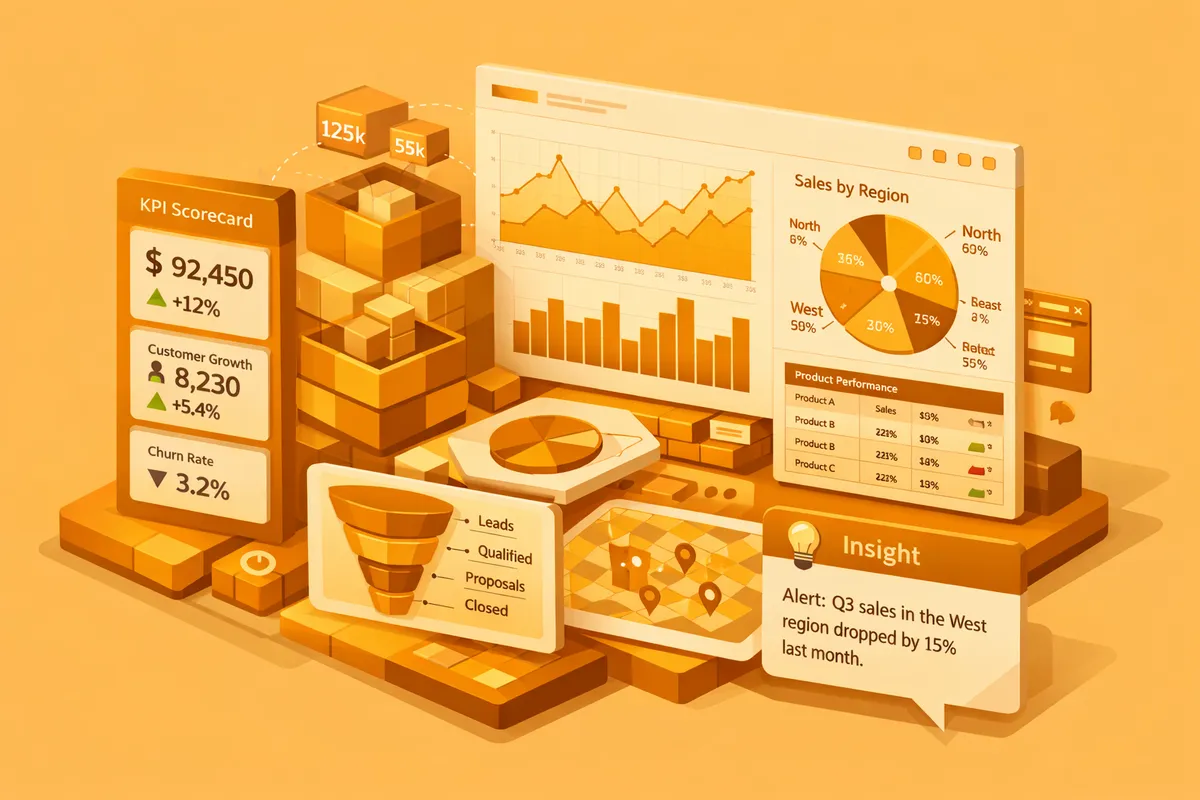
Business Intelligence in South Shore service illustration

Our Business Intelligence Services in South Shore

  • Data source audit mapping every system generating business data in your South Shore operation
  • Data warehouse design that unifies fragmented sources into one consistent, queryable foundation
  • Executive and management dashboards showing the metrics your leadership team needs to act on, updated automatically
  • Nonprofit program performance dashboards satisfying funder reporting requirements without manual assembly
  • Sales and revenue analytics showing performance by product, service, location, staff member, and time period
  • Customer and client analytics tracking retention, lifetime value, and behavior patterns
  • Financial performance visibility connecting revenue, expenses, margins, and cash flow in one view
  • Operational dashboards for scheduling, capacity utilization, and service delivery efficiency
  • Grant and program reporting automation for South Shore community organizations
  • Training for your team on reading dashboards, interpreting trends, and making data-informed decisions

Industries We Serve in South Shore

Community nonprofits and social service organizations affiliated with institutions like Little Black Pearl, By the Hand Club, and the South Shore Chamber of Commerce need business intelligence that tracks program outcomes, client demographics, funding source performance, and operational costs in formats that satisfy both internal leadership and external funders.

Restaurants and food businesses on Bryn Mawr and throughout South Shore need revenue analytics by menu category, labor cost visibility, table turn data, and customer retention metrics that turn a profitable feeling into documented reality that can support expansion decisions.

Health and behavioral health providers near Rainbow Beach and across the South Shore catchment area need clinical and administrative dashboards that show appointment utilization, no-show patterns, staff productivity, and payer mix across an organization that may span multiple programs and funding streams.

Small contractors and trade businesses serving South Shore and the surrounding Far South Side neighborhoods need job-level profitability tracking, labor cost analysis, and revenue forecasting that most contracting businesses try to manage from a bank account balance and a gut feeling.

What to Expect Working With Us

1. Data landscape discovery. We map every system your organization uses, what data it generates, how reliable that data is, and what decisions you are currently making without adequate information. This is the foundation for everything that follows.

2. Architecture and dashboard design. We design your data warehouse structure and dashboard layout before building anything. You see and approve the analytical framework before we write the first line of code or configure the first pipeline.

3. Build and integration. We connect your data sources, clean and standardize the data, load it into the warehouse, and build the dashboards your team will actually use. Phased delivery means you see working dashboards within the first few weeks.

4. Training and ongoing support. We train your team on using the dashboards, interpreting the data, and making decisions from it. Monthly refinements improve the system as your team develops clearer ideas about what they need to see.

Frequently Asked Questions

Business intelligence scales to any organization that generates data and makes decisions from it. A restaurant with two locations, a contractor with four crews, or a nonprofit managing three programs all benefit from consolidated, automated reporting. The version we build for a South Shore small business is not a scaled-down enterprise system. It is a system designed from the ground up for your specific size and needs. The questions it answers are the same ones that matter to organizations a hundred times larger, applied to your actual operational reality.

Most businesses have more data than they realize. Point-of-sale systems record every transaction by product, time, and payment type. Scheduling software logs every appointment, cancellation, and no-show. Payroll systems track labor hours and costs. Accounting software holds expense categories and invoice histories. Square, Stripe, and similar payment processors generate detailed sales reports. Even a basic Google Business Profile generates search impression and click data. The value of business intelligence is connecting these sources into a unified picture that none of them provide alone.

Grant reporting typically requires pulling data from multiple sources: client intake systems, program attendance records, outcome assessment tools, and financial management software. When those sources do not communicate, each grant report is a manual assembly project that takes days and risks inconsistency between reports submitted to different funders. Business intelligence builds automated pipelines that pull the required data from each source, apply the calculation logic your funders specify, and generate reports on demand. The first time you submit a grant report in an hour rather than a week is the moment the investment pays for itself.

Yes. If you have historical business data and you continue collecting current data, business intelligence can surface trends in foot traffic, revenue patterns, and customer demographics that reveal whether the neighborhood change is bringing new customers, shifting existing patterns, or creating opportunities worth acting on. Understanding the impact of a major neighborhood change requires baseline data to compare against. The right time to build that baseline is before the change fully arrives.

A focused analytics project for a small South Shore business, connecting two to three data sources and building five to eight dashboards, typically takes four to six weeks. More comprehensive implementations connecting more sources and building role-specific views for management and operational teams take eight to twelve weeks. We deliver working dashboards early so your team starts getting value before the full implementation is complete.

We scope every engagement based on actual requirements rather than applying a standard package. A basic analytics setup for a single-location business is significantly more affordable than enterprise BI implementations. We are transparent about costs in the discovery phase and never include capabilities you do not need. For South Shore community organizations operating on tight program budgets, we discuss what a realistic phased approach looks like given actual budget constraints. Learn more about our [business intelligence services across Chicago](/chicago/business-intelligence) or explore other [digital services available in South Shore](/chicago/south-shore).

Ready to get started in South Shore?

Let's talk about business intelligence for your South Shore business.