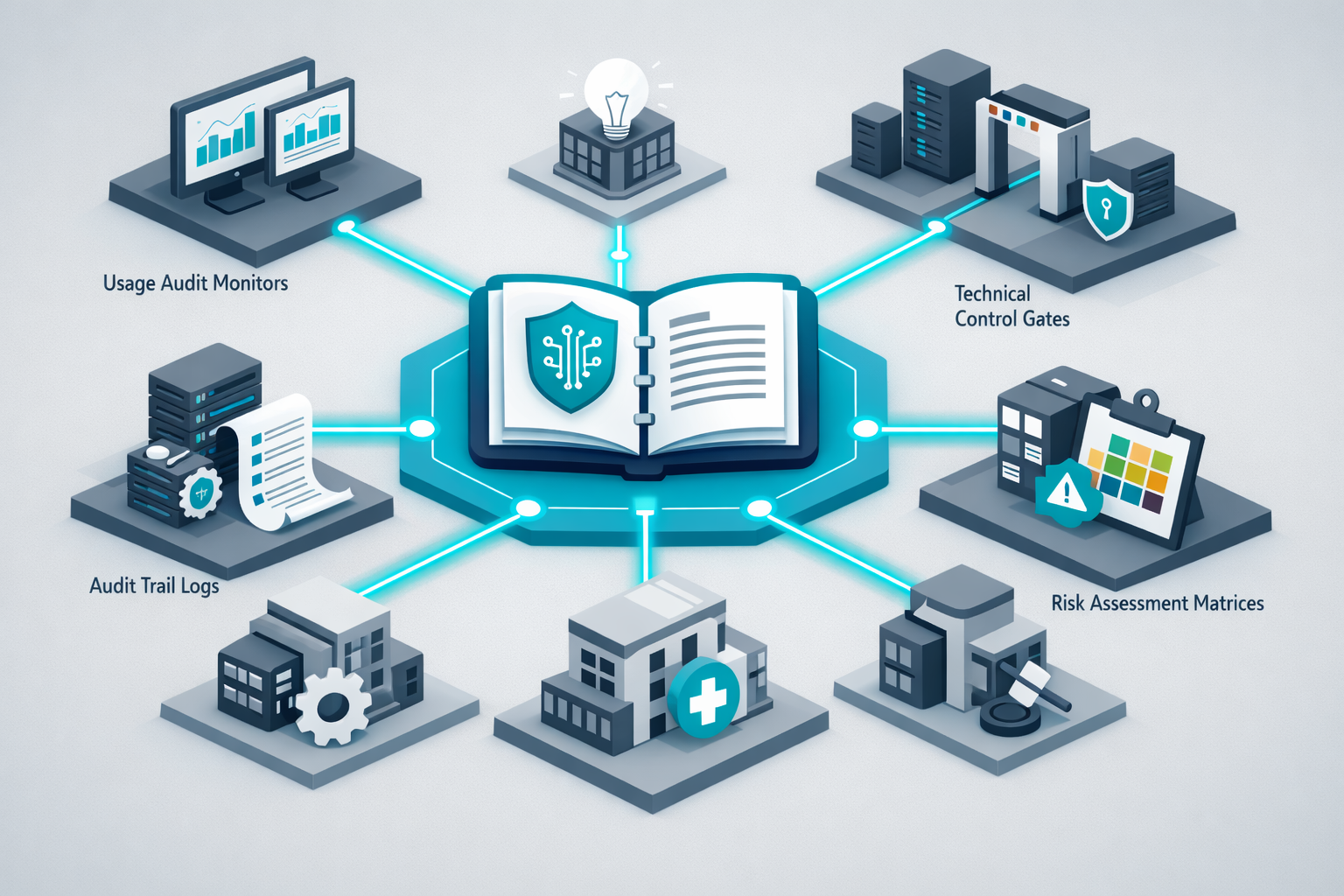
How We Build AI Governance for South Shore
AI usage audit. We start by mapping what AI tools are currently being used across your organization, by whom, with what data, and for what purposes. For most South Shore organizations, this audit is the first time leadership has a complete picture of AI adoption. Staff survey, tool inventory, data flow mapping, and interviews with department leads produce a factual baseline for every governance decision that follows.
Risk assessment. From the audit, we build a risk assessment that maps each AI use case to the regulatory requirements, contractual obligations, and organizational risk tolerances that apply. For a South Shore nonprofit handling federal grant funds, we map the Section 504 and grant-specific accessibility and data handling requirements. For a professional services firm, we map client confidentiality and professional responsibility obligations. For a healthcare provider, we map HIPAA and Illinois health data requirements. The assessment is specific to your context, not a generic template.
Policy framework. We develop an AI acceptable use policy, data classification rules that define what information can be processed through which categories of AI tool, output review requirements for AI-generated content that reaches clients or the public, vendor assessment criteria for new AI tools, and incident response procedures for when something goes wrong. The policies are written to be practical and enforceable, not aspirational documents that sit unread in a shared drive.
Technical controls. Policies without enforcement are suggestions. We implement data loss prevention rules that block sensitive data from reaching unauthorized AI tools, approved tool whitelists, access controls, and logging infrastructure that creates the audit trails regulated organizations require. For a South Shore healthcare provider, we build controls that prevent PHI from reaching unapproved AI tools and that log AI usage in patient-related workflows. For a law firm, we build controls around privileged information and client confidential data.
Training and ongoing governance. We train your staff on the framework with role-specific guidance. Your grants manager has different AI use cases than your clinical staff, which has different use cases than your marketing team. Training is tailored so each role understands what is approved, what is not, and how to handle edge cases. We help you establish an AI governance committee or working group that maintains the framework as tools, regulations, and business needs evolve. For small South Shore organizations that cannot justify a full committee, we build lightweight governance structures that work with a single accountable leader and periodic reviews.
Industries We Serve in South Shore
Nonprofits and community organizations. South Shore nonprofits serving residents face governance needs around constituent data, grant compliance, and funder reporting. Organizations adjacent to the By the Hand Club network, community development corporations, and social service providers all work with data that carries privacy and compliance obligations.
Healthcare and clinical practices. Clinics, dental practices, mental health providers, and wellness businesses serving South Shore residents need HIPAA-compliant AI governance that addresses both the federal privacy framework and Illinois-specific health data requirements. Clinical AI use, administrative AI use, and patient-facing AI use each require distinct policy treatment.
Legal and professional services. South Shore-based attorneys, accounting firms, and consulting practices face professional responsibility obligations that govern AI-assisted work product. Governance addresses confidentiality, privilege, competency standards, and client communication obligations that general AI policies do not cover.
Faith-based and community-serving organizations. Churches along 75th Street and 79th Street and faith-based nonprofits that handle constituent data, pastoral communications, and program records need governance that protects the trust relationships these organizations depend on.
Educational and youth-serving organizations. Schools, after-school programs, and youth services operating in South Shore need governance frameworks that address FERPA, the Children's Online Privacy Protection Act, and Illinois-specific student data protections. AI use in instruction, assessment, and student communication requires particular care.
Small and mid-sized businesses. Contractors, restaurants, and service businesses on the 71st Street corridor and throughout South Shore increasingly use AI for operations, marketing, and customer communications. Governance at this scale is lighter-weight but still necessary to protect customer data and manage vendor risk.
Cultural organizations. Arts organizations, cultural producers adjacent to Little Black Pearl and the DuSable Museum context, and creative businesses that handle donor records and program data need governance appropriate to their scale and the specific sensitivity of the communities they serve.
What to Expect Working With Us
1. AI usage audit. We map current AI tool usage, data flows, and business purposes across your organization. Staff surveys, tool inventory, interviews with department leads, and technical review of your environment produce a comprehensive current-state picture.
2. Risk assessment and policy design. From the audit we build a risk assessment and design a governance framework that addresses your specific regulatory, contractual, and organizational requirements. Policies are written for your actual context, not copied from a template.
3. Technical controls. We implement the enforcement layer. Data loss prevention, approved tool lists, access controls, and audit logging that embeds governance in the workflow rather than depending on individual compliance.
4. Training and ongoing governance. Role-specific training for your staff. Governance committee or working group setup for your scale. Quarterly or semi-annual reviews that keep the framework current as AI tools and regulations evolve.