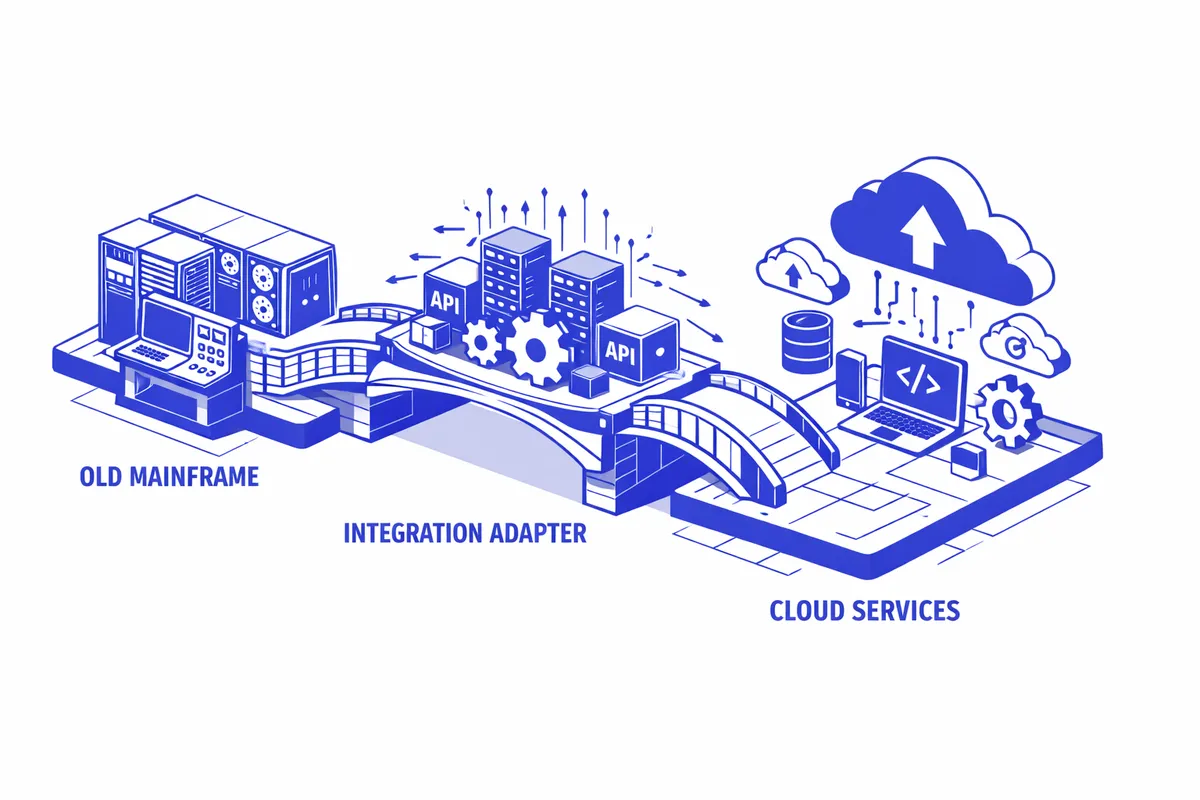
How We Build Legacy System Integration for South Loop
Legacy integration projects begin with a systems landscape assessment. We document every system your South Loop organization runs, the data that lives in each, the integration capabilities each system exposes, and the manual processes that currently connect them. For a South Loop financial services firm, that inventory might include a legacy accounting platform, a modern CRM, a recent HR system, and a compliance reporting tool that were all purchased independently and communicate through spreadsheet exports.
From the landscape assessment, we design the integration architecture. Legacy systems present integration challenges that modern systems do not: limited or no API access, proprietary data formats, performance constraints that prevent real-time synchronization, and the risk that touching the system incorrectly causes data corruption or system instability. We design around these constraints using database-level integrations where APIs are unavailable, file-based exchange where database access is restricted, and scheduled batch synchronization where real-time is not supported or necessary.
The implementation approach for South Loop legacy integration is conservative and reversible. We build integrations in phases, validate data accuracy at each phase before proceeding, and maintain the ability to revert to manual processes if an integration creates unexpected problems. Legacy systems in active production use at South Loop organizations often have undocumented business rules embedded in their data structures, and careful integration design surfaces those rules before they cause problems in connected modern systems.
Industries We Serve in South Loop
Financial and professional services firms on Michigan Avenue and State Street often run core accounting, portfolio management, or compliance systems that predate the modern integration era but cannot be easily replaced because of regulatory requirements, custom functionality, or the operational risk of migrating decades of financial data. Legacy integration for South Loop financial firms creates connections between these systems and the modern CRM, reporting, and client portal tools that professional services clients now expect.
Cultural and nonprofit institutions near Museum Campus, including the institutions that support and surround the Field Museum, Shedd Aquarium, and Adler Planetarium, run membership, ticketing, and donor management systems accumulated over decades. Legacy system integration for South Loop cultural institutions creates the unified view of constituent relationships that modern fundraising and member engagement requires, without discarding the historical data that institutional memory depends on.
Property management firms on Roosevelt Road and State Street managing South Loop's residential tower portfolio run property management platforms, maintenance management systems, and tenant billing tools that may not have been designed to connect. Legacy integration creates the automatic data flows between these systems that eliminate the reconciliation work property management staff currently perform manually each month.
Healthcare practices on Roosevelt Road run legacy practice management and electronic health record systems that predate the modern integration standards, creating connectivity gaps with modern billing platforms, patient communication tools, and the telehealth infrastructure that post-pandemic healthcare delivery requires. Legacy integration for South Loop healthcare connects these systems within HIPAA-compliant integration patterns.
Law firms and professional practices near Printers Row on State Street and Wabash Avenue run legacy practice management and document management systems alongside modern case management and billing tools. Integration creates the automatic matter-creation, time-capture, and billing workflows that eliminate manual data transfer between systems.
Higher education and Columbia College-adjacent organizations on Wabash Avenue run student information systems, financial aid platforms, course management tools, and institutional reporting systems that were implemented over decades and frequently cannot communicate with each other or with the modern analytics and communication tools that institutional operations now require.
What to Expect Working With Us
1. Systems landscape assessment and integration design. We document your South Loop organization's full system landscape, assess the integration capabilities of each system, map the manual data transfer processes that currently connect them, and design an integration architecture that addresses the highest-priority connections within the constraints the legacy systems impose.
2. Integration development and testing. We develop integrations using the connection methods available for each legacy system: API where available, database-level access where API is absent, file-based exchange where database access is restricted. Testing uses real data from your South Loop operation in a staging environment before any changes touch the production system.
3. Phased production deployment. We deploy integrations to production in phases, validating data accuracy against manual process outputs at each phase before disabling the manual process. This approach protects South Loop organizations from integration errors that would otherwise go undetected until they created significant data problems.
4. Documentation and operational handoff. We deliver complete integration documentation including data flow diagrams, connection specifications, error handling procedures, and the operational monitoring setup that alerts your team when an integration stops working. South Loop organizations that have depended on legacy systems for decades need integration documentation they can depend on for the next decade.