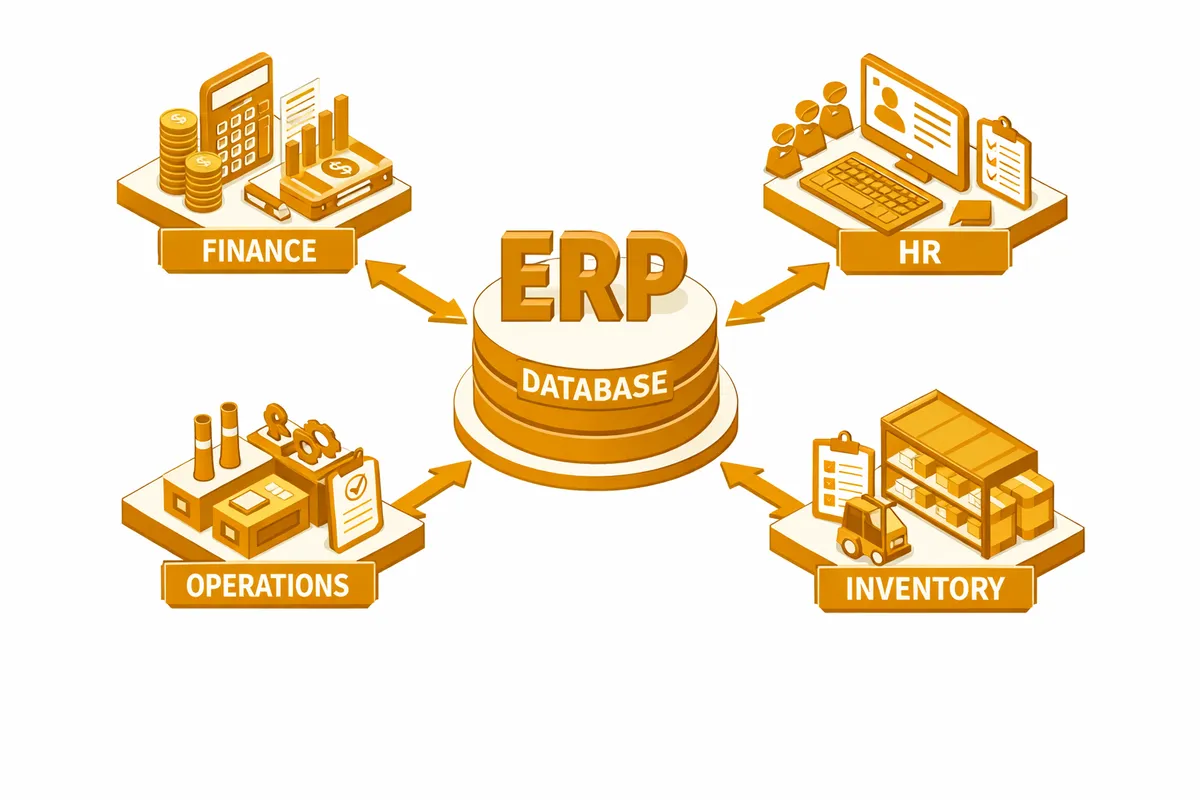
How We Build Custom ERP for South Loop
We begin with a process audit: mapping every operational workflow the South Loop business runs, documenting the data that flows through each, and identifying where current tools create friction, duplication, or gaps. For South Loop businesses that have outgrown a patchwork of spreadsheets, QuickBooks, and standalone scheduling tools, this audit typically reveals three to five integration failures where data has to be manually moved between systems, creating delay and error on every transaction.
The architecture we design for South Loop ERP systems reflects the actual operational structure of the business. For hospitality businesses near Soldier Field, we build revenue mode switching directly into the operations logic so event-night rates, staffing models, and inventory thresholds activate automatically based on the event calendar rather than requiring manual configuration before every game. For professional services firms on Wabash Avenue and Michigan Avenue, we build client and matter management into the core data model so billing, document management, and project tracking are organized around the client relationship from day one.
Integration is central to every South Loop ERP build. The system connects to whatever point-of-sale, payment processing, payroll, and banking systems the business is already running. For South Loop businesses with institutional clients whose procurement systems generate purchase orders or require vendor portal connectivity, we build those integrations into the system architecture before development begins so the ERP is compliant with client requirements at launch.
Industries We Serve in South Loop
Hospitality and hotel businesses along Michigan Avenue and State Street manage revenue complexity that standard hospitality ERP platforms misrepresent. Custom ERP for South Loop hotels builds Soldier Field event calendars, Museum Campus exhibition schedules, and seasonal occupancy patterns into the operations logic directly so pricing, staffing, and inventory management respond to the actual demand environment rather than to generic occupancy averages that smooth over the spikes.
Events and catering companies serving Soldier Field post-game hospitality, Museum Campus fundraising events, and Printers Row corporate entertainment need job-costing ERP logic that tracks every event separately. Custom ERP for South Loop events businesses captures labor, food and beverage, venue, and equipment costs per event and compares actual margin against estimated margin so the business learns which event types are genuinely profitable.
Property management and real estate firms in South Loop's high-rise corridor manage tenant billing, maintenance work orders, vendor contracts, and owner reporting across multiple buildings with different ownership structures. Custom ERP for South Loop property management builds the data model around individual properties and units rather than forcing residential management into the inventory frameworks that commercial ERP platforms designed for manufacturing assume.
Professional services firms on Wabash Avenue and Michigan Avenue serving Loop-area clients need ERP systems that manage client relationships, matter billing, document workflows, and staff utilization in an integrated platform. Custom ERP for professional services builds matter management, time capture, billing generation, and client reporting into a single system rather than requiring professionals to move between four different tools for tasks that belong in one place.
Retail and specialty businesses on Roosevelt Road managing in-store, online, and wholesale channels need ERP logic that handles three distinct inventory and order management workflows in a single operational view. Custom ERP for South Loop retail connects point-of-sale, e-commerce, and wholesale order management so the business has one inventory truth rather than three systems that require manual reconciliation.
Creative studios and production businesses on Wabash Avenue near Columbia College manage project-based operations with multiple clients, multiple billing structures, and production cost tracking requirements that standard ERP platforms do not model well. Custom ERP for South Loop creative businesses builds project management, time tracking, asset management, and client billing into an integrated system that matches the actual workflow of creative production.
What to Expect Working With Us
1. Process audit and requirements mapping. We document every operational workflow, data flow, and integration point across your South Loop business. For businesses near Soldier Field or Museum Campus with event-driven operations, we map the demand variation patterns that the ERP system needs to handle automatically rather than requiring manual configuration before every event.
2. Architecture design and integration planning. We design the data model, module structure, and integration architecture for your ERP system. For South Loop professional services firms with institutional clients, we design client integration requirements into the architecture before development begins so the system meets vendor compliance standards at launch.
3. Development and testing. We build the ERP system using documented, maintainable code and test against real operational data from your business. Testing covers the edge cases that South Loop operations create: Soldier Field event-night demand spikes, Museum Campus seasonal patterns, and the billing variations that Printers Row professional clients impose.
4. Deployment, training, and ongoing support. We deploy the ERP system with structured training for every role that uses it and provide ongoing support as the system matures and operational requirements evolve. Custom ERP development is an ongoing relationship rather than a one-time build because South Loop businesses change and the system needs to change with them.