South Loop-Specific BI Challenges
The mixed-use character of South Loop creates analytical challenges that single-industry BI frameworks do not handle cleanly. A company that manages residential property in the Central Station development, operates ground-floor commercial space leased to retailers, and provides parking services to both residents and Museum Campus visitors needs a BI system that understands the relationships between these three revenue streams and the shared cost structure supporting all three. Standard BI tools assume cleaner category boundaries than this business model creates.
The convention calendar at McCormick Place creates a temporal analytical challenge: raw financial comparisons across calendar periods are misleading when convention event density varies significantly between periods. A BI system for South Loop businesses serving convention traffic needs a convention calendar overlay that allows analysts to distinguish between convention-driven performance and baseline performance. A restaurant that grew revenue twenty-five percent in Q3 year over year, but hosted two major convention groups in Q3 of the current year versus none the prior year, has not actually improved its baseline business performance at all. Convention-adjusted analysis shows the true trend.
Residential density creates a customer cohort analysis opportunity specific to South Loop. The large residential buildings along Indiana Avenue, Prairie Avenue, and Michigan Avenue serve populations that are trackable over time: residents who move in, how long they stay, what services they consume during their tenure, and what factors predict lease renewal versus departure. For property management companies and the service businesses that serve residents, cohort analysis built on residential tenure data produces insights about customer lifetime value that few businesses in less densely residential neighborhoods can access.
Core BI Capabilities We Build
Data warehouse design and implementation. A central repository that consolidates data from all your operational systems, cleaned and structured for analytical use. The data warehouse is the foundation that makes complex multi-system analysis possible without requiring analysts to assemble data manually for each question.
ETL pipelines. Extract, transform, and load processes that keep your data warehouse current by pulling data from source systems on a defined schedule, applying transformations and quality checks, and loading it into the warehouse in the format your analytical layer needs.
Dimensional data modeling. The analytical schema that makes complex queries fast and intuitive. We model your data so analysts and business users can answer complex questions without needing database engineering expertise to navigate the data structure.
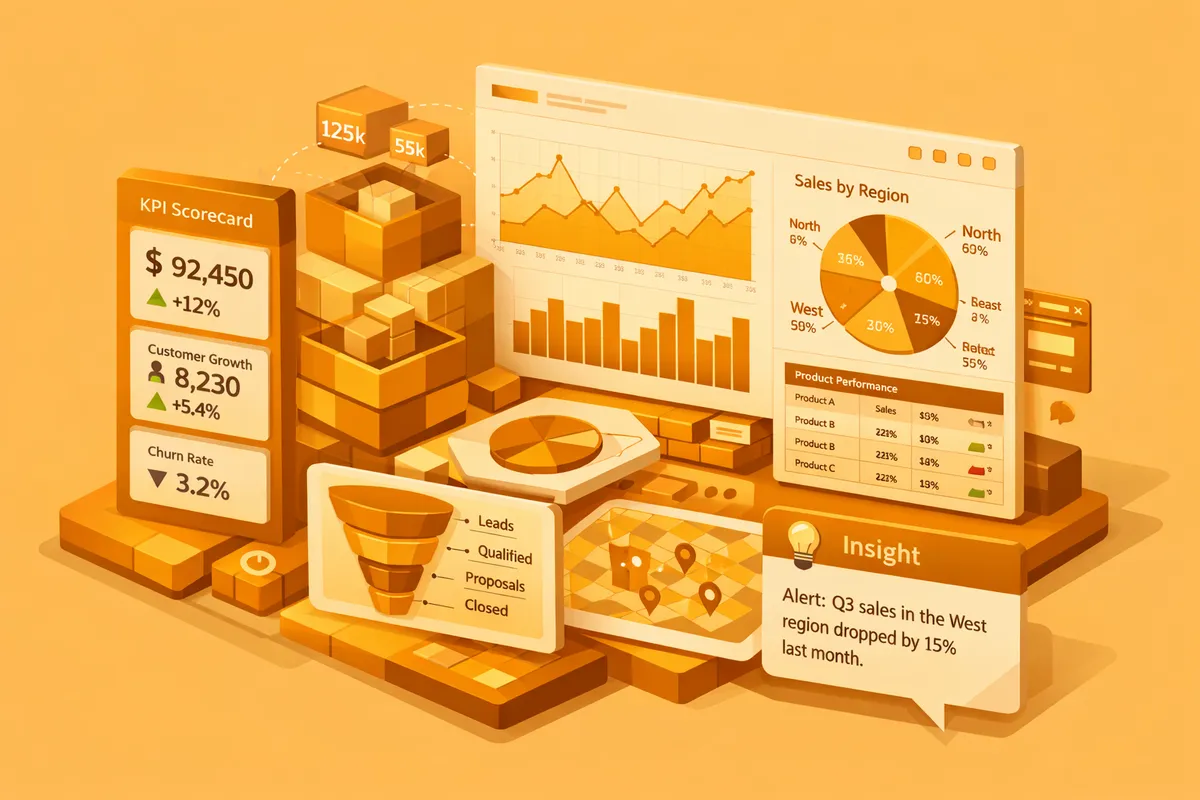
BI dashboards and reports. Built on Tableau, Power BI, Looker, or your preferred visualization platform, dashboards and reports that surface the insights your leadership team needs without requiring them to run queries or interpret raw data.