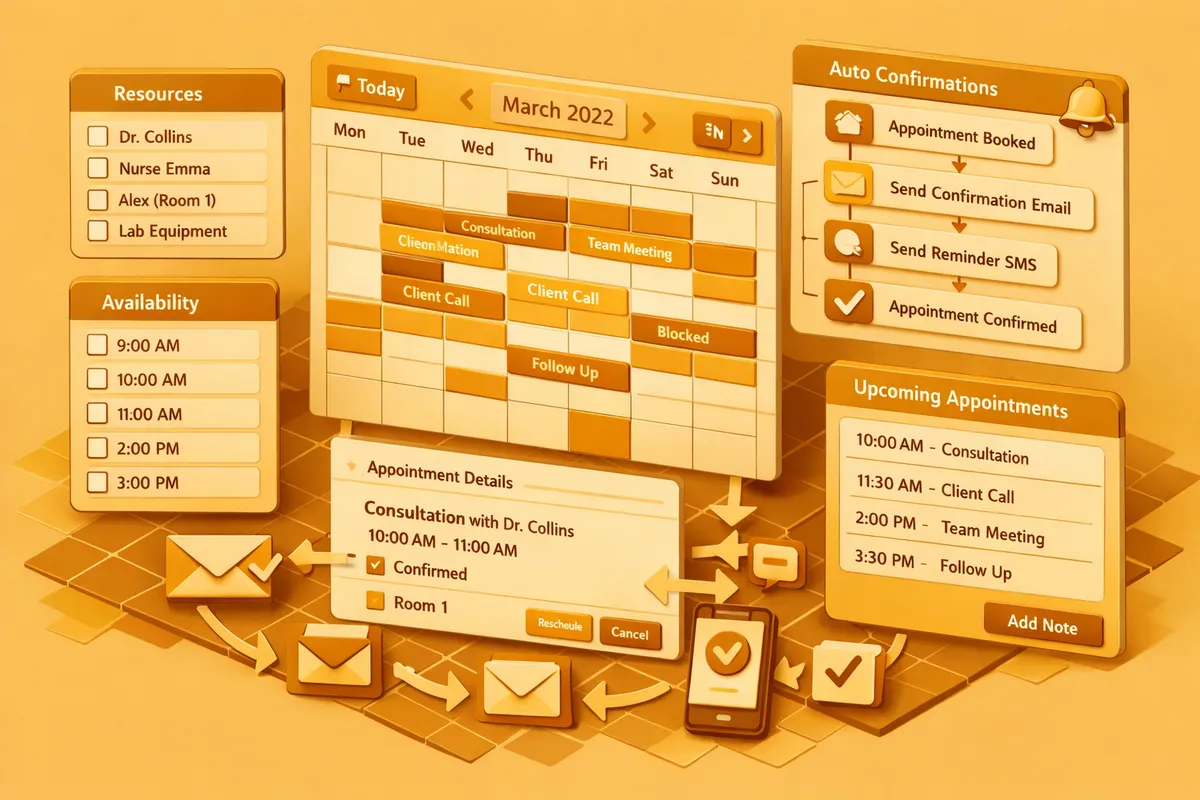
Booking Scheduling in South Loop
Booking Scheduling for businesses in South Loop, Chicago. We know the neighborhood, the customers, and what it takes to compete locally.

How We Build Booking Systems for South Loop Businesses
Multi-Segment Booking Architecture
We design booking systems that handle different customer segments through one platform. The booking interface adapts based on context. A returning resident sees their preferences and past bookings. A first-time visitor sees welcoming onboarding with location details and what to expect. A group booking gets routed to the appropriate inquiry workflow. A student accessing the booking page through a university-specific link sees student pricing and eligible services.
Segment-specific booking links enable targeted marketing. A South Loop fitness studio can share one link on Instagram for general class bookings, a different link in a Columbia College newsletter for student-priced sessions, and a third link in a South Loop condo building newsletter for resident promotions. All three links book against the same calendar with real-time availability, but each presents the appropriate pricing, messaging, and service options for its audience.
For businesses that serve convention traffic, the system includes a convention-mode configuration that activates when major McCormick Place events are scheduled. The restaurant adds extended hours, the salon opens additional booking slots, and the fitness studio promotes day-pass options. Convention visitors see availability tailored to their likely schedule: early morning, lunch break, and evening options.
Location and Transit Integration
South Loop businesses serve customers arriving by different modes. Residents walk or drive from nearby condo towers. Office workers come south on the Red Line from the Loop. Students walk from campus. Tourists arrive by rideshare or public transit from hotels across the city. Convention visitors shuttle from McCormick Place.
Booking confirmations include location-appropriate transit details. For a Printer's Row restaurant, the confirmation notes the nearest CTA station, parking garage options, and the street entrance. For a Michigan Avenue service business, directions include both walking routes from the Roosevelt CTA station and rideshare drop-off suggestions. For businesses near McCormick Place, directions include the shuttle route from the convention center.
These details seem minor but they reduce friction for first-time visitors who are unfamiliar with the South Loop's geography. A tourist who receives clear directions is less likely to arrive late and throw off the schedule. A convention visitor who knows where to find parking arrives calm instead of stressed from circling blocks. The booking system contributes to the client experience before the client walks in.
Student and Educational Institution Booking
Columbia College and Roosevelt University bring thousands of students to the South Loop. Businesses that serve this audience need booking systems that accommodate student-specific requirements: verified student pricing, academic calendar awareness, and booking patterns that reflect student life.
We configure student verification through email domain validation, student ID integration, or manual approval. A South Loop yoga studio offering a $10 student drop-in rate verifies student status during the booking flow. A salon offering 20 percent student discounts validates the discount at checkout through the booking system rather than requiring front desk verification.
Academic calendar integration adjusts availability and promotions based on the school year. During exam weeks, a study-friendly cafe extends its hours and opens additional reservation slots for group study bookings. During summer break, a fitness studio reduces class frequency in time slots that were student-heavy and increases availability for resident-focused scheduling. The system adapts to the rhythm of the academic year automatically.
Industry Solutions Across the South Loop
Fitness and Wellness on Wabash and Michigan
The South Loop's rapid residential growth has driven a boom in fitness studios, gyms, and wellness providers along Wabash and Michigan Avenue south of Roosevelt. These businesses compete for a health-conscious population that expects booking convenience on par with the Loop fitness studios they might also consider.
For personal training gyms, the booking system manages individual sessions, partner workouts, and small group classes through one calendar. Trainer availability, equipment allocation, and space capacity all factor into the booking logic. A partner training session requires two adjacent time slots with the same trainer and enough equipment for both clients. A small group class requires minimum enrollment to run and maximum capacity based on the space and equipment available.
Class pack and membership tracking integrates with booking. A client with a 10-session pack sees their remaining sessions and books directly against their balance. An unlimited member books without restrictions. A drop-in client pays at the time of booking. The front desk no longer needs to check each person's status manually, and the system prevents a 10-session client from booking an 11th session without purchasing more.
For wellness businesses including massage, acupuncture, and chiropractic offices, the system manages practitioner-specific scheduling with treatment-appropriate durations, room assignments, and intake requirements. New client bookings include health history questionnaires. Returning clients book with minimal friction. Treatment cycle management sends rebooking reminders at the intervals the practitioner recommends.
Restaurants on Printer's Row and Michigan Avenue
Printer's Row dining is intimate and neighborhood-oriented, with small restaurants where every reservation matters. Michigan Avenue south of Roosevelt brings a different scale, with restaurants that serve both local residents and visitors from the hotel cluster near McCormick Place.
For Printer's Row restaurants, the booking system maximizes every seat. No-show prevention through confirmation workflows and deposit requirements for larger parties protects the small restaurant from the outsized impact that even one empty table has on a 40-seat dining room. Regulars are recognized through client profiles that note preferences and visit history. Seasonal patio management adds outdoor seating to the inventory during warm months without disrupting indoor reservation flow.
For Michigan Avenue restaurants near the hotel district, the system manages hotel concierge referral tracking. When a guest at a nearby hotel books through a concierge-specific link, the booking notes the referral source. The restaurant can track which hotels send the most diners and invest in those relationships accordingly. Convention-adjacent restaurants benefit from event-triggered promotions that appear in booking confirmations for nearby hotel guests during major conventions.
Event Spaces and Meeting Venues
The South Loop's proximity to McCormick Place creates demand for event spaces, meeting rooms, and private dining venues that serve convention overflow. Businesses that offer event hosting need booking systems that handle inquiry-to-execution workflows efficiently.
Event booking pipelines manage initial inquiry capture, follow-up communications, proposal generation, contract execution, deposit processing, logistics coordination, and post-event follow-up. A South Loop restaurant with a private dining room receives an inquiry, automatically sends a customized events package, follows up on a defined schedule, processes the contract and deposit through the booking system, and coordinates day-of details including menu finalization, AV requirements, and room setup specifications.
Meeting room rentals at co-working spaces and shared offices manage hourly booking with equipment inventories, catering add-ons, and technology setup requirements. A half-day meeting room booking specifies projector, whiteboard, video conference setup, and catering for 12 people. The system reserves the room, alerts the facilities team about equipment needs, and routes the catering order to the preferred vendor.
Professional Services and Medical Offices
South Loop's residential growth has attracted medical practices, dental offices, and professional services firms that serve the neighborhood's growing population. These businesses manage scheduling that balances new patient acquisition with established patient retention.
New patient onboarding workflows collect insurance information, medical history, and appointment preferences before the first visit. The system verifies insurance eligibility where possible and alerts the front desk to any issues before the patient arrives. Established patients book through a streamlined flow that pre-selects their provider and suggests the appropriate appointment type based on their treatment history.
For multi-location practices that have a South Loop office and locations in other neighborhoods, the system manages cross-location scheduling. A patient who usually visits the Lincoln Park location can book at the South Loop office when it is more convenient. Their records, provider preferences, and history are visible at both locations through the shared system.
What to Expect Working With Us
1. Multi-segment booking analysis. We identify the distinct customer segments your South Loop business serves and design the booking experience to accommodate each segment's needs.
2. Convention and event calendar integration. For businesses affected by McCormick Place events, we build convention-awareness into the booking system with demand forecasting and availability adjustments.
3. Student and institutional booking configuration. For businesses serving the Columbia College and Roosevelt University population, we set up student verification, academic calendar integration, and student-specific pricing.
4. Location and transit information. Booking confirmations include customized arrival details based on where the customer is likely coming from.
5. Launch and multi-audience optimization. After launch, we optimize the system for each customer segment based on booking patterns, no-show rates, and channel performance.
Frequently Asked Questions
Yes. The system serves both audiences through the same platform with segment-specific configurations. Residents see standard booking with loyalty recognition and regular scheduling. Convention visitors access through event-specific links with extended hours, relevant services, and location details oriented from McCormick Place. Both book against the same calendar, so availability is always accurate regardless of which audience is booking.
Student pricing configures as a separate tier within the booking system. Students are verified through email domain validation (using their .edu address), student ID upload, or manual approval. Once verified, the student sees applicable pricing when booking. The discount applies automatically at checkout without front desk intervention. Student verification can expire at intervals you define, requiring periodic re-verification.
Yes. Similar to Old Town's entertainment-dining coordination, we can integrate show schedules from nearby venues into your reservation management. Pre-show and post-show dining windows adjust based on performance times. Dinner-and-show packages can be offered through shared booking workflows. The system helps your restaurant capture the audience that attends events at neighboring venues.
Patio management adds outdoor seating to your reservation inventory on the date you specify each spring and removes it in the fall. The system treats patio tables as a distinct section with their own capacity, turn times, and weather contingency rules. If a forecast shows rain, the system can notify patio-reserved guests with the option to move indoors or reschedule. During the transition weeks when weather is unpredictable, the system can hold patio tables as contingent until a defined cutoff time.
The system reports bookings by customer segment, booking channel, service type, and time period. You can see what percentage of bookings come from residents versus students versus convention visitors. Revenue reports break down by segment. No-show rates are tracked per segment, which often reveals significant differences. For example, convention visitors may show different no-show patterns than neighborhood regulars. This data informs segment-specific policies and marketing decisions.
Yes. Meeting rooms and desk reservations configure as separate booking types with different rules. Meeting rooms book by the hour with equipment and catering add-ons. Desk reservations book by the day or half-day with amenity selections. Both share the facility's capacity calendar. When a meeting room books, the corresponding desk capacity adjusts if the room is located within the co-working space's shared floor plan.
Ready to get started in South Loop?
Let's talk about booking scheduling for your South Loop business.