How We Build AI Strategy Consulting in South Loop
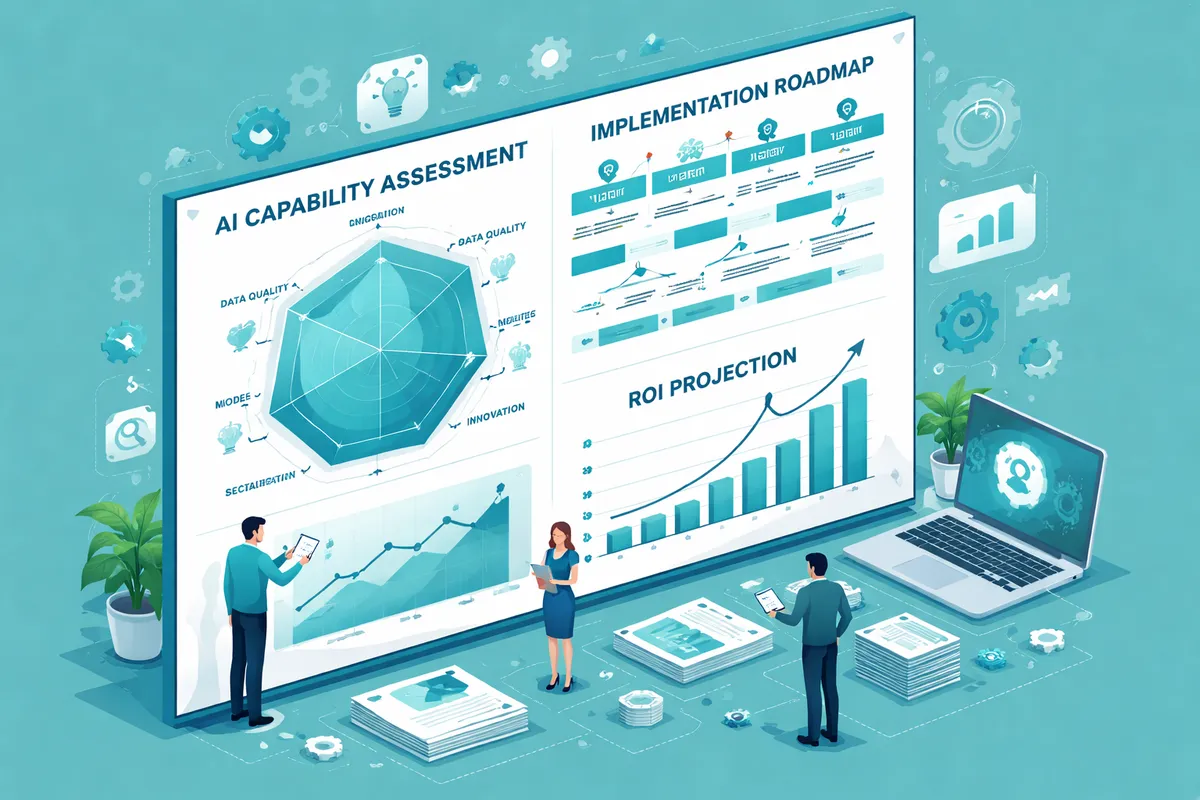
We conduct an assessment of your operations, technology stack, and customer data. Then we map AI opportunities ranked by impact, feasibility, and return on investment timeline. For restaurants near Museum Campus and Soldier Field, we evaluate demand forecasting tied to the event calendar, event-triggered marketing automation, and customer engagement tools, comparing the cost of each against the expected revenue impact in the specific context of South Loop's event-driven economy.
For property managers along Wabash Avenue and Michigan Avenue, we assess predictive maintenance, tenant communication automation, and operational analytics across their portfolio. For retailers in Printers Row and along State Street, we identify inventory optimization, personalization, and search visibility improvements that capture both the resident base and the visitor traffic that passes through the neighborhood on its way to and from Museum Campus.
What to Expect Working With Us
1. Event-calendar mapping. For South Loop businesses, we start by mapping the Soldier Field schedule, the McCormick Place convention calendar, and the Museum Campus seasonal patterns, because these drive demand more than any other single factor and must be built into the forecasting and marketing strategy from day one.
2. Operations and data assessment. We review your current technology, data quality, and operational workflows to identify which AI applications you are positioned to use immediately and which require foundational work, such as cleaner data or better integrations, before AI can deliver reliable outputs.
3. Prioritized roadmap delivery. You receive a written AI strategy with phased recommendations, budget estimates, and expected return on investment projections. The sequence accounts for the South Loop's event-driven dynamics rather than applying a generic hospitality or retail template.
4. Ongoing support. Quarterly strategy reviews update the roadmap as the neighborhood grows, new AI tools emerge, and your operational data accumulates to support more sophisticated applications than were feasible at the beginning of the engagement.
Industries We Serve in South Loop
Restaurants near Museum Campus and Soldier Field receive AI strategies that capitalize on event-driven traffic patterns rather than treating every week as equivalent. We map the specific AI tools that maximize game-day, convention-week, and exhibit-season revenue: demand forecasting to prepare accurately, marketing automation to reach the right audience before and during events, and customer service tools to handle the surge without proportionally increasing staffing costs. One restaurant discovered that a three-hundred-dollar-per-month forecasting tool would save more money than the two-thousand-dollar platform they were evaluating, because the simpler tool was calibrated to the actual data they had rather than requiring infrastructure they had not yet built.
Property management companies in South Loop's towers get roadmaps for tenant experience automation, predictive maintenance, and portfolio analytics. For companies managing five hundred or more units, the strategy often identifies substantial annual savings from maintenance optimization and communication automation alone, because the scale of the portfolio makes even incremental efficiency improvements significant in absolute dollar terms.
Retail and service businesses in Printers Row and along State Street receive strategies for reaching South Loop's mixed audience: search optimization to capture tourist and convention traffic, personalization to retain residents, and inventory intelligence to stock for the specific demand patterns this neighborhood creates. The mix of permanent residents and transient visitors requires a segmented marketing approach that most small retailers have not yet implemented, and AI makes that segmentation practical without requiring a full-time marketing team.
Professional services firms along Wabash Avenue and Michigan Avenue serving Loop-adjacent clients receive AI strategies that address both the productivity opportunity and the professional regulatory constraints that govern how attorneys, financial advisors, and consultants can use AI in client-facing work. Strategy for professional services in South Loop is not the same as strategy for hospitality or property management.
Creative agencies and studios on Wabash Avenue near Columbia College receive AI strategies that account for the creative community's specific adoption patterns, the institutional disclosure requirements that academic clients impose, and the production workflow opportunities that AI offers for agencies that need to scale output without scaling headcount proportionally.