How We Build Accounting Automation for South Loop
We start by mapping the actual financial flows of the South Loop business: revenue streams, payment types, billing cycles, expense categories, and reporting needs. For hospitality businesses near Soldier Field, this map distinguishes event-night revenue from base revenue and designs automation that tracks both separately in every report. For creative businesses near Columbia College, the map covers project-based billing, retainer revenue, and time tracking, and designs automation that handles each without manual intervention from the agency team.
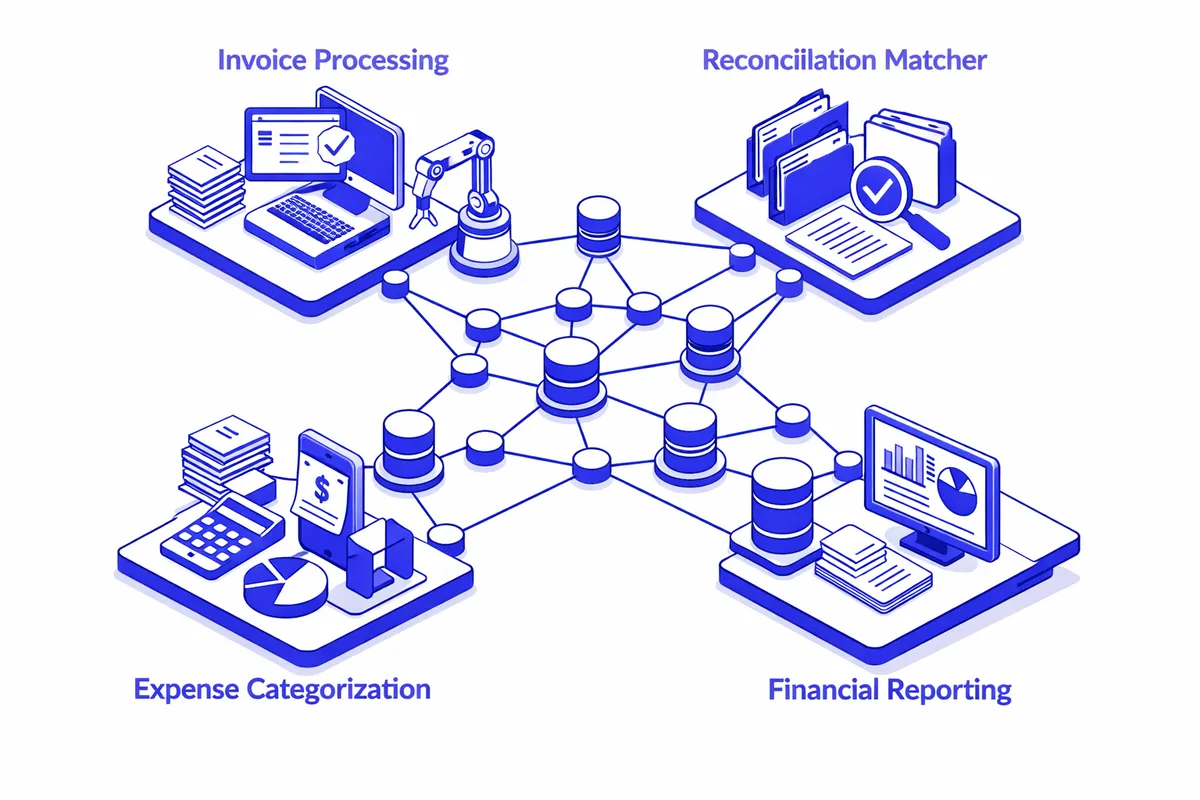
The automation stack we build typically connects the point-of-sale, billing, payroll, and banking systems that South Loop businesses are already using. QuickBooks, Xero, Square, Stripe, Gusto, and the major banking APIs all connect through our integrations. We add the automation layer that moves data between these systems on schedule, flags exceptions for human review, and generates the reports that South Loop business owners actually need to make decisions rather than the generic reports the software produces by default.
For South Loop businesses with recurring billing, including property management companies along Indiana Avenue, membership-based businesses, and subscription services, we build the billing infrastructure that generates, sends, and follows up on invoices without human involvement. Reconciliation happens automatically. Exceptions surface in a dashboard. The owner sees the financial picture each morning without touching the underlying data.
Industries We Serve in South Loop
Restaurants and hospitality businesses on Michigan Avenue and State Street deal with revenue volume and payment type complexity that overwhelms manual accounting quickly. Accounting automation for South Loop restaurants separates event-driven revenue from base revenue, tracks covers and private dining separately, and reconciles payment processor settlements, tip pools, and vendor payments automatically so the owner sees clean numbers every morning rather than spending Sunday cleaning up last week's books.
Creative agencies and media studios on Wabash Avenue near Columbia College bill on project, retainer, and hourly bases simultaneously across different clients with different payment terms. Accounting automation for creative businesses handles time tracking integration, project profitability reporting, and invoice generation across multiple billing structures without the manual work that typically consumes one administrative day per week for an agency of five to ten people.
Property management and real estate firms in South Loop's high-rise corridor manage recurring monthly billing for dozens or hundreds of units while tracking maintenance expenses, vendor payments, and property-level profitability separately for each building. We build automation that handles lease billing, payment reconciliation, and expense tracking at the scale these portfolios require without a proportionally sized accounting staff.
Retail businesses on Roosevelt Road managing in-store, online, and wholesale channels need accounting automation that reconciles three transaction streams and three cost structures into a single financial picture. We connect point-of-sale, e-commerce, and wholesale billing into unified automation that eliminates the manual reconciliation that otherwise consumes hours every week without producing any business value.
Professional services firms including legal, consulting, and financial practices in South Loop offices bill by the hour, by project, or by retainer, and often all three with the same client over the course of a relationship. Accounting automation for professional services covers time tracking, billing generation, expense capture, and the client-level profitability reporting that lets partners understand which clients and matter types are actually generating returns worth the firm's time.
Event and entertainment businesses serving Soldier Field and Museum Campus events manage venue, production, catering, and staffing costs that change with every event and cannot be tracked against a standard cost structure. We build job-costing automation that tracks expenses against each specific event, generates client invoices from actual cost data, and produces the post-event profitability analysis that informs future pricing for similar event types.
What to Expect Working With Us
1. Financial flow mapping. We document the actual revenue streams, payment types, billing cycles, and expense categories of your South Loop business. This map drives every automation decision so the system matches your business rather than forcing your business to match the software's assumptions about how businesses operate.
2. System integration design. We design the connections between the software systems you are already using: point-of-sale, billing, payroll, banking, and any South Loop-specific systems like event management or property management platforms that need to feed financial data to your accounting layer.
3. Automation build and testing. We build the integrations, automation rules, and reporting dashboards. Testing uses real transaction data from your business so the automation handles the edge cases that generic testing misses, including the revenue spike patterns that Soldier Field game days and Museum Campus events create.
4. Training and handoff. We train your team on the automated system, document the exception handling procedures, and provide support through the first full billing cycle to catch anything the testing did not surface in the controlled environment.