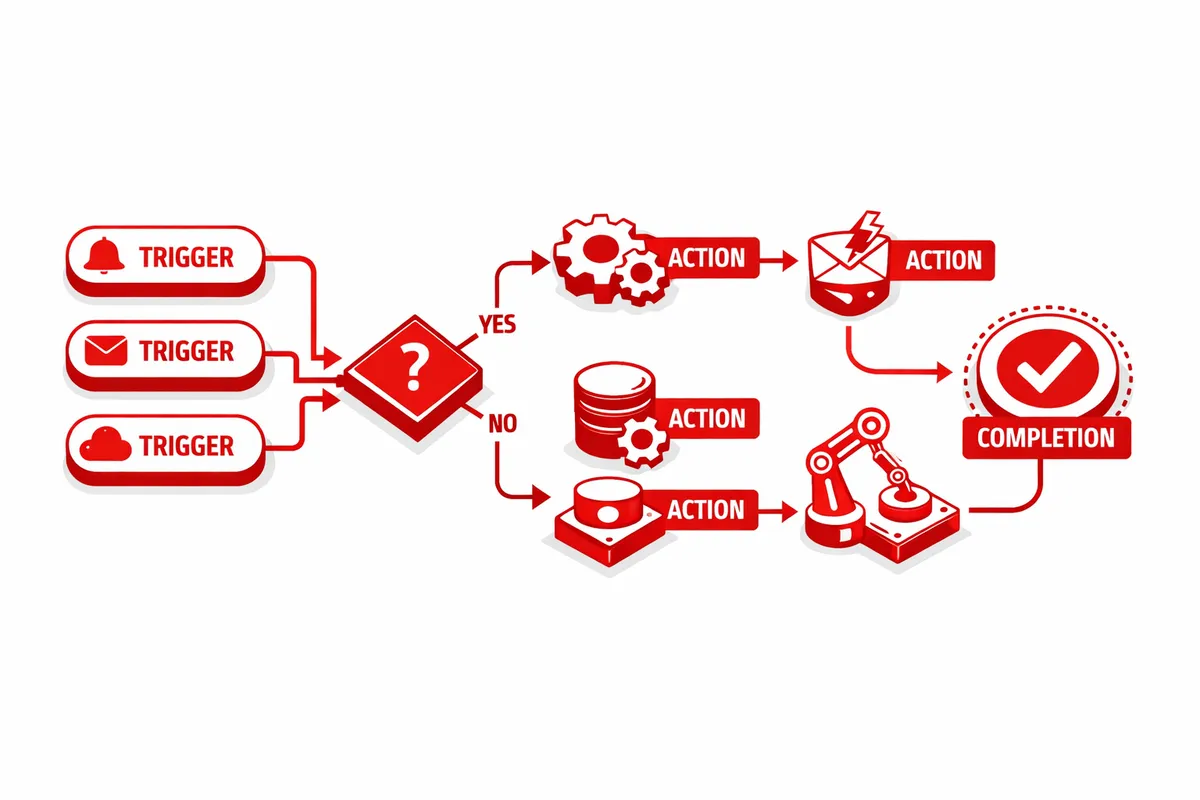
How We Build Workflow Automation for Schaumburg
We begin by auditing your current process landscape. For Schaumburg tech firms, that audit covers the sales-to-delivery handoff, project lifecycle management, client communication, and billing workflows. For healthcare practices, it covers patient intake, scheduling, insurance, and referral management. For insurance agencies, it covers policy management, renewal cycles, and claims coordination. The audit identifies every manual step, estimates the time cost, and ranks processes by automation ROI.
Integration architecture is the technical core of every engagement. Schaumburg businesses typically run five to fifteen software platforms: a CRM, a project management tool, an accounting system, a communication platform, an industry-specific application, and several point solutions for particular workflows. We connect those systems so data flows between them without manual re-entry. A change in the CRM propagates to the project management system. A completed invoice in the project tool flows to accounting. A new patient record in the practice management system triggers the scheduling and intake workflow. The platforms work as a unified system rather than independent silos.
For Schaumburg's tech and professional services sector, we prioritize the client lifecycle workflows first: from lead to proposal to contract to onboarding to delivery to billing. These workflows touch every department and are the source of most coordination errors and delay in growing firms. The automation layer makes the client lifecycle run consistently at any volume, whether the firm is onboarding two clients this month or twenty.
We build Schaumburg healthcare automations with particular attention to HIPAA compliance requirements. Every automated workflow that touches protected health information is designed with the access controls, audit logging, and data handling standards that HIPAA requires. Healthcare workflow automation that does not meet HIPAA standards is not automation worth having.
Industries We Serve in Schaumburg
Technology firms and IT services companies on the Golf Road and Meacham Road corridors automate sales-to-service handoffs, project provisioning, client onboarding, helpdesk ticket routing, recurring service delivery workflows, and client reporting. The managed service provider model in particular benefits from automated ticket routing, escalation management, and SLA tracking that currently requires manual oversight. When a client submits a support request, the automation classifies the ticket, assigns it based on skill match and availability, starts the SLA clock, and escalates if the response threshold is not met, all without dispatcher intervention.
Healthcare offices and medical practices serving the Schaumburg residential population automate new patient intake, insurance eligibility verification, referral coordination, appointment reminders, recall outreach, and post-visit follow-up. A Schaumburg medical practice that automates its insurance verification workflow recovers the front office time that is currently going to manual phone calls with insurance carriers for each new patient appointment.
Insurance agencies along Roselle Road and Higgins Road automate policy renewal workflows, client outreach sequences, claims intake and status communication, carrier submissions, and annual coverage review scheduling. Automated renewal management ensures every policy reaches the client sixty, forty-five, and thirty days before renewal with the current coverage summary and a clear call to action, without requiring an agent to manually track each renewal date.
Corporate offices and professional services firms on Schaumburg's major commercial corridors automate internal approval workflows, expense reporting, vendor management, contract routing, and executive reporting. For mid-market companies in the fifty to five-hundred employee range, these internal workflows are currently running on email chains and spreadsheets that create approval delays, lost records, and reporting gaps. Automated approval routing with audit trails replaces the email chain with a process that is trackable, compliant, and faster.
Convention and hospitality businesses supporting the Schaumburg Convention Center automate event intake, contract generation, coordination workflows for catering, audio-visual, and setup services, and post-event billing and reconciliation. A full-service event booking from initial RFP to final invoice currently requires coordinators to manage each vendor relationship manually for every event. Automation handles the coordination layer so coordinators focus on client relationships rather than logistics tracking.
Retail and franchise operations near Woodfield Mall and along Schaumburg's retail corridors automate inventory management, vendor reorder workflows, staff scheduling communications, and loss prevention reporting. For franchise operations in particular, automated reporting that flows from point-of-sale to the franchisee's accounting system and to the franchisor's reporting platform eliminates the manual reconciliation that currently happens at period end.
What to Expect Working With Us
1. Process audit and prioritization. We document your full workflow landscape and produce a ranked automation roadmap. For Schaumburg tech firms, we typically identify twenty-five to forty automatable processes in the initial audit. For healthcare practices, the number is similar. The roadmap ranks by ROI so the highest-return automations deploy first.
2. Integration architecture design. We map every system in your Schaumburg operation, document the data flows that should exist between them, and design the integration architecture before writing a single line of automation logic. This step prevents the common failure mode of building automations on top of disconnected systems and discovering integration problems during deployment.
3. Phased deployment with immediate returns. Core automations deploy within two weeks and deliver measurable time savings from the first week. Schaumburg businesses consistently see ten to twenty hours per week of recovered staff time in the first month across the initial automation wave.
4. Advanced workflow build and iteration. Multi-step workflows with conditional logic, exception handling, and multi-party coordination deploy in weeks three through eight. The team encounters edge cases as the system runs in production; we resolve them and strengthen the workflows during this phase.
5. Ongoing monitoring and expansion. Every automation logs its execution data. We review performance quarterly, identify new automation candidates as your Schaumburg operation evolves, and keep the workflow library current as your team's process needs change.