How We Build UI/UX Design for Schaumburg
Every project starts with user research. For Schaumburg's corporate clients, that means interviewing and observing the actual people who will use the product: the insurance agent who needs to process renewals efficiently, the healthcare front desk staff managing appointment bookings, the account manager at a tech firm reviewing client dashboards. We watch how they work with the current tool or workflow before we propose how to improve it. This phase is non-negotiable. Enterprise UX designed without talking to actual users almost always solves the wrong problems, and Schaumburg's demanding corporate users will make that clear within days of launch.
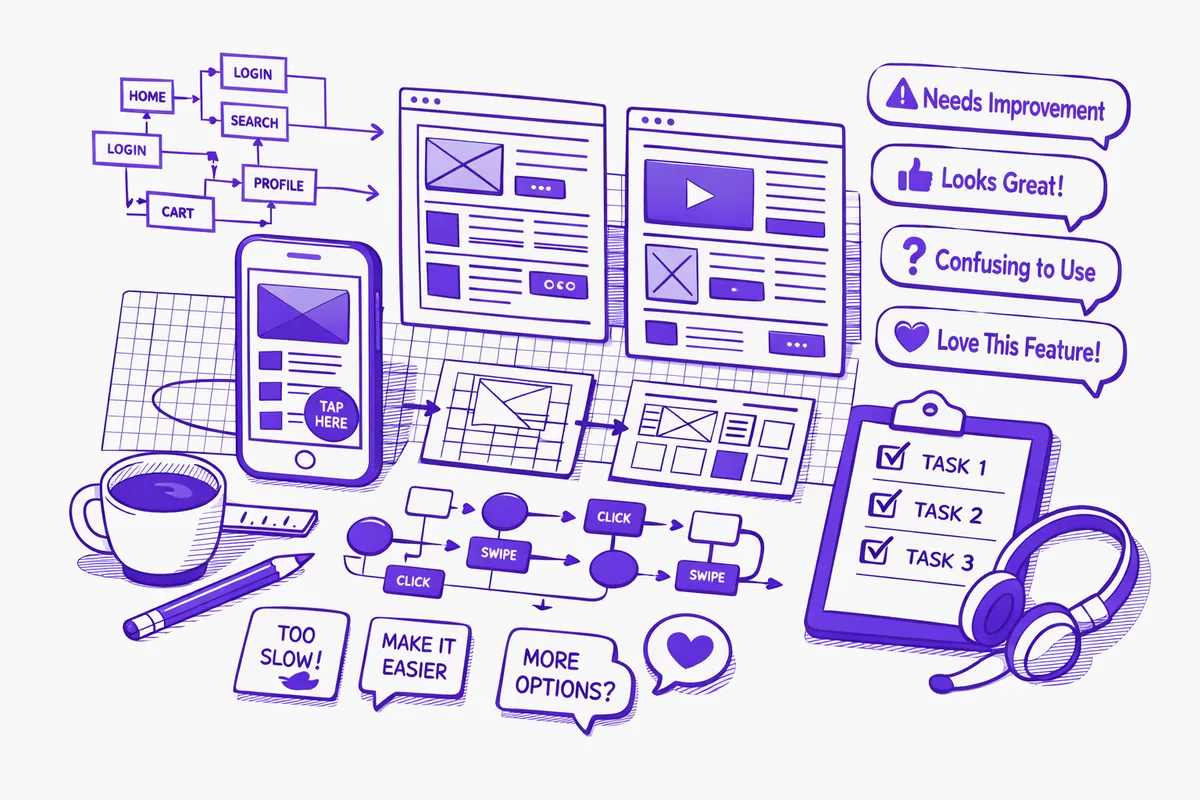
Research findings translate into information architecture and user flow design before any visual design begins. This is the structural phase where we determine what information lives at what level of the hierarchy, how users navigate between tasks, and what the cognitive load looks like at each step. For Schaumburg's corporate users, this phase often reveals that the current tool is organized around the database schema rather than the user's job, which is a common source of the friction that makes enterprise software so painful. Restructuring the information architecture alone, before touching any visual design, frequently produces the largest improvement in user satisfaction.
Visual design comes after the structure is approved. UI design for Schaumburg's corporate and healthcare clients operates within defined brand systems and often within specific technical constraints imposed by the frameworks and platforms being used. We design for both: brand consistency and implementability. A beautiful design that cannot be built within the actual constraints is not a useful design. Technology firms headquartered near Woodfield Road often have engineering teams with strong opinions about implementation, and we design with those constraints in view from the beginning rather than handing off designs that create conflict with the development team.
Prototyping and usability testing validate the design before development begins. We build interactive prototypes and test them with representative users from the Schaumburg business environment, identifying any remaining friction points or confusion before a single line of production code is written. Fixing a design problem in a prototype costs a fraction of fixing it after the product is built. For healthcare portals on Roselle Road where patient adoption is the success metric, testing with actual patient-representative users before development begins is the difference between a portal that achieves its adoption goals and one that goes live and remains unused because the first-login experience was too confusing.
Industries We Serve in Schaumburg
Technology companies and software firms near Woodfield Road use UI/UX design for client-facing product interfaces, enterprise dashboard design, and internal tooling that their teams use daily. A software company's product is its UX. The quality of the interface is the quality of the product from a user perspective, and it is the primary driver of renewal and expansion decisions.
Insurance agencies and carriers along Golf Road use UI/UX design for agent-facing workflow tools, policyholder portals, and claims management interfaces. Insurance workflows are inherently complex, and the difference between a claims interface that an agent can work through in four minutes and one that takes twelve is not a minor efficiency gain. It is a fundamental difference in operational capacity.
Healthcare practices and specialty clinics on Roselle Road use UI/UX design for patient portals, appointment scheduling interfaces, and clinical documentation tools. Patient portal adoption is directly linked to how easy the portal is to use. A portal with a confusing first-login experience has low adoption regardless of its features. A portal with a clear, simple interface that patients can use without a tutorial builds the adoption that makes the investment worthwhile.
Corporate headquarters and regional operations along Meacham Road use UI/UX design for internal business applications, employee portals, and management dashboards. Internal tools that are genuinely pleasant to use attract more consistent adoption than those that employees tolerate because they have no choice, and higher adoption means better data quality in the systems that run the business.
Hotel and hospitality management near the Schaumburg Convention Center uses UI/UX design for property management system interfaces, event booking portals, and staff coordination tools. Convention season generates concentrated operational complexity, and the tools that staff use to manage it should reduce cognitive load rather than add to it.
Professional services firms operating from Schaumburg's office corridor use UI/UX design for client-facing reporting dashboards, project management interfaces, and proposal tools. Professional services firms that put a well-designed client dashboard in front of their accounts are communicating organizational quality through every interaction.
What to Expect Working With Us
1. User research and current-state audit. We interview and observe the users who will interact with the product, document the current workflow or tool, and identify the most significant friction points and unmet needs. For Schaumburg's corporate and regulated-industry clients, this phase includes reviewing any compliance or technical constraints that will affect design decisions.
2. Information architecture and user flow design. We map the structure of the product: navigation hierarchy, task flows, state management, and the logic of how users move between functions. This blueprint is reviewed and approved before any visual design work begins, so structural disagreements are resolved cheaply.
3. Visual design and design system build. We produce high-fidelity UI designs for all screens and states, built on a component-based design system. The design system is the deliverable that makes implementation consistent and that enables future extensions without rebuilding from scratch each time.
4. Prototype testing and handoff. We build an interactive prototype, test it with users from the target audience, and incorporate findings before delivering to development. The developer handoff includes annotated designs, the complete component library, and interaction specifications so the development team can build the product accurately without extensive back-and-forth.