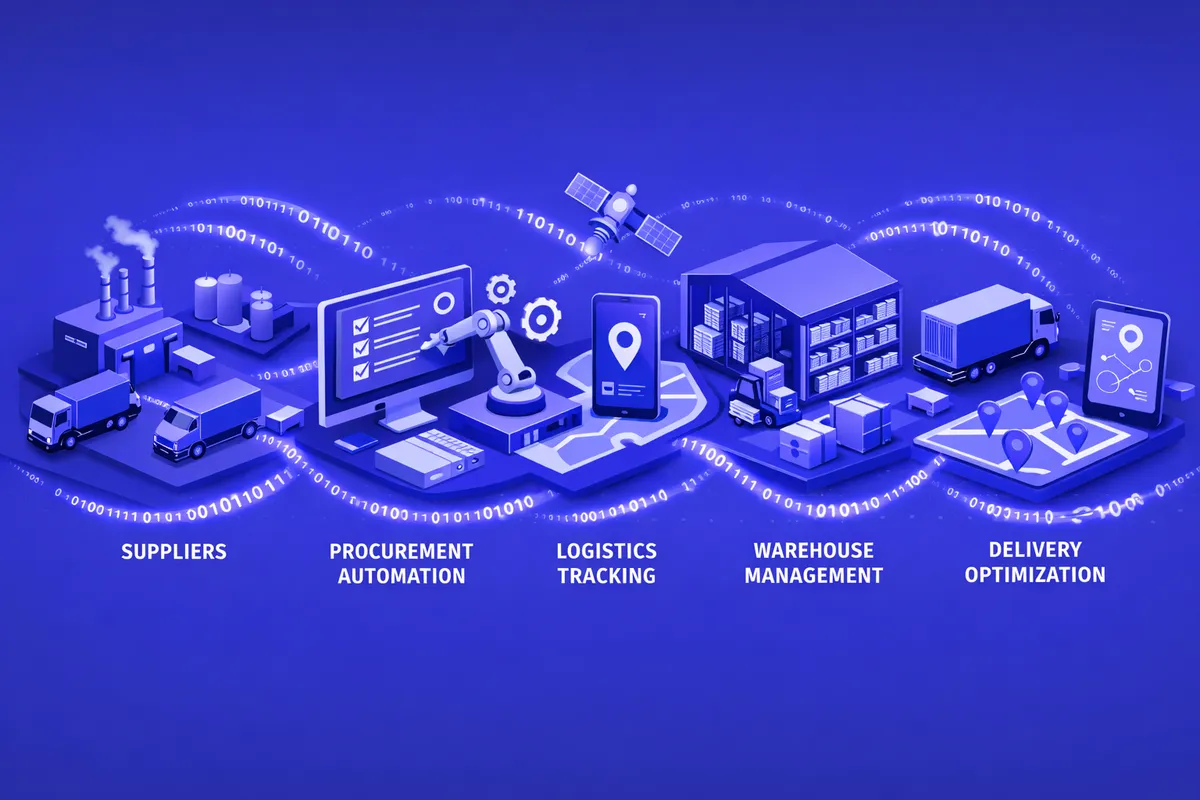
How We Build Supply Chain Automation for Schaumburg
Supply chain automation for Schaumburg's corporate campus and hospitality operations begins with process mapping at the enterprise scale. We document procurement workflows across facilities, departments, and procurement categories to understand where the bottlenecks are, which approval workflows create delay, and which vendor relationships carry the most financial and operational risk from inconsistent management.
For corporate campus operations along Golf Road and Meacham Road, the automation architecture typically addresses three distinct procurement layers. Facilities and maintenance procurement automation handles the vendor relationships for building services, mechanical maintenance, janitorial contracts, and capital maintenance projects across campus buildings. IT procurement automation manages the vendor relationships, purchase orders, asset tracking, and contract renewal management for technology hardware, software licenses, and managed services. Professional and event services procurement manages the vendor relationships for corporate events, travel, and professional services that occur on a project or event basis rather than a recurring schedule.
Schaumburg's hotel operations near the Convention Center require procurement automation that integrates with property management systems. Food and beverage purchasing automation connects inventory management to purchase order generation, triggering reorders based on par levels that adjust dynamically against the conference booking calendar. When a major event books three hundred room nights and a full-day meeting package at Woodfield Road, the food and beverage procurement system recalculates inventory requirements and adjusts purchasing schedules without requiring a purchasing manager to manually update every vendor order.
We integrate supply chain automation with the accounting and ERP systems that Schaumburg corporate operations already run. For most corporate campuses, this means integration with Oracle, SAP, NetSuite, or Microsoft Dynamics. For hotel operations, it means integration with the property management system and the accounting platform. The integration layer ensures that purchase orders, receiving records, and vendor invoices flow automatically through the accounting system without manual data entry.
Industries We Serve in Schaumburg
Technology companies and corporate offices along Golf Road and Meacham Road manage procurement across IT hardware and software, facilities services, professional development, and corporate events. Automated IT procurement tracks asset lifecycles, initiates replacement purchase orders based on warranty expiration and asset age, manages software license renewals against contract terms, and routes IT purchasing through the approval workflows that corporate governance requires. The IT team focuses on technology decisions; the procurement system handles the administrative cycle.
Hotels and convention properties along Woodfield Road and near the Schaumburg Convention Center manage procurement across food and beverage, housekeeping supplies, maintenance services, and event production materials. Conference calendar-integrated procurement automation adjusts par levels and ordering schedules against the booking calendar, ensuring that food and beverage inventory, housekeeping supplies, and event setup materials arrive on the schedules that the event calendar requires. The purchasing manager reviews an exception dashboard rather than recalculating every vendor order against every new booking.
Insurance and financial services firms with Schaumburg campus operations manage procurement for office supplies, printed materials, technology services, facilities management, and professional services across organizations where procurement compliance is part of the audit environment. Automated approval routing by dollar threshold and expense category, combined with complete purchase order documentation, ensures that procurement processes meet compliance requirements without requiring manual documentation at every step.
Retail and restaurant operations in and around Woodfield Mall manage procurement across wholesale purchasing, inventory management, and vendor relationships that serve both the high-traffic retail season and the slower months when buying decisions determine whether the high season is profitable. Automated reorder point management adjusts par levels against seasonal traffic patterns, generates purchase orders on schedules that account for vendor lead times, and reconciles received merchandise against purchase orders before invoices reach accounts payable.
Healthcare and medical office operators with Schaumburg locations along Higgins Road manage procurement for clinical supplies, medical equipment maintenance, facility services, and professional services across practices where supply disruptions directly affect patient care. Automated par-level management for clinical supplies triggers reorders before stockout conditions develop, and contract renewal tracking ensures that medical equipment maintenance agreements are reviewed before automatic renewal rather than after.
Professional services and consulting firms on the Schaumburg Road and Roselle Road corridors manage vendor relationships for technology, office operations, client entertainment, and professional development. Automated procurement workflows with budget-category tracking and approval routing provide the expense visibility that professional services firms need for project cost management without adding a procurement administration function to a staff that was hired for client work.
What to Expect Working With Us
1. Enterprise procurement mapping. We spend the first three weeks documenting procurement workflows, vendor relationships, and approval structures across your Schaumburg operation. For corporate campuses with multiple procurement categories and department-level purchasing authority, this mapping produces a clear inventory of where automation will deliver financial benefit, where compliance risk exists in current manual processes, and where vendor performance data is missing.
2. Multi-system integration architecture. Schaumburg corporate operations typically run established ERP or accounting systems. We design the automation layer against your existing systems environment, specifying the integration points between the supply chain automation platform and your accounting, property management, or ERP system before any build begins. This design phase prevents integration surprises during deployment.
3. Phased build by procurement category. We build and deploy automations by procurement category in order of financial impact and operational risk. For a corporate campus, that typically means facilities and maintenance procurement first because the dollar volume and contract complexity create the most risk in a manual environment. For hotel operations, food and beverage purchasing automation comes first because inventory management at convention scale is the highest-frequency operational pressure.
4. Vendor performance reporting and review cadence. Post-deployment, we configure vendor performance dashboards that give procurement managers the visibility to make data-driven vendor decisions. We establish a quarterly review cadence to assess which vendor relationships are performing to contract terms and where the performance data supports a renegotiation or competitive bid. Schaumburg corporate operations that document vendor performance systematically accumulate negotiating leverage that manual operations never develop.