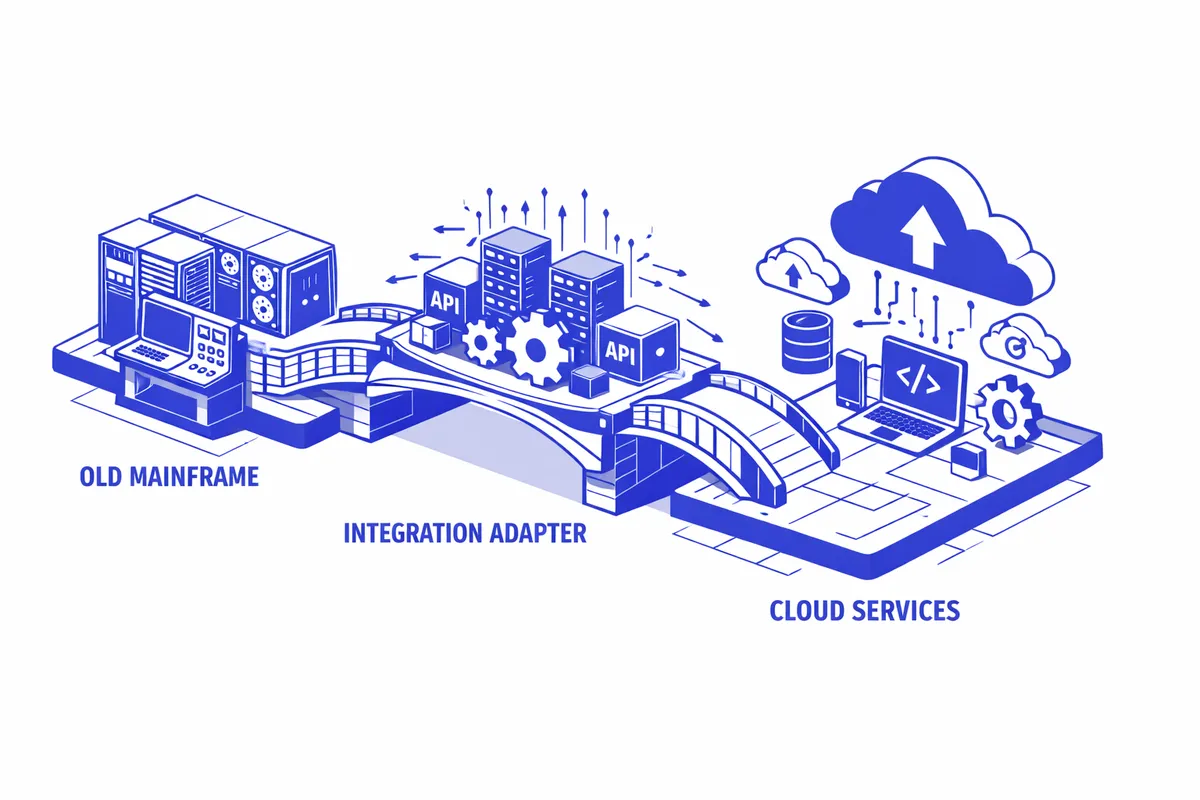
How We Build Legacy System Integration for Schaumburg
The first task is mapping what exists. Most Schaumburg companies operating on legacy platforms have several layers of the same problem: a core platform from an earlier era, middleware that was added to make the core platform do things it was not originally designed to do, and workarounds that accumulated when the middleware was not enough. We document all of it before we propose any integration architecture.
The integration layer we build depends on what the legacy system offers. Some older platforms expose documented APIs or data exports that can be consumed by a modern middleware layer. Others require database-level integration, where we read and write directly to the underlying database. Some require custom connectors that translate the legacy system's proprietary data formats into something modern platforms understand. We have worked with the system types common in Schaumburg's corporate sector, including insurance industry platforms, healthcare EMR systems, and enterprise financial systems, and we do not approach every engagement as if it is the first time we have seen a legacy database.
Integration architecture is designed for resilience, not just function. Data flows in regulated industries need audit logging, error handling, and retry logic. If a data transfer fails between your legacy claims system and your new analytics platform, the failure needs to be visible and recoverable, not silent and corrupting. We build those safeguards into every integration rather than treating them as optional additions.
Testing runs against production-like data volumes before any integration goes live. For Schaumburg's insurance and healthcare clients, we also conduct compliance reviews to confirm the integration architecture meets data handling requirements before the first byte of customer data flows through the new connection.
Industries We Serve in Schaumburg
Insurance agencies and carriers with legacy policy management systems along Golf Road use integration services to connect those systems to modern CRM platforms, claims analytics dashboards, and customer self-service portals. The policy management system stays in place; it just starts sharing data with the tools that improve agent productivity and customer experience.
Healthcare practices and specialty clinics serving the Roselle Road corridor use integration services to connect older EMR and practice management platforms to modern patient communication tools, billing systems, and care coordination platforms. Patients get a better experience because their clinical record reaches the right system. Providers get operational efficiency because staff stops manually transferring information between platforms.
Financial services firms and corporate treasury functions operating near Schaumburg Road use integration services to connect legacy financial systems to modern reporting platforms, payment processing infrastructure, and audit tools. Finance teams spend less time in spreadsheets and more time analyzing the numbers that matter.
Corporate headquarters and regional offices along Meacham Road that operate enterprise-grade systems from an earlier era use integration services to connect those systems to modern HR platforms, procurement tools, and employee self-service portals. The underlying ERP keeps running; it just starts feeding data to systems that employees actually prefer to use.
Hotels and convention-adjacent businesses near the Schaumburg Convention Center use integration services to connect property management or event booking platforms to modern revenue management tools, CRM systems, and guest communication platforms. When your occupancy data, billing system, and guest communication all talk to each other, the team running convention week operations is working from a single source of truth instead of three.
Retail and franchise operations with inventory systems that predate modern ecommerce platforms use integration services to connect their stock management systems to online storefronts, supply chain tools, and demand forecasting platforms. Inventory stays accurate across channels because the data source is the same, not duplicated and reconciled manually.
What to Expect Working With Us
1. System mapping and integration audit. We document every system in scope: what it does, what data it holds, how it currently communicates with other systems, and what integration capabilities it exposes. For Schaumburg's legacy-heavy clients, this audit often reveals hidden dependencies that would cause failures if not accounted for in the integration design.
2. Integration architecture design. We propose an integration layer that achieves your operational goals without disrupting systems that are still performing their core function. For regulated industries, we design the audit logging and error handling at this stage, not as an afterthought.
3. Build, test, and compliance review. Integration development is followed by testing against production-volume data, then a compliance review for clients in insurance, healthcare, or financial services. No integration goes live until it has been tested to failure and the failure modes have been confirmed to behave safely.
4. Deployment, monitoring, and documentation. Live deployment is managed with rollback capability. We monitor integration performance for the first 30 days and document the architecture and error-handling procedures so your internal team understands what is running and what to do if something needs attention.