How We Build Inventory Management for Schaumburg
For businesses serving the Schaumburg Convention Center corridor on Golf Road and Roselle Road, we build convention-calendar demand modeling into the reorder logic from the first configuration. The system ingests the convention center's event calendar and models demand uplift by event type, attendance size, and event duration. A trade show with 10,000 attendees over three days generates a different demand signal than a corporate conference with 500 attendees over two days, and the system learns those patterns from your historical sales data aligned against the event record. Reorder timing and par levels adjust automatically ahead of convention weekends so that inventory is positioned before the demand surge, not during it.
For corporate campus clients on Woodfield Road and Meacham Road, we build enterprise-grade inventory systems with cost-center-based purchasing workflows, approval hierarchies that match your procurement governance structure, and integration with enterprise ERP systems including SAP, Oracle, and Microsoft Dynamics. The system connects inventory requests to budget owners, generates audit-compliant purchase order records, and provides the category-level spend visibility that corporate finance requires. We build this at the scale and governance level that enterprise procurement demands, not at the SMB scale that consumer inventory software was designed for.
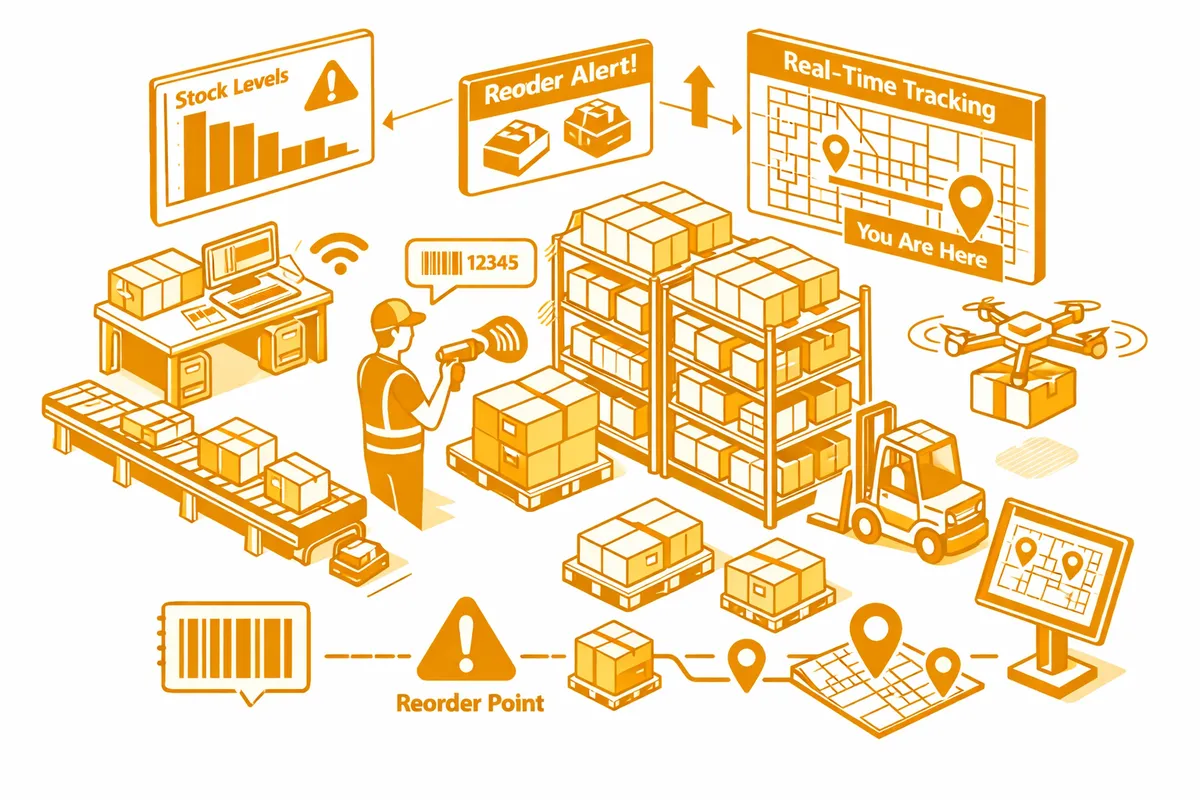
For retailers within the Woodfield Mall ecosystem, we build high-velocity retail inventory systems with SKU-level sell-through tracking, automatic replenishment order generation when items hit reorder points, and markdown recommendation logic based on inventory age, sell-through rate, and competitor pricing signals. The system integrates with your retail management platform and feeds floor performance data into buying decisions in real time rather than on a weekly reporting cycle.
For hospitality and hotel operations near the convention center, we build occupancy-driven supply inventory that connects housekeeping, food service, and event supply procurement to the property management system's room booking data and the convention center's event calendar. Supply reorders fire based on actual and projected occupancy, not on static par levels that ignore the Schaumburg market's week-to-week variance.
Mobile access is standard for Schaumburg businesses where managers are on the floor, on the lot, or between locations. Real-time inventory status and reorder approval workflows are available from any device.
Industries We Serve in Schaumburg
Restaurants, bars, and food service operations along Golf Road, Roselle Road, and the Schaumburg Convention Center corridor manage food and beverage inventory against the convention calendar's demand spikes and week-to-week variance. We build POS-integrated inventory systems with convention-calendar demand forecasting, perishable lifecycle tracking, FIFO enforcement, and beverage pour analysis tuned to the high-volume, high-variance Schaumburg food service environment.
Retail stores within and adjacent to the Woodfield Mall ecosystem manage high-SKU merchandise inventory with replenishment speed requirements that demand real-time sell-through data. We build retail inventory systems with SKU-level velocity tracking, automatic replenishment order generation, markdown recommendation logic, and multi-channel sync for any online sales channels, all integrated with the retail management platforms used by Woodfield Mall tenants.
Corporate campus offices and tech employers on Woodfield Road, Meacham Road, and Schaumburg Road manage office supply, IT hardware, and facilities inventory across multiple cost centers and budget owners. We build enterprise inventory systems with cost-center purchasing workflows, approval hierarchies, ERP integration, and category-level spend reporting that meets corporate finance and procurement governance requirements.
Hotels and hospitality businesses near the Schaumburg Convention Center manage linen, amenity, food service, and event supply inventory tied to room occupancy and convention bookings. We build property-management-integrated supply inventory systems with occupancy-driven reorder automation, event calendar demand modeling, and vendor management that keeps supply chains aligned with the Schaumburg hospitality market's volatility.
Insurance agencies and professional service firms serving Schaumburg's corporate and residential base along Higgins Road and Golf Road manage professional supply inventory with client renewal cycles and seasonal peaks. We build calendar-aware professional inventory systems with automated alerts, reorder workflows, and reporting that keeps agency principals focused on client relationships rather than supply logistics.
Healthcare offices and specialty medical practices serving Schaumburg's suburban residential population manage clinical supply inventory with expiration date sensitivity and lot tracking requirements that consumer software cannot handle. We build clinical inventory systems with compliance documentation, automated expiration alerts, controlled substance logging, and reorder automation calibrated to the supplier lead times and minimum order quantities specific to your Schaumburg practice.
What to Expect Working With Us
1. Discovery and requirements gathering. We begin with your Schaumburg operation's specific context: your customer base, your demand patterns relative to the convention center calendar or Woodfield Mall foot traffic, and the inventory categories that create the most operational friction. For corporate campus clients, this includes mapping procurement governance requirements and integration needs against your ERP or procurement platform. The discovery session produces a requirements document and a prioritized feature list specific to your Schaumburg business.
2. System design and platform selection. We design the inventory architecture appropriate to your scale, governance requirements, and channel mix. For enterprise corporate campus clients, this is a full custom or enterprise platform implementation with deep ERP integration. For restaurant and retail operators in the Schaumburg Convention Center corridor, this is typically a configured commercial platform with targeted customization for convention-calendar demand modeling. We give honest recommendations calibrated to your actual needs.
3. Build, integrate, and migrate. We implement the system, integrate with your POS, property management system, ERP, or accounting tools, and migrate historical inventory data. For Schaumburg businesses with multi-year convention calendar data, historical event-demand alignment informs the initial forecasting model and makes the system more accurate from the first convention weekend.
4. Launch support and optimization. We stay through the first full convention season or retail cycle to tune demand models, adjust replenishment logic, and address any gaps. For enterprise corporate clients, this includes integration validation against your procurement governance audit cycle. Ongoing maintenance retainers cover system evolution as your Schaumburg operation grows.