How We Build ERP Integration for Schaumburg
Schaumburg corporate engagements typically start with a wider discovery scope than smaller local businesses. Multiple departments, multiple system owners, and multiple data consumers mean the integration architecture must account for data governance: who owns each data record, who has permission to update it, what the source of truth is when systems disagree, and how conflicts are resolved.
We run structured discovery with each system owner and department, producing a comprehensive data flow map before designing any integration. For a Schaumburg technology company, this means sessions with finance, sales operations, HR, and IT to document the current state and the desired integrated state.
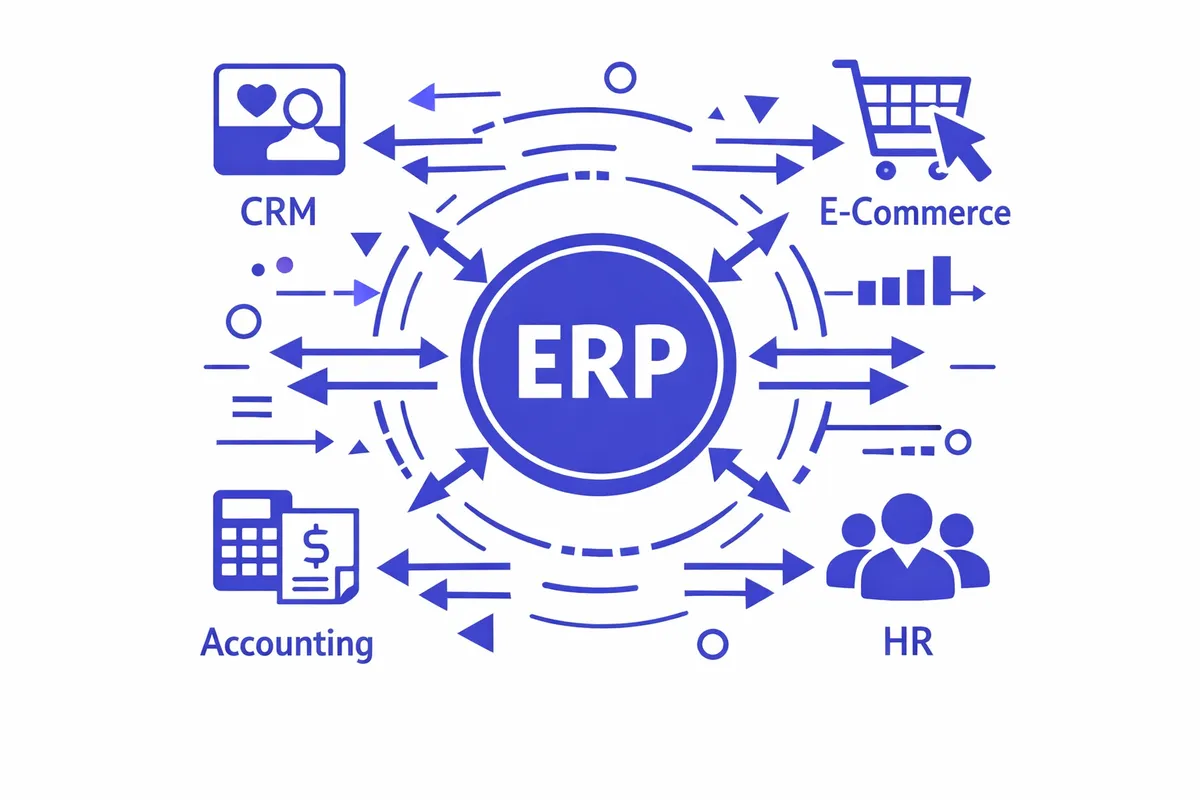
Integration architecture for corporate environments typically includes: an API middleware layer that handles authentication and rate limiting for each connected system, error handling and retry logic with alerting, data transformation services that translate between the different schemas each platform uses, and audit logging that tracks every data movement for compliance and debugging.
Implementation follows a phased roadmap. Phase one connects the highest-priority system pair and establishes the middleware infrastructure. Subsequent phases add connections to the same infrastructure, reducing the marginal cost and timeline of each additional integration. A Schaumburg company that has built a Salesforce-to-NetSuite connection on solid middleware infrastructure can add a Workday-to-NetSuite payroll sync in a fraction of the time the first integration required.
Industries We Serve in Schaumburg
Technology companies and software firms along Golf Road and Higgins Road run sales, finance, HR, and delivery in separate best-of-breed platforms that were not designed to share data. We build the integration layer that connects Salesforce or HubSpot to NetSuite or Dynamics, moves HR data to the financial system, and provides the unified data view that management needs for operational decisions.
Healthcare administration and insurance companies near the Schaumburg Convention Center manage claims, policy, billing, and business operations in platforms built for each specific function. We connect claims platforms to accounting, policy management to CRM, and billing systems to the financial reporting infrastructure.
Retail and franchise operations near Woodfield Mall with multiple locations running POS, inventory, ecommerce, and accounting in separate systems need integration that consolidates sales and inventory data across channels into a single operational view. We build multi-location retail integrations connecting POS to inventory to ecommerce to accounting.
Corporate services firms operating from Schaumburg campuses that have grown through acquisition often have multiple legacy systems that predate their current ERP. We build the connectors that bring acquired entity data into the parent ERP without requiring full system replacement.
Manufacturing-adjacent and distribution companies on Meacham Road running supply chain and warehouse platforms alongside accounting and CRM need the connections that move order data from CRM to warehouse, warehouse fulfillment data to accounting, and purchasing data from supply chain to the financial system.
Professional services and consulting firms with Schaumburg offices that bill clients on project-based engagements often run professional services automation tools alongside accounting platforms with no native integration. We connect project management, time tracking, and billing data to the core financial system.
What to Expect Working With Us
1. Multi-department discovery. For Schaumburg corporate engagements, discovery involves structured sessions with each system owner and department. We document current data flows, manual processes, and the governance questions that must be answered before integration design begins.
2. Architecture and governance design. We produce an integration architecture document that covers connection design, data ownership and source-of-truth decisions, error handling, monitoring, and the governance model for ongoing operation. Corporate IT teams review and approve before development begins.
3. Phased implementation. We build phase one, establishing the middleware infrastructure and the highest-priority connection, then deliver subsequent connections on the same infrastructure. Each phase delivers measurable reduction in manual work.
4. Enterprise monitoring and support. Corporate integrations include comprehensive monitoring dashboards, alerting, and audit logging. We provide SLA-backed support options appropriate for business-critical integrations.