How We Build Customer Portals for Schaumburg
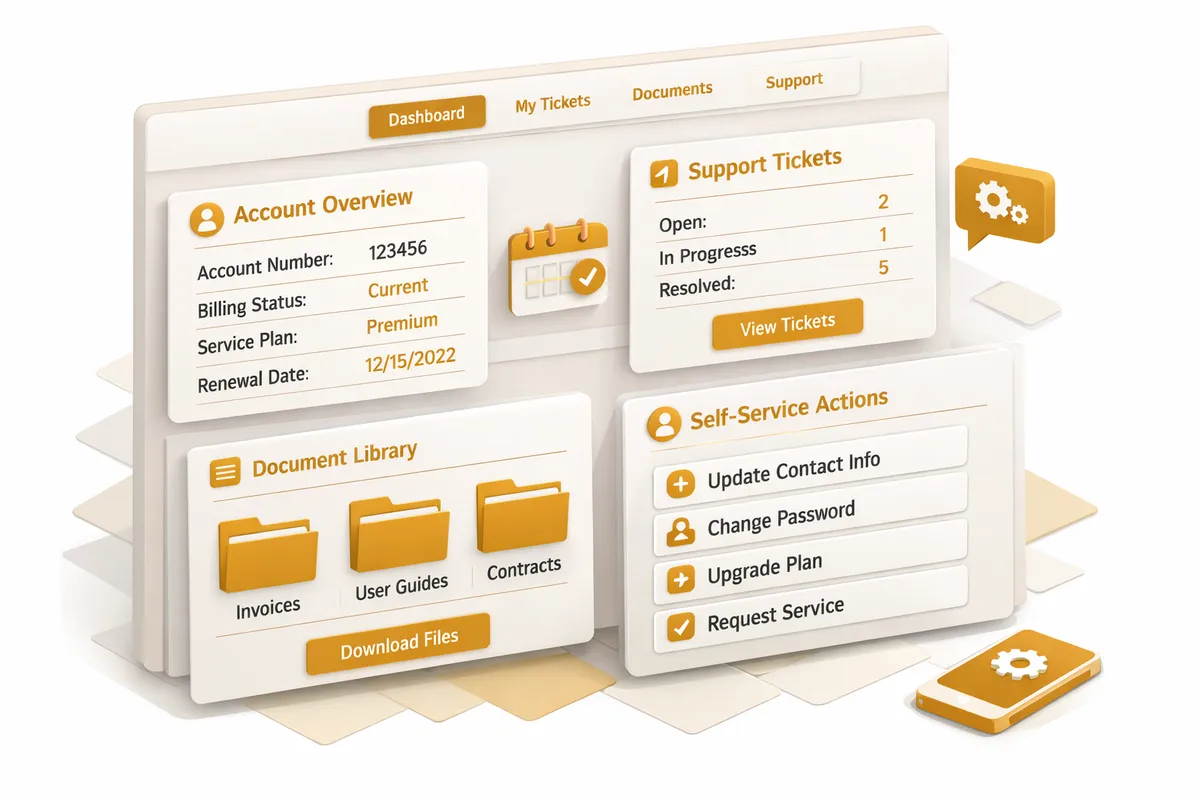
Every portal engagement starts with a workflow audit. We spend time at your office, whether that is a suite in one of the Schaumburg office parks off Meacham Road or a clinic on Roselle Road, understanding how your team currently communicates with clients: what questions come in repeatedly, what documents get sent manually, what actions clients request through channels that require staff intervention. That audit determines the portal's feature set before we write a single line of code.
We build on a secure, role-based architecture so different client tiers see different data. An enterprise account at a Schaumburg tech firm sees their full usage dashboard, billing history, and support tickets. A smaller client on a starter plan sees a trimmed view appropriate to their relationship. Permissions are configurable, so the portal grows with your client relationships without requiring a rebuild.
Integration with your existing systems is built into the process, not bolted on afterward. If you use a CRM, billing platform, ERP, or project management tool, the portal connects to those sources so clients see live data rather than manually updated snapshots. This matters especially for Schaumburg's professional services firms, where billing accuracy and document access are not optional features but legal and operational requirements.
Launch includes staff training and a client onboarding flow that reduces friction for the people actually using the portal from day one. Most Schaumburg clients see measurable reductions in inbound email and phone volume within the first 30 days.
Industries We Serve in Schaumburg
Insurance agencies and financial services firms along Golf Road use customer portals to give policyholders and financial advisory clients direct access to their accounts, documents, and renewal timelines. Clients check coverage details, download certificates of insurance, and submit service requests without calling the office, which frees agents to focus on sales and complex claims rather than administrative lookups.
Technology companies and software firms near Woodfield Road deploy portals as the primary interface for client account management. Product usage dashboards, license tracking, support ticket submissions, and contract renewal workflows all live in the portal. For Schaumburg tech employers with distributed client bases, this creates a professional, branded experience that reinforces their market positioning.
Healthcare offices and specialty clinics serving patients from Roselle Road and surrounding areas use portals to manage intake forms, appointment history, referral coordination, and billing statements. HIPAA-compliant architecture is standard in our healthcare portal builds, and patients appreciate access to their records and care summaries without calling the front desk.
Professional services firms including law offices, accounting firms, and consulting practices based in Schaumburg's commercial corridors use portals for secure document exchange, project status visibility, and invoice management. Clients upload supporting materials, download deliverables, and approve work without routing everything through email with its associated security and version-control risks.
Hotels and corporate hospitality venues near the Schaumburg Convention Center use portals for corporate account management, allowing repeat clients to access booking histories, manage preferences, and coordinate group accommodations for conference season without requiring manual handling from the reservations team.
Retail brands and franchise operations with headquarters or regional offices near Woodfield Mall use portals for vendor management, franchisee communications, and wholesale client accounts. These portals centralize ordering, compliance documentation, and performance reporting for the operational teams managing multiple locations.
What to Expect Working With Us
1. Workflow and integration mapping. Before any design work begins, we document every client touchpoint your team currently manages manually. For a Schaumburg insurance agency, that might be 15 distinct interaction types. For a tech firm, it might be 30. We prioritize which ones belong in the portal's first release based on frequency and staff time saved.
2. Architecture and role design. We configure the portal's permission layers, data connections, and branding to match your client tiers and brand standards. Schaumburg's corporate clients expect polished, professional interfaces. The portal should look like it belongs to your company, not like an off-the-shelf tool with your logo dropped in.
3. Integration build and testing. We connect the portal to your existing business systems and test each data flow against real scenarios. This phase accounts for the integration complexity common among Schaumburg's enterprise-facing firms: billing systems, CRMs, ERP platforms, and industry-specific software all need stable connections before launch.
4. Launch, training, and performance review. We train your team, build the client onboarding sequence, and monitor portal activity for the first 60 days. Monthly reporting covers which features clients use most, where they drop off, and what additions would further reduce your team's manual workload.