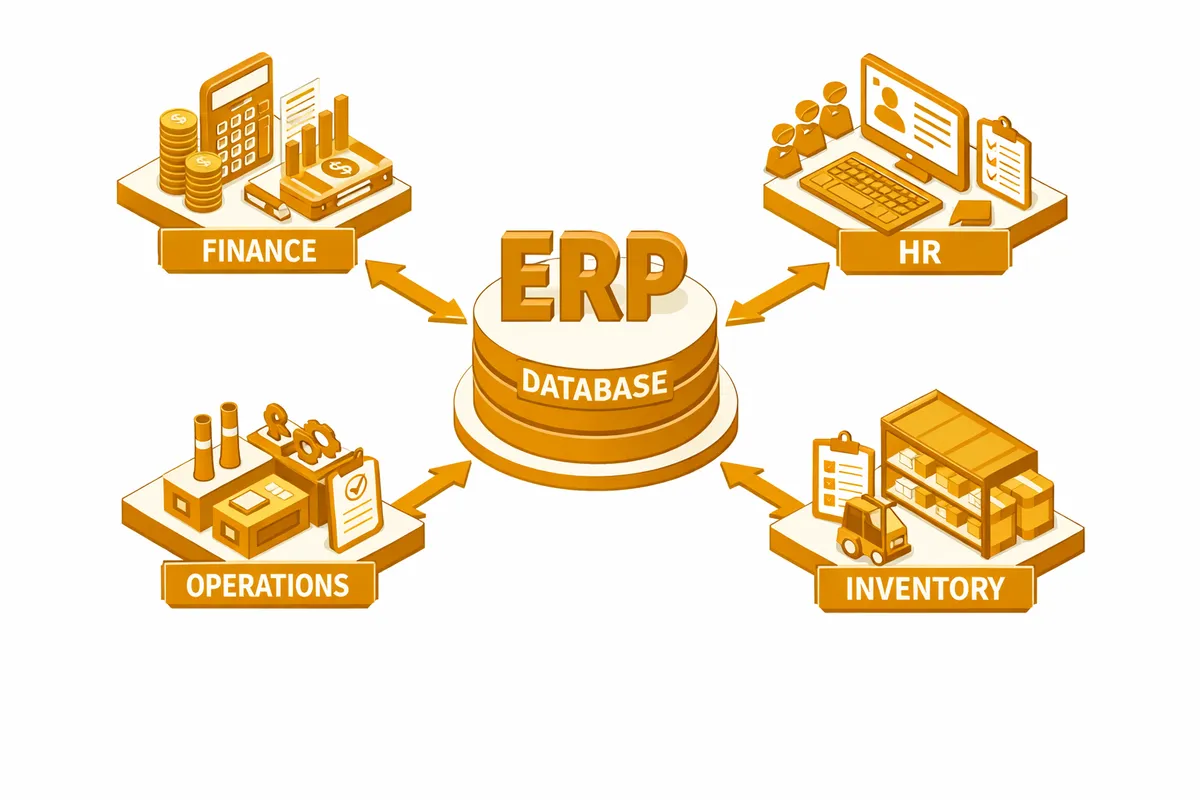
How We Build Custom ERP for Schaumburg
Schaumburg engagements begin with two to three weeks of structured discovery across your leadership, operations, finance, and technology teams. For a Schaumburg professional services firm, this means mapping every project delivery workflow, every billing cycle, every HR and capacity planning process, and every reporting request that currently requires manual assembly. For a multi-location retailer, it means understanding how purchasing, receiving, inventory allocation, loss prevention, and financial consolidation work across locations and what the current data fragmentation costs in analyst time and operational risk.
From discovery we design a module architecture and data model built around your specific operation. A Schaumburg technology services firm ERP typically includes a project management module with resource allocation and utilization tracking, a time and billing module with approval workflows and rate card management, a financial module with profitability by client and project, and a client relationship module with health scoring. A multi-location retailer ERP includes a merchandise planning module, a purchase order management module, a multi-location inventory module with inter-store transfers, and a financial consolidation module that produces the reporting the corporate team needs.
We implement in phases, with the highest-impact module live within fourteen to twenty weeks. For Schaumburg businesses where a single operational area, such as project profitability reporting or inventory consolidation, is causing the most pain, that area gets the first phase. Subsequent phases add capability on an operational foundation that is already working.
Industries We Serve in Schaumburg
Technology services firms and consulting companies operating from the Schaumburg corporate campus area near Golf Road and Higgins Road need ERP that connects project management, resource allocation, time tracking, and client billing into a single platform with real-time profitability visibility. We build these systems around the specific engagement models and billing structures used in each firm.
Multi-location specialty retailers with stores in the Woodfield Mall area and additional locations across the northwest suburbs need ERP connecting merchandise planning, purchase order management, multi-location inventory, and financial consolidation. We build systems that give store managers location-level operations tools and corporate buyers chain-level visibility simultaneously.
Insurance carriers and financial services firms near the Schaumburg Convention Center managing policy administration, claims, agent relationships, and compliance reporting need ERP that handles the specific workflow and regulatory requirements of their business rather than a generic professional services platform. We build custom policy and claims administration modules that fit the actual business processes.
Healthcare groups and medical practice networks operating multiple Schaumburg and northwest suburban locations need ERP for consolidated operations: scheduling capacity across locations, billing and AR management, credentialing and compliance, and referral relationship management. We build systems that connect individual practice operations to group-level management reporting.
Regional distributors and manufacturers with warehouse and distribution operations near Schaumburg Road and Meacham Road need ERP connecting purchasing, warehousing, order management, and financial reporting. We build these with mobile interfaces for warehouse operations and web interfaces for management reporting and customer portal access.
Corporate real estate and property management firms managing commercial properties across the northwest suburbs need ERP for lease administration, tenant billing, maintenance management, and property-level financial reporting. We build systems designed around commercial property management workflows rather than adapting residential property software.
What to Expect Working With Us
1. Structured discovery. Two to three weeks of workshops and interviews with your operations, finance, and leadership teams. For Schaumburg businesses with multiple departments or locations, discovery includes all operational layers, not just the executive perspective.
2. System architecture and phased plan. A module design, data model, and phased implementation plan reviewed and approved before development starts. You see exactly what the system will include and when each phase delivers.
3. Phased implementation. Highest-impact modules live within fourteen to twenty weeks. The phased structure ensures your team is working with valuable software throughout the engagement rather than waiting for a full system.
4. Post-launch validation and support. Operational validation period after each phase launch, warranty coverage for fixes, and maintenance retainer options for additions and enhancements as the business evolves.