How We Build Chatbots for Schaumburg
Custom chatbot development starts with an inquiry audit. We analyze your current customer communication: the questions that come in by email, by phone, and through whatever chat tool is already in place. We categorize those by topic, frequency, and resolution complexity. For a Schaumburg insurance agency, that analysis typically reveals that 60 to 70 percent of inbound calls are about policy status, billing questions, and documentation requests that the chatbot can answer or route accurately. For a healthcare practice, it reveals appointment scheduling and insurance questions as the dominant categories.
That inquiry map becomes the training data structure for the chatbot. We build conversation flows for the highest-frequency categories first, then add coverage for secondary topics in subsequent phases. Each flow is written to match your brand voice: the tone a professional services firm on Roselle Road uses with corporate clients is calibrated differently than the tone a restaurant near Woodfield Mall uses with dinner guests.
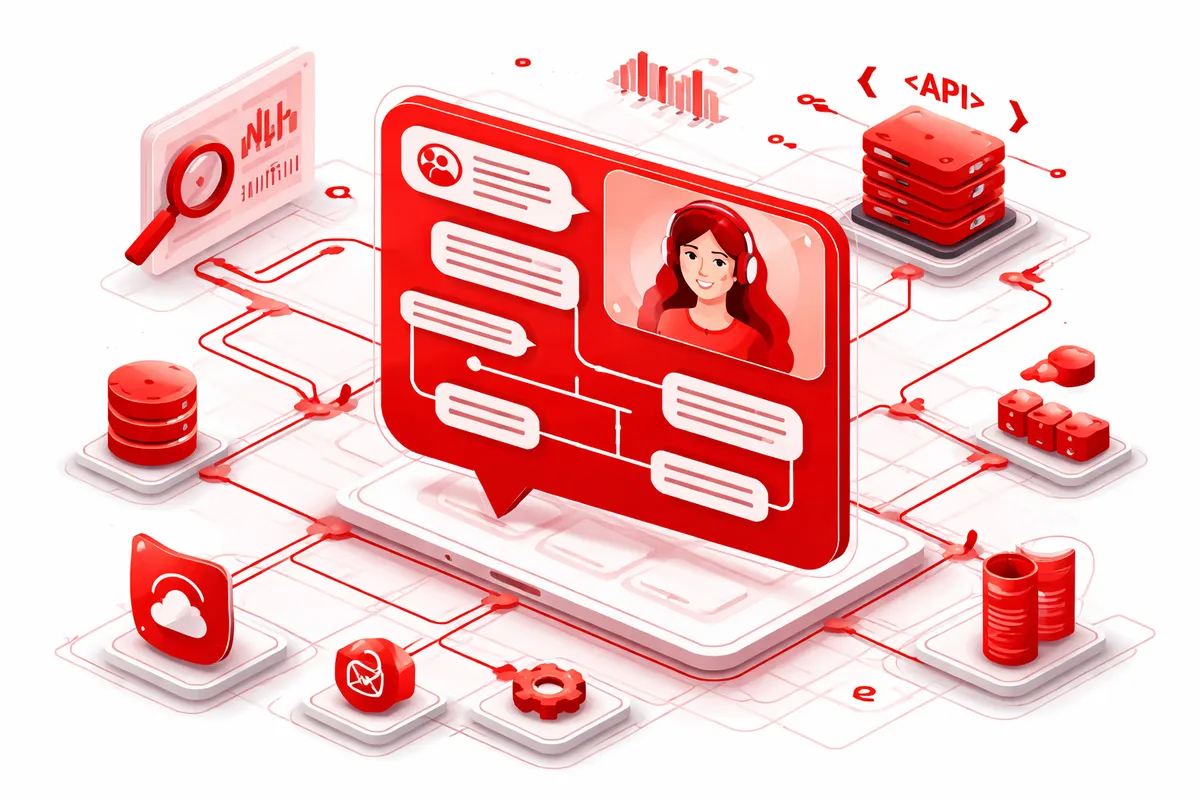
Integration is as important as the conversation layer. A chatbot that can answer questions is useful. A chatbot that can check appointment availability in your scheduling system, pull order status from your commerce platform, or verify insurance eligibility through your practice management software is transformative. We build those integrations to the depth your business requires, because a chatbot that forces a customer to call anyway after the conversation is a failed experience.
Training the AI on your actual business knowledge involves feeding the system your product documentation, FAQs, policy documents, and historical conversation data. This is what separates a Schaumburg-specific chatbot from a generic template: the system knows your specific procedures, your specific products, and the specific questions your specific customers ask.
Industries We Serve in Schaumburg
Corporate technology and software companies along Golf Road deploy chatbots as the front door of their sales funnel. The chatbot handles initial prospect qualification, routes enterprise inquiries to the appropriate sales team member, answers product and pricing questions for early-stage buyers, and schedules demos without requiring a rep to be available. For companies selling to corporate buyers across multiple time zones, the after-hours chatbot coverage converts inquiries that would otherwise go cold overnight.
Insurance agencies near Meacham Road use chatbots primarily for existing client service: policy questions, billing inquiries, documentation requests, and claims status updates. The chatbot resolves the high-volume, low-complexity service requests that currently consume agent time, leaving producers free to focus on new business development and complex client situations. A Meacham Road agency that answers billing questions by chatbot instead of inbound call gains hours of producer time each week.
Healthcare offices and medical practices in the Schaumburg corridor build chatbots around the new patient acquisition and scheduling workflow. A practice on Higgins Road gets inquiries from patients who searched for a specific specialist, found the practice website, and want to confirm insurance acceptance and book an initial appointment in a single conversation. A chatbot that completes all three steps converts that inquiry without requiring front desk involvement.
At the Spring Valley Nature Center and other recreational destinations near Schaumburg, visitor-facing chatbots answer questions about hours, events, programming, and directions that currently consume staff time on repetitive phone calls. Visitor services chatbots free staff for the in-person interactions that require human judgment.
Hotels and conference properties near the Schaumburg Convention Center build chatbots that handle the pre-arrival, in-stay, and post-stay communication workflows that generate high volumes of routine interaction. Guests get immediate responses to amenity questions, room service menus, checkout times, and local restaurant recommendations without waiting for the front desk to be available.
Retail businesses and restaurants in the Woodfield Road corridor use chatbots to handle high-volume consumer questions about products, inventory, promotions, and reservations. For restaurants, the chatbot manages reservation requests, waitlist notifications, and dietary accommodation questions. For retail, it answers availability questions and captures lead information for out-of-stock items.
What to Expect Working With Us
1. Inquiry audit and scope definition. We analyze your current customer communication to build a clear picture of the questions your chatbot needs to answer and the integrations it needs to support. For Schaumburg clients, this phase produces a prioritized topic map that determines the first-phase build scope and the phasing of subsequent feature additions.
2. Conversation design and brand voice calibration. We write the conversation architecture: the flow logic, the response copy, the escalation triggers, and the tone guidelines. For Schaumburg's corporate and professional services clients, tone calibration is a deliberate process of establishing the right balance between efficiency and warmth. We test copy against your team before any AI training begins.
3. AI training and integration build. We train the AI on your specific business knowledge and build the integrations with your scheduling, CRM, or service platforms. Training is an iterative process: we review conversations from early testing phases, identify gaps and inaccuracies, and refine the AI's responses before launch. Integration testing validates that the chatbot's access to live data, appointment availability, and account information is accurate and reliable.
4. Launch, monitoring, and optimization. Post-launch, we monitor conversation quality through regular transcript review, tracking resolution rates, escalation frequency, and user abandonment patterns. Most chatbots improve significantly in their first 90 days as real conversation data reveals topics and phrasings the initial training did not anticipate. We provide monthly performance reports and quarterly scope expansion reviews.