How We Build Booking Systems for Schaumburg
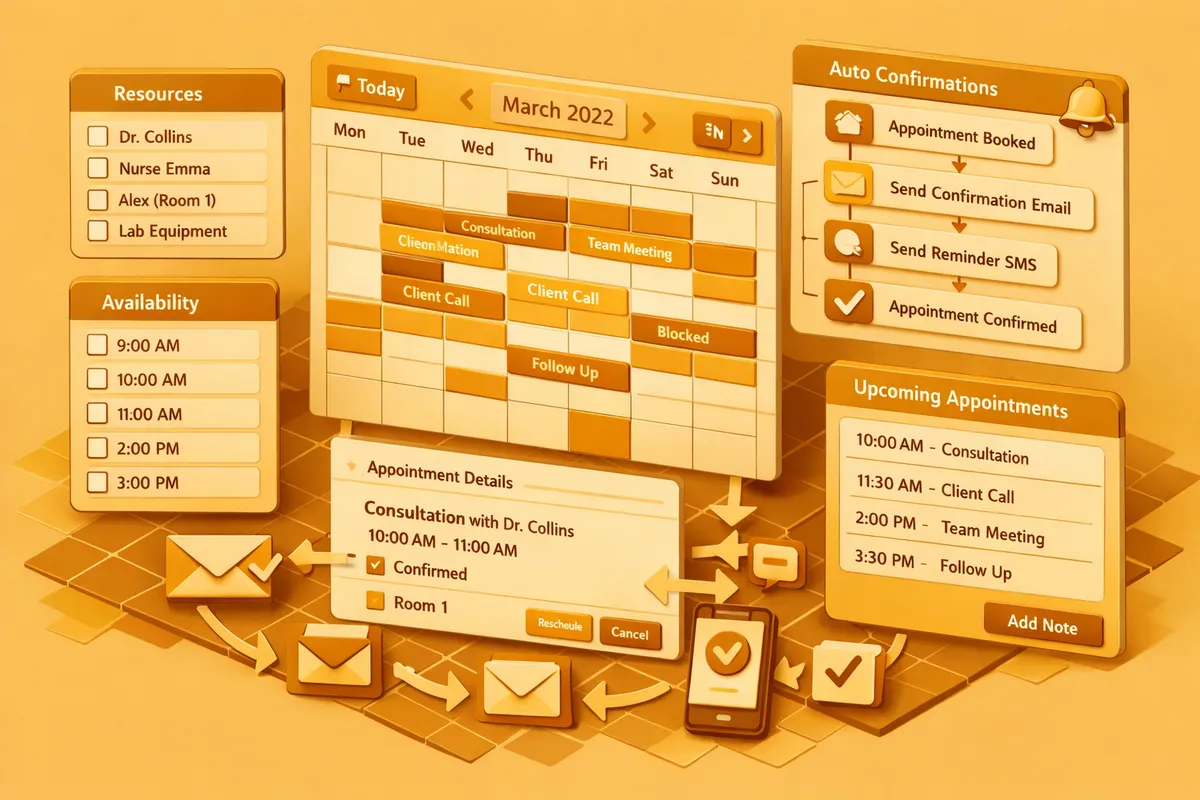
The starting point is an honest conversation about what your scheduling problem actually is. Surface-level problems, like not having an online booking page, are straightforward to address. The harder problems, like managing shared resource availability across three providers and two locations, or handling the conditional logic that controls which appointment types are available based on patient status or appointment history, require system design that goes beyond any standard scheduling tool's configuration options.
We map your scheduling logic in full before selecting or building technology: which resources get scheduled, what the booking rules are for each appointment type, how conflicts are detected and prevented, what integrations with clinical, financial, or CRM systems are required, and what the confirmation and reminder workflow looks like. For a Schaumburg medical practice, that mapping often reveals that the scheduling workflow has 15 distinct conditional rules that the practice's current tool is handling through staff workarounds rather than system logic.
Build options depend on complexity and budget. For organizations with standard scheduling needs, we configure and extend existing platforms to handle the specific logic your business requires. For organizations with complex multi-resource, multi-location, or integration-heavy requirements, we build custom scheduling infrastructure that handles your exact workflow rather than approximating it. Schaumburg's healthcare and hospitality sectors typically fall in the latter category.
Industries We Serve in Schaumburg
Healthcare offices and medical practices on Higgins Road and throughout the Schaumburg corridor use custom scheduling systems to handle multi-provider availability, patient type restrictions (new vs. existing), appointment category logic, and integration with EMR systems and insurance eligibility verification. The scheduling system is often the patient's first interaction with the practice; it sets expectations for every subsequent interaction.
Hotels and conference facilities near the Schaumburg Convention Center manage the most complex scheduling environments in the market: room inventory management, group block coordination, event space booking with setup and teardown time buffering, catering and A/V resource scheduling, and the proposal workflow that converts a group inquiry into a signed contract. Custom booking infrastructure designed for convention-adjacent properties handles all of those dimensions in a single integrated system.
Professional services and consulting firms on Roselle Road book time at the level of individual consultant calendars and aggregate firm capacity. A 20-person consulting firm needs scheduling infrastructure that reflects real availability across its team, prevents double-booking, and integrates with CRM to connect scheduling activity to the client relationship record. Standard consumer scheduling tools are not designed for this use case.
Corporate training and workshop providers serving Schaumburg's business corridor need scheduling systems that handle cohort enrollment, room or virtual session capacity, prerequisite logic, waitlist management, and confirmation workflows across populations of 20 to 200 participants. The logistics of corporate training scheduling are consistently underestimated until the organization tries to manage them manually at scale.
Specialty retail and service businesses near Woodfield Mall, including hair salons, spas, auto service centers, and fitness studios, use scheduling systems to manage staff calendars, service time estimates, and the client preference data that makes repeat booking faster. Online booking that shows real-time availability and completes in under 60 seconds converts at dramatically higher rates than booking workflows that require a phone call or a multi-step form.
Insurance and financial services firms along Meacham Road schedule client review meetings, prospect consultations, and team coordination across producers and support staff. For an insurance agency with 15 producers and a shared client services team, scheduling infrastructure that reflects everyone's real availability and routes booking requests to the appropriate team member reduces the coordination overhead that currently consumes significant administrative time.
What to Expect Working With Us
1. Scheduling logic documentation. We spend time with your team mapping every rule, exception, and integration requirement in your scheduling workflow before touching any technology. This is the phase where Schaumburg clients most often discover that their scheduling problem is more complex than they initially described, and where we identify the requirements that will determine the right build approach.
2. System design and platform selection. Based on the documented logic, we design the system architecture and select or build the appropriate platform. We provide a clear recommendation with rationale: when a configured platform is the right answer and when a custom build is justified by your specific requirements. For Schaumburg's healthcare and hospitality clients, custom builds are more common than in other industries.
3. Build and integration. We build the scheduling system, connect it to your existing platforms, and test every workflow branch against your documented rules. For healthcare clients, testing includes specific validation of availability logic and confirmation that the system handles edge cases, like provider illness or emergency availability changes, without manual intervention at each affected appointment.
4. Launch and adoption support. We document the system for your staff, deliver training on administrative functions, and monitor performance in the first 30 days. Scheduling systems generate adoption data quickly: if booking completion rates are lower than expected or if staff are creating workarounds, we identify the root cause and adjust the system before the workaround becomes entrenched behavior.