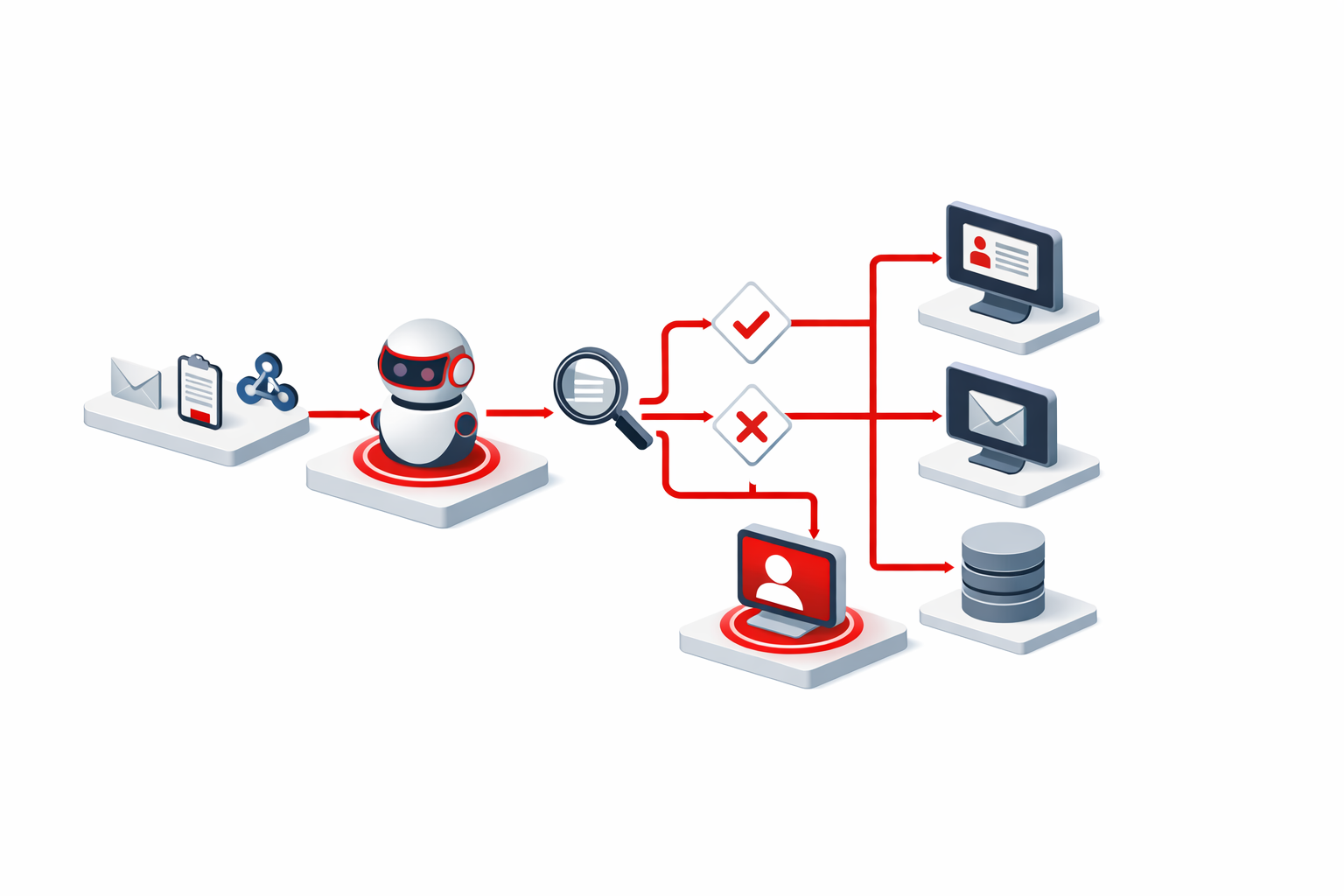
How We Build Autonomous Workflow Agents for Schaumburg
We begin with a process inventory targeted at the workflows that consume the most human time relative to the judgment they actually require. For Schaumburg corporate clients, that inventory often surfaces a cluster of high-volume, low-complexity workflows in finance, HR, compliance, and procurement that together account for a significant fraction of total administrative labor cost. We document each workflow in detail: inputs, decision points, outputs, exception conditions, and the systems it touches.
From that inventory, we prioritize the agent build sequence based on labor cost reduction potential, error rate reduction, and cycle time improvement. For a Schaumburg insurance firm processing high volumes of routine claims documentation, a document routing and classification agent typically ranks near the top: the volume is large, the error cost is high, and the logic is well-defined enough for an agent to execute reliably.
Agent architecture for Schaumburg clients typically involves a combination of structured workflow logic for the predictable steps, AI reasoning for the steps that require variable input interpretation, and a clear exception routing system that delivers genuinely complex cases to the appropriate human with full context. We do not build agents that handle everything until they cannot; we build agents that handle what they are designed for and route the rest efficiently.
Integration with the enterprise systems that Schaumburg organizations already run, including Salesforce, SAP, NetSuite, Microsoft 365, and industry-specific platforms in insurance and healthcare, is built into the design phase rather than treated as a separate project.
Industries We Serve in Schaumburg
Corporate technology and software companies along Golf Road deploy autonomous agents in sales operations (quote-to-contract workflows, renewal processing), finance (invoice matching and approval routing), and IT (access provisioning, ticket categorization, system monitoring alerts). The agent layer handles the workflow overhead that grows as the organization scales but does not require proportionally more senior judgment as it grows.
Insurance agencies near Roselle Road operate in a workflow environment where documentation accuracy directly affects regulatory compliance. Autonomous agents handle certificate of insurance issuance, policy renewal notifications, claims documentation assembly, and the routing logic that ensures every document reaches the right reviewer with the right context. Agents that enforce documentation standards consistently eliminate the human error variability that creates compliance exposure.
Healthcare service providers in the Schaumburg corridor use autonomous agents for scheduling coordination, insurance verification, prior authorization tracking, and billing documentation. These are workflows where errors have direct financial and clinical consequences, making the consistency and completeness of agent execution more valuable than the speed gains alone.
At the Schaumburg Convention Center, event management organizations use autonomous agents to handle registration processing, exhibitor communications, session scheduling, and post-event billing workflows. The volume of routine communication and documentation in a large event program is significant; agents handle the mechanical portions while event staff focus on relationship management and problem-solving.
Professional services firms on Schaumburg Road use agents to automate project status reporting, client communication cadences, utilization tracking, and document management workflows that accumulate across a portfolio of concurrent client engagements. The agent handles the administrative layer of client delivery so consultants can focus on the client-facing work.
Retail and hospitality organizations near Woodfield Mall use autonomous agents for inventory reorder workflows, vendor communication, scheduling, and the reporting processes that keep operations running without manual coordination overhead. An agent that monitors inventory thresholds and triggers reorder workflows without a manager's intervention ensures stock levels are maintained without the attention cost of manual monitoring.
What to Expect Working With Us
1. Process inventory and prioritization. We document your highest-volume administrative workflows and rank them by automation opportunity: labor cost, error rate, cycle time, and strategic impact. For Schaumburg corporate clients, this phase consistently surfaces automation candidates that were not on the initial list, because the workflows that have been normalized as "just how we do things" are often the ones with the most efficiency to recover.
2. Agent architecture and integration design. We design the agent logic, decision tree, exception handling, and system integration architecture before any code is written. For workflows that touch regulated data, we build the compliance controls into the architecture at this stage. Integration design accounts for your specific technology stack, whether that is Microsoft 365, Salesforce, or industry-specific platforms common in Schaumburg's insurance and healthcare sectors.
3. Build, testing, and parallel operation. Agents are built in a test environment and validated against real workflow data before going live. We run agents in parallel with the existing manual process during an initial period, comparing outputs and catching edge cases before the manual process is retired. This approach ensures zero disruption to operations during the transition.
4. Live operation, monitoring, and expansion. Once an agent is live, we monitor performance metrics: throughput, exception rate, processing time, and accuracy on key output fields. We report on those metrics monthly and use them to guide refinement. Most Schaumburg clients expand scope to additional workflows within six months of their first successful agent deployment.