How We Build AI Strategy for Schaumburg
The strategy engagement starts with an operational inventory. We map the workflows, decision points, and information flows across your organization to identify where AI creates legitimate value versus where it is being considered because AI is topical rather than because it solves a real problem. For a Schaumburg corporate client, that often means looking at sales operations on Golf Road, underwriting processes for insurance firms on Meacham Road, and service delivery workflows that generate repeatable manual work at significant scale.
From the inventory, we produce a use case matrix: every identified AI opportunity ranked by expected value, implementation complexity, and strategic fit. Value is estimated in concrete terms, reduced labor hours, improved conversion rates, faster cycle times, reduced error rates. Complexity accounts for data readiness, integration requirements, and change management demands. Strategic fit reflects your organization's priorities and risk posture. That matrix becomes the foundation of your roadmap.
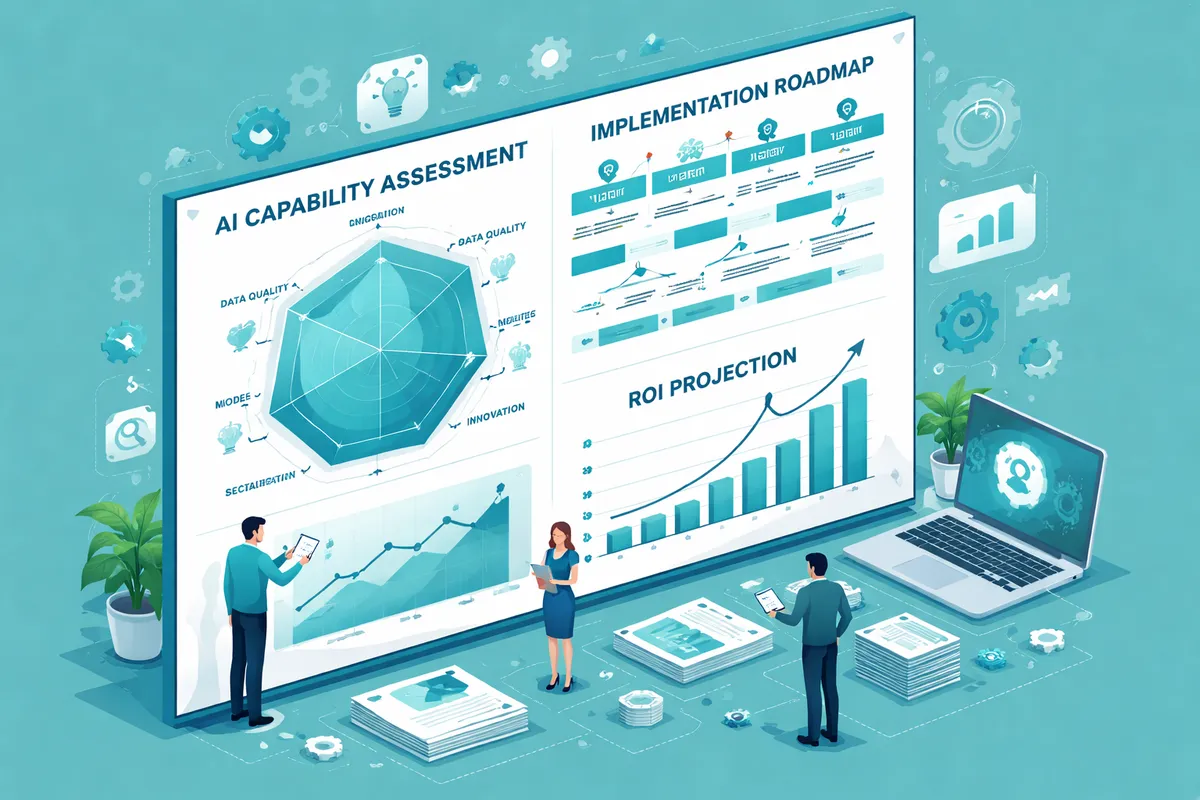
The roadmap itself is sequenced to build capability progressively. Early projects are chosen for high visibility and manageable complexity: they produce results that justify continued investment and build organizational confidence in AI execution. Later phases tackle the higher-complexity, higher-value transformations that require the data infrastructure and internal expertise the early projects have established. We also build the governance framework, data policies, vendor evaluation criteria, and risk management procedures that keep the program coherent across multiple years of investment.
For Schaumburg's corporate organizations, the governance layer often requires more detail than clients initially expect. Large employers along Golf Road and Meacham Road manage data across dozens of departments, and the question of which teams can use which AI tools on which data sets involves legal, IT, and operational stakeholders who may have never been in the same room to discuss it. We facilitate those alignment sessions and produce governance documentation that is specific enough to be actionable rather than a set of principles that every department interprets differently when implementation begins.
Industries We Serve in Schaumburg
Corporate headquarters and enterprise services firms along Golf Road use AI strategy consulting to align technology investments with business outcomes across functions: sales, operations, marketing, and service delivery. A corporate headquarters managing multiple business units needs a cross-functional AI strategy that prevents redundant vendor procurement, ensures shared data infrastructure, and coordinates the change management that makes adoption stick.
Insurance agencies and risk services firms near Meacham Road approach AI strategy through a compliance-first lens. Actuarial modeling, claims processing automation, fraud detection, and customer service AI all present regulatory considerations specific to Illinois insurance law and federal guidelines. AI strategy in this sector maps the compliance landscape before it maps the capability roadmap.
Professional services consultancies on Schaumburg Road use AI strategy to build internal capability that they can eventually extend to clients. A consultancy that develops a genuine AI competency becomes a more valuable partner to its clients. The strategy engagement addresses both the internal capability build and the service line development opportunity.
Healthcare service providers serving the corridor between Schaumburg and Hoffman Estates face HIPAA requirements that constrain AI data usage in specific ways. AI strategy for healthcare organizations starts with a data governance architecture that ensures patient data is handled appropriately throughout the AI pipeline, not just at the point of storage.
Technology firms and software companies along Higgins Road use AI strategy consulting to evaluate build-versus-buy decisions on AI capability, prioritize feature investments that differentiate their products, and structure internal operations to take advantage of AI tools without creating technical debt that limits future flexibility.
Hotels and conference facilities near the Schaumburg Convention Center approach AI strategy from a revenue optimization and operations angle: dynamic pricing models, group business forecasting, housekeeping optimization, and guest experience personalization. The strategy engagement maps which of those opportunities is achievable with existing data infrastructure and which requires foundational work first.
What to Expect Working With Us
1. Operational intelligence gathering. We begin by understanding your business from the inside: interviewing key stakeholders across functions, mapping workflows and decision processes, reviewing existing technology investments, and auditing your data infrastructure. For Schaumburg corporate clients, this phase typically surfaces AI opportunities that were not on anyone's original list, and clarifies which proposed initiatives are less promising than they appear.
2. Use case evaluation and roadmap design. We build the ranked use case matrix and translate it into a phased roadmap with clear sequencing, resource requirements, and success metrics for each initiative. The roadmap is specific enough that your team can begin execution without further consulting support, though most clients choose to engage us through implementation.
3. Governance and risk framework. Alongside the roadmap, we develop the organizational framework that governs your AI program: data policies, vendor evaluation criteria, procurement guardrails, monitoring requirements, and escalation procedures. For Schaumburg's regulated industries, this framework is particularly detailed on compliance boundaries.
4. Leadership alignment and communication. AI strategy fails when leadership does not remain aligned through implementation. We build the internal communication materials, board-level briefings, and stakeholder alignment sessions that keep the program on course. A strategy that the CFO, CTO, and business unit leads all understand and support in the same way has a fundamentally different execution trajectory than one that each function interprets differently.