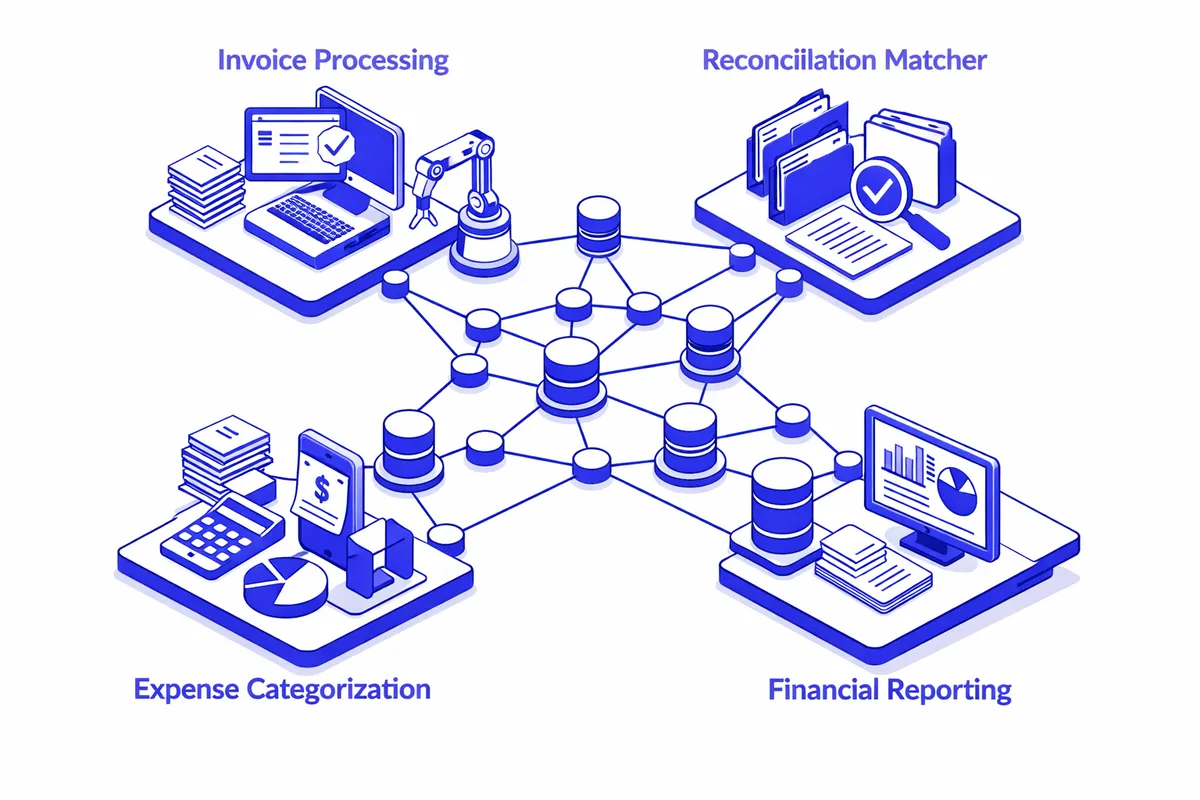
How We Build Accounting Automation for Schaumburg
Schaumburg's corporate environments require automation built to enterprise standards: documented, auditable, and maintainable by internal teams rather than dependent on external support. We build to those standards regardless of whether the client is a 500-person technology company or a twelve-person professional services firm.
Every engagement begins with a process architecture session. We map the current accounting workflow from data origin to final report, separating the steps that require human judgment from the steps that follow a deterministic rule. For a tech firm on Golf Road, that typically means separating revenue recognition decisions from the mechanical work of posting subscription renewals, generating invoices, and reconciling payment processor settlements. The former stays with the controller. The latter becomes automation.
We build on existing systems. Schaumburg corporate environments typically run NetSuite, Sage Intacct, or Microsoft Dynamics for their primary accounting system, often alongside Salesforce or a CRM for revenue data. We build the integration layer between those systems that moves data automatically, applies the transformation rules your finance team currently applies manually, and delivers clean entries to your general ledger on the schedule your close calendar requires.
For multi-entity Schaumburg operations, we build intercompany reconciliation automation that handles the eliminations, allocations, and consolidated reporting that currently require significant controller or CFO time. The automation does not make consolidation judgments; it assembles the data and applies the standing rules so that human review focuses on the exceptions rather than the data gathering.
Industries We Serve in Schaumburg
Technology companies and corporate offices along Golf Road and Meacham Road use accounting automation to manage subscription revenue recognition, multi-stream billing, and cross-entity intercompany transactions. Tech firms often operate faster close cycles than their finance teams were designed to support; automation compresses the mechanical work that extends the close timeline, getting preliminary financials to leadership days earlier without adding headcount.
Insurance agencies on Roselle Road and Higgins Road use accounting automation to handle carrier statement reconciliation, commission calculation, and policy renewal billing. The combination of multiple carrier relationships, overlapping billing schedules, and commission structures that vary by line of business creates reconciliation complexity that scales poorly with manual processes; automation applies the correct logic to each carrier and surfaces discrepancies automatically.
Retail and hospitality operations near Woodfield Mall on Woodfield Road automate daily revenue reconciliation, gift card liability tracking, and multi-location consolidated reporting. Retail accounting in a high-volume location requires daily discipline; automation provides the structure without requiring daily manual effort from accounting staff.
Healthcare practices and medical offices near Higgins Road and Roselle Road automate insurance reimbursement reconciliation, patient balance posting, and ERA/EOB processing. Medical billing generates high volumes of small transactions with complex matching logic; automation handles the volume and flags the exceptions, underpayments and claim rejections, that require staff review.
Hotels and conference facilities near the Schaumburg Convention Center automate their daily revenue audit, reconciling property management system revenue against payment processor settlements against general ledger entries. Convention-adjacent properties face large group billing, master account management, and complex attrition calculations that benefit from automated consistency across the event accounting cycle.
Professional services firms throughout the Schaumburg corridor automate project accounting: time and expense entry flowing into billing systems, milestone-based invoice generation, and reimbursable expense reconciliation. These firms often run projects across multiple clients simultaneously with different contract terms; automation keeps the billing current and flags when project costs approach budget thresholds before the overage becomes a client issue.
What to Expect Working With Us
1. Enterprise-grade process documentation. We produce written documentation of every automation we build, formatted for your internal finance team and your external auditors. Every workflow is documented with data flow diagrams, rule specifications, and exception handling procedures. This is not supplemental; it is a deliverable we build in parallel with the automation itself.
2. Close calendar alignment. We sequence the build around your specific close calendar and reporting deadlines. If your parent company requires preliminary financials by the third business day of each month, we build and test the automations that affect that timeline first, before anything else.
3. Parallel testing with real data. Every automation runs against three months of historical transactions before touching current-period data. We validate outputs against your actuals and document the match rate. You approve the automation going live; it does not go live on our timeline.
4. Internal team training and handoff. We train your accounting team on the automation logic, the exception reports, and the maintenance procedures before we step back. Schaumburg corporate environments need automation that the internal team can own; we build and train to that standard.