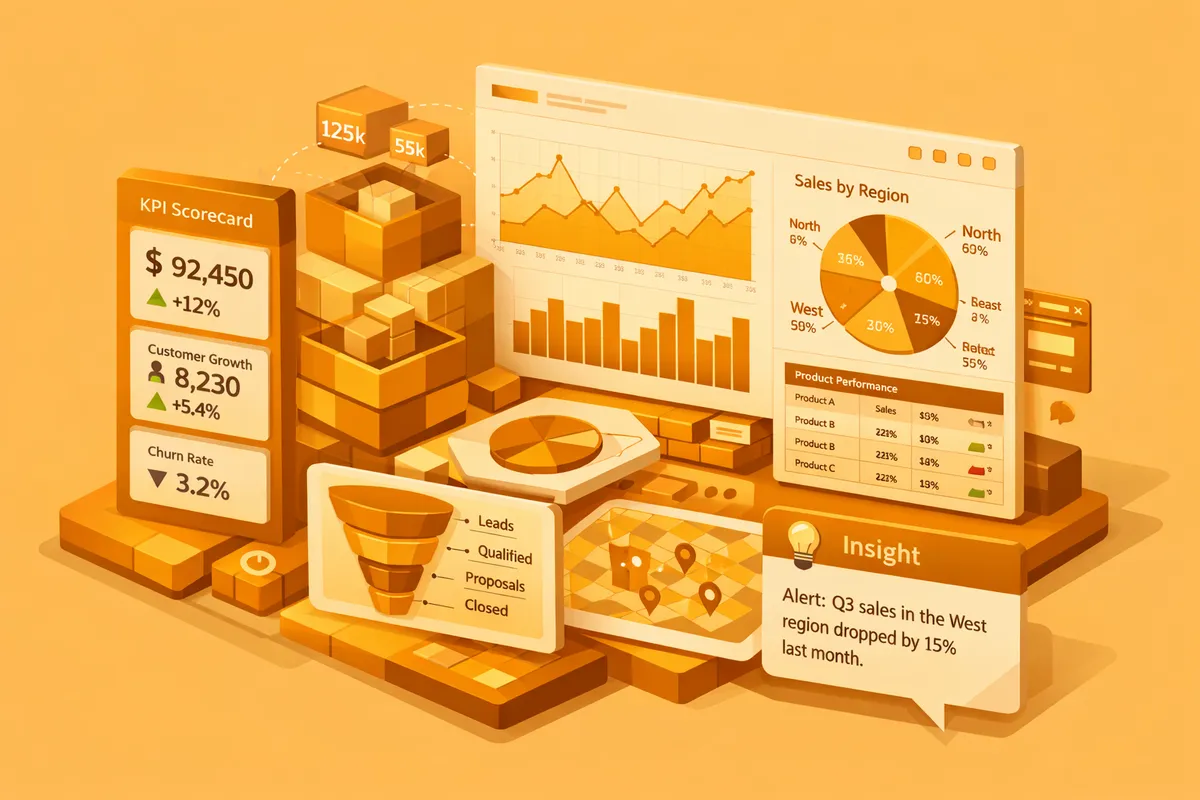
How We Build Business Intelligence for Roscoe Village
Roscoe Village engagements begin with a conversation about customer retention, not data systems. The central question for most businesses here is: who comes back, how often, and why? We work backward from that question to identify what data is needed, what systems currently hold it, and what pipeline will connect them.
For a Roscoe Street restaurant, the core data sources are typically the POS system, reservation platform, and delivery app accounts. We connect those to a unified analytics layer that shows daily revenue by source, table turn rates, reservation conversion rates, and ticket averages by server and by daypart. The restaurant owner reviewing dashboards each morning sees immediately whether the prior evening's service hit its benchmarks across every revenue channel.
For specialty retail, the data model shifts toward inventory and customer frequency. We track sell-through rates by product category, margin by vendor, and the purchasing behavior of loyalty program members versus walk-in customers. A pet service or boutique on Roscoe Street that can identify its top fifty customer households by annual spend has a relationship asset worth more than most advertising budgets.
Pediatric practices and family service businesses near Hamlin Park build BI around appointment capacity, no-show rates by appointment type, revenue per visit, and patient retention cohort analysis. A practice serving Roscoe Village's family demographic that sees declining retention among patients who age out of pediatric care knows where to invest in care coordination or referral relationships.
Industries We Serve in Roscoe Village
Independent restaurants and wine bars on Roscoe Street use BI to track cover count, ticket average, channel revenue split, and reservation conversion. When a restaurant near Fountainhead Tavern can see that its Friday reservation list fills by Wednesday while its Tuesday service operates at sixty percent capacity, the promotional decision writes itself. BI makes that comparison automatic rather than requiring an owner to mentally reconstruct three months of service data.
Boutique retail and specialty shops along the Roscoe Village corridor build dashboards around sell-through rate by category, vendor margin, inventory turnover, and customer purchase frequency. A specialty shop near Roscoe Books that knows its highest-margin product lines by quarter allocates floor space and buying budget based on evidence, not habit.
Pediatric practices and family health businesses near Jahn Elementary and Hamlin Park use BI to track patient volume, visit type distribution, insurance reimbursement by payer, and scheduling efficiency. A pediatric practice managing well-visits, sick visits, and developmental screenings across a large panel of families needs appointment type data to staff appropriately for the predictable surge in sick visits during the fall back-to-school period.
Pet services and specialty care businesses on the Roscoe Street corridor build BI around service revenue by type, repeat customer frequency, seasonal volume patterns, and referral source tracking. For a grooming or boarding service near Addison Street, knowing that boarding demand spikes in the two weeks before major holidays allows for waitlist management and staffing decisions made in advance rather than in reaction.
Wine bars and hospitality operators serving the Roscoe Village community use BI to monitor beverage margin by category, event revenue versus walk-in revenue, private party booking pace, and customer frequency data. A wine bar that can see which events drive the most repeat attendance builds a programming calendar around evidence rather than intuition.
Preschools and childcare providers near Hamlin Park build BI around enrollment, waitlist conversion, tuition collection rates, and program-level margin. For a small childcare operation, knowing which program types are consistently oversubscribed and which run below capacity allows for offerings decisions that both serve families and improve financial performance.
What to Expect Working With Us
1. Customer retention audit. Before touching any data system, we sit with the owner or manager to document what is known about the business's customer base: who comes back, who does not, and what patterns the owner already senses but cannot yet quantify. This framing prevents us from building dashboards that measure what is easy to measure instead of what matters to the business.
2. Source system integration. We connect your POS, reservation system, loyalty program, and any other operational platforms to a unified data layer. For most Roscoe Village businesses, the integration takes two to three weeks. We test every data feed before building dashboards on top of it so that what you see reflects what actually happened in your business.
3. Dashboard build with owner iteration. We build initial dashboards focused on the five to seven metrics the owner identified as most important in step one. We review working dashboards with the owner before finalizing and make revisions based on what they find useful and what they find irrelevant. Roscoe Village business owners are not data scientists; dashboards that require interpretation to understand are dashboards that get ignored.
4. Ongoing refinement and seasonal updates. Roscoe Village businesses have enough seasonal variation that dashboards need to account for it. We include seasonal comparison views in every build so owners are looking at current performance against the same period in prior years, not against an arbitrary average that flattens the neighborhood's real rhythm.