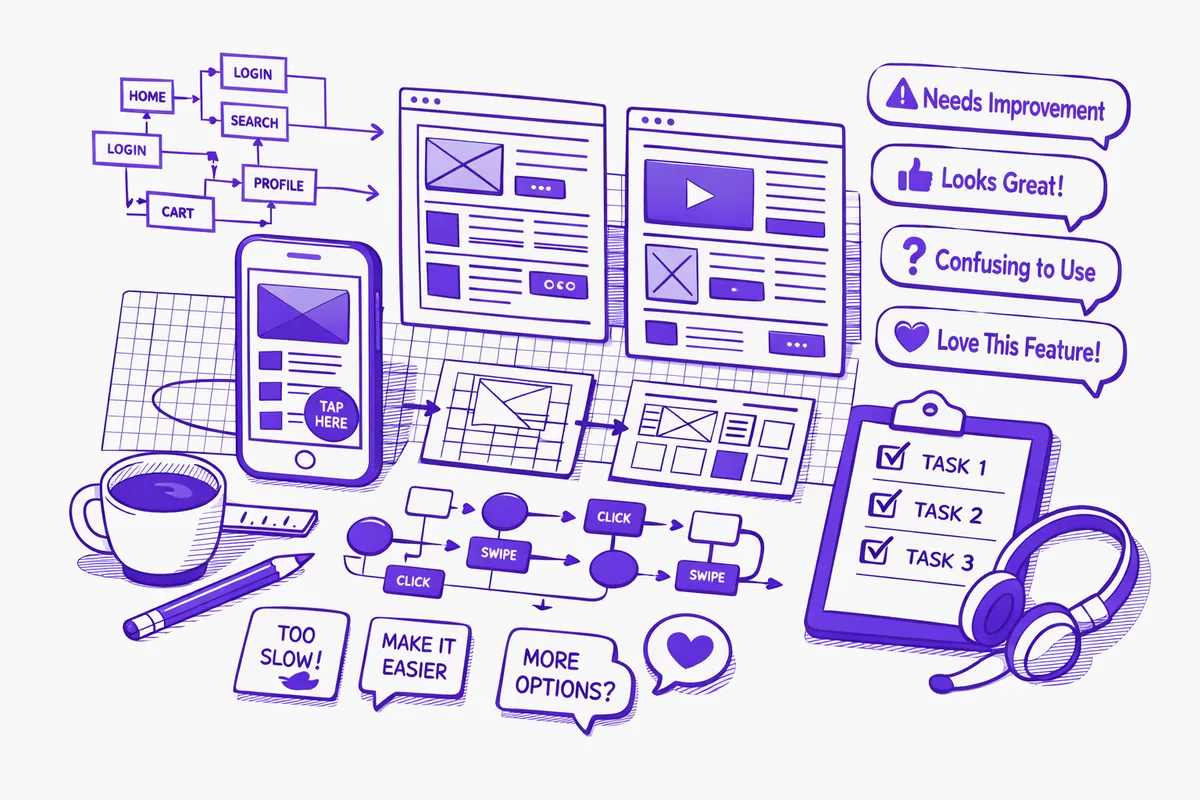
How We Do UI/UX Design for Rogers Park
Research is where every Rogers Park project starts. We conduct user interviews with actual members of the communities the product serves. For a Rogers Park nonprofit building a tenant platform, that means interviewing tenants across the neighborhood's language communities, not just English-speaking ones. We observe how people currently navigate similar tasks, where they get stuck, what information they need that isn't currently available, and what design patterns from their existing digital experiences they're familiar with and trust.
From research we build personas and journey maps that reflect the actual Rogers Park user, not a generic user persona. A persona for a Rogers Park Food Co-op member is a real person who shops twice a week, has a specific device and connection profile, a specific level of comfort with technology, and specific questions about their equity stake that the current interface doesn't answer clearly. That specificity drives design decisions that generic personas can't.
Design itself is iterative and tested. We prototype early and test with actual users before any development investment. Usability testing with Rogers Park community members surfaces problems that didn't appear in design reviews because the assumptions built into the review weren't the assumptions the actual users brought to the interface. An Ethiopian user who encounters an interface feature that relies on a Western convention may navigate it differently than the designer expected. Testing reveals this. Assumptions don't.
Industries We Serve in Rogers Park
Community organizations and advocacy groups including RPCAN and neighborhood tenant rights organizations need UI/UX design for platforms that serve non-technical users across language and literacy barriers. We design for the actual tenant navigating a housing crisis, not for the tech-comfortable urban professional.
Health and social services organizations like Howard Brown Health need design that creates trust with communities that have experienced discrimination in institutional settings. Color, imagery, language, and privacy messaging all require careful research and design for these organizations' digital products to work with their communities.
Cooperatives and community businesses like the Rogers Park Food Co-op need design for member-facing tools that support democratic participation from members with varying tech comfort. Cooperative governance interfaces should feel inclusive and straightforward, not bureaucratic and technical.
Loyola University Chicago adjacent startups building education technology, social services tools, and community platforms benefit from UX research access to the Loyola community as a pilot population and design approaches appropriate for academic users across disciplines.
Nonprofit technology platforms targeting the social sector need design that works for the organizations they serve: often small, often understaffed, often using older devices and slower connections. Enterprise design conventions don't translate to these contexts.
What to Expect Working With Us
1. Research and discovery. We conduct user research with actual members of your Rogers Park user community. Interviews, observation, and usability testing with real users produce insights that desk research can't. For multilingual projects, research happens across language communities with interpreters or researchers who are community members themselves.
2. Information architecture and wireframing. We design the structure of the product before the visual layer. Information architecture decisions determine what information is available, how it's organized, and how users navigate between tasks. Wireframes establish the layout and flow without visual design, so structural decisions get validated before aesthetic decisions add complexity.
3. Visual design and component system. We design the visual language that communicates your brand and builds trust with Rogers Park users. For multicultural contexts, color, imagery, and typography choices are grounded in research, not convention. We deliver a component system that scales as the product grows.
4. Prototype, test, and refine. High-fidelity prototypes are tested with Rogers Park users before handoff to development. Testing at this stage catches problems that are much more expensive to fix after development. We revise based on testing findings until we're confident the design serves the actual user, not the imagined one.