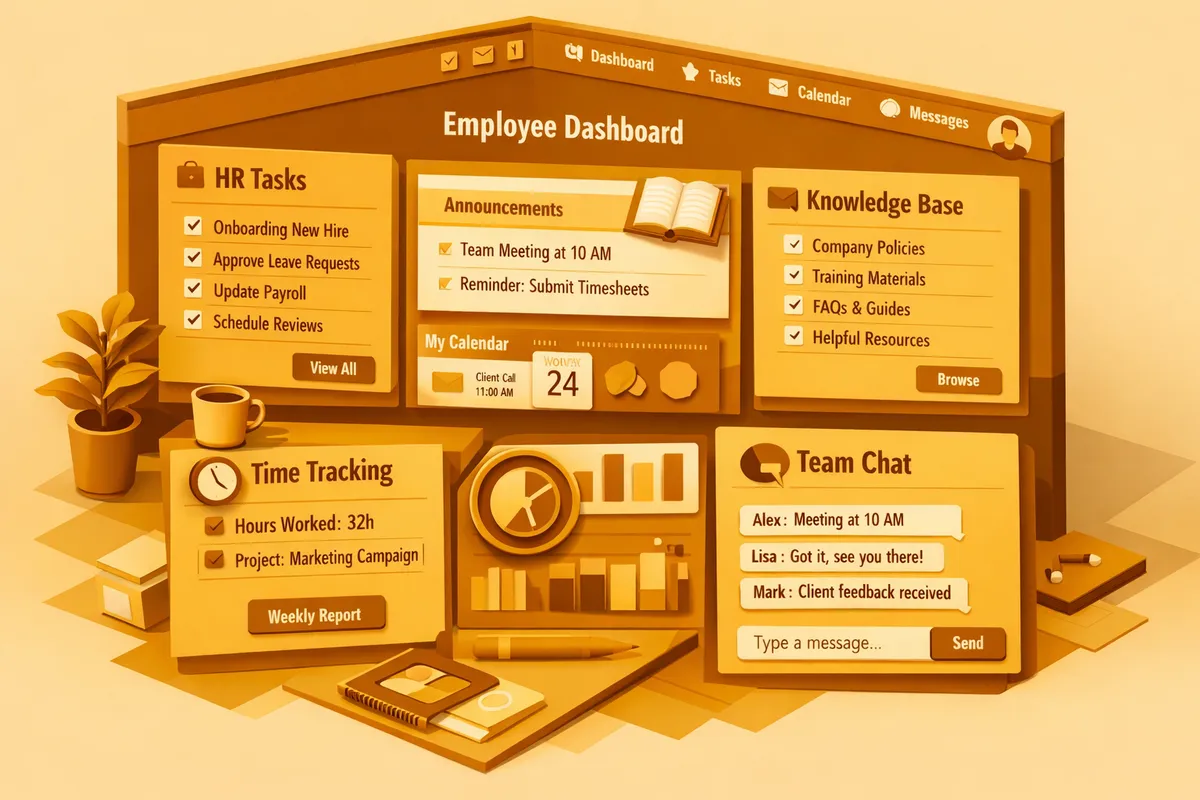
How We Build Employee Portals for Rogers Park
Discovery begins with a workforce audit. We map every employment type in your organization, identify the information and transactions each group needs access to, and assess the current state of how those needs are being met. For most Rogers Park organizations, this audit reveals a mix of processes: some managed through disconnected software tools, some handled through email, and some requiring in-person staff visits that could be entirely self-served through a portal.
Authentication and access control are designed around your organizational structure. A Rogers Park health organization with clinical staff, administrative staff, outreach workers, and volunteers needs access controls that give each group appropriate visibility without exposing information that should be restricted by role or employment classification. We design role-based access architectures that reflect the real complexity of your workforce rather than defaulting to a simple employee/manager binary.
Integration with your existing payroll, HRIS, and scheduling systems determines whether the portal surfaces accurate, current information. A portal that requires manual data entry to stay current is not a self-service tool. It is an additional system for administrators to maintain. We integrate portals with your payroll processor (ADP, Gusto, Paychex, or other platforms common among Rogers Park small and mid-size organizations), your HR information system, and your scheduling tools so employees see real data without staff creating or updating it.
Multilingual interface design is handled through the portal's localization architecture. We build language-switching into the interface at the design phase so employees can use the portal in their preferred language without losing functionality. Core portal content is translated and implemented during the build phase. Ongoing content updates are managed through a translation workflow that keeps multilingual content current without requiring separate maintenance for each language version.
Industries We Serve in Rogers Park
Nonprofits and social service organizations throughout Rogers Park manage complex workforces with compliance documentation requirements, training tracking needs, and multilingual communication demands. Employee portals for this sector include HR self-service, training certification tracking, policy document distribution, and compliance record management that would otherwise require significant administrative staff time.
Health and social service providers including Howard Brown Health and the neighborhood's network of clinics and wellness organizations manage clinical licensing records, continuing education requirements, staff credentialing, and HIPAA training documentation for workforces where compliance is both operationally important and legally required. An employee portal with document management and certification tracking capabilities directly addresses these needs.
Retail and hospitality businesses along Clark Street and the neighborhood's restaurant corridors manage hourly workforces with scheduling complexity, tip tracking, and time-off request volume that benefits substantially from employee self-service. Workers who can check their schedules, request shift changes, and submit time-off requests from their phones are less likely to create scheduling conflicts or miss shifts.
Educational and Loyola-adjacent organizations manage academic staff, administrative staff, and student workers with very different employment terms and information access needs. Employee portals for educational contexts typically include academic calendar integration, training and professional development tracking, and internal communications tools for staff communication across multiple departments.
Community organizations including cultural organizations, cooperatives, and member-driven groups with paid staff and volunteer workforces use simplified employee portals that cover the HR basics for paid staff while providing coordination tools for volunteers.
What to Expect Working With Us
1. Workforce audit and requirements mapping. We document every employment type, identify the self-service transactions each group needs, and map the current state of how those needs are addressed. This process typically surfaces more manual process than organizations have consciously recognized and establishes the priority order for portal features.
2. System design and localization planning. We design the portal's architecture, access control model, and integration requirements. For organizations with multilingual workforces, we plan the localization scope, identify which languages require full translation, and design the content management workflow for keeping multilingual content current.
3. Development and integration. We build the portal and connect it to your payroll, HRIS, scheduling, and document management systems. Integration work is where most of the development complexity lives, and we invest the rigor required to ensure the portal surfaces accurate, current data from the start.
4. Training and rollout. We train both portal administrators and the broader workforce. Training is designed for the range of digital comfort levels typical in Rogers Park's workforce, including mobile-first training for hourly workers more likely to access the portal from a phone than a desktop computer. We monitor adoption and address friction in the weeks following launch.