How We Build Document Management for Rogers Park
System design begins with a document audit. We catalog every document type your organization creates, receives, and stores, identify the workflows those documents move through, and assess the current state of your document organization. For most Rogers Park organizations, this audit reveals more document variety and more workflow complexity than leadership had consciously recognized.
Taxonomy design determines how documents are organized and how users find them. We design folder structures and tagging systems that reflect how your staff thinks about documents rather than how a software vendor organized their default templates. A community health organization on Touhy Avenue needs a taxonomy that reflects their programs, client populations, and grant structures. A small architecture firm near Loyola needs a taxonomy that reflects project phases, client relationships, and document types. Both need to be intuitive enough that staff find documents on the first try rather than searching for five minutes.
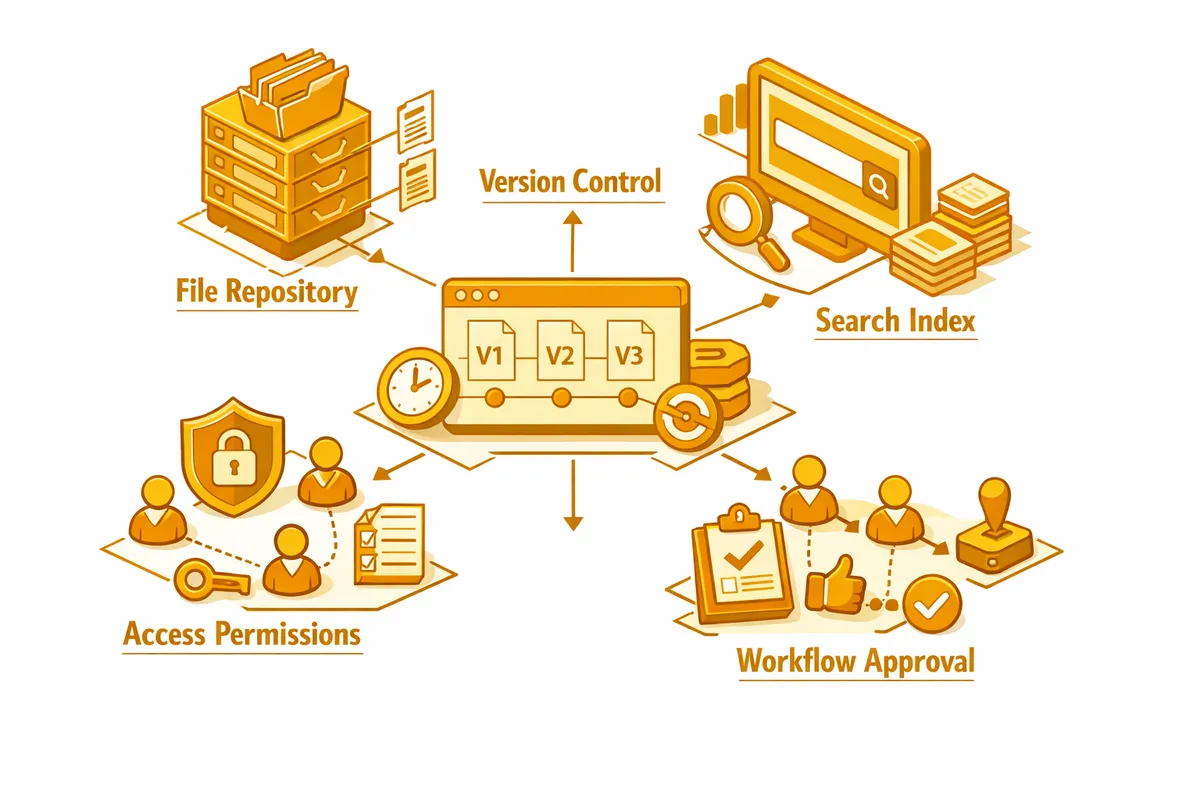
Version control is a baseline feature for any professional document management environment. Every edit to a document creates a version record showing who made the change, when, and what changed. Documents can be restored to any prior version. This eliminates the chaos of "final," "final-revised," and "final-revised-v2" naming conventions and provides a reliable audit trail for organizations with compliance requirements.
Workflow automation routes documents through review and approval processes without manual coordination. A grant report that needs executive director approval before submission can be routed automatically when the program manager marks it complete. A client intake form that requires two staff signatures can move through the approval workflow with notifications to each approver rather than requiring someone to track down signatures manually. For Rogers Park organizations managing high document volumes with lean staffing, workflow automation recovers meaningful time.
Industries We Serve in Rogers Park
Nonprofits and social service organizations are the most document-intensive organizations in Rogers Park relative to their staff capacity. Grant compliance files, client case records, board meeting materials, volunteer documentation, and program delivery records all require organized, searchable, version-controlled management. Organizations that receive multiple grants simultaneously manage document requirements that would overwhelm a disorganized system.
Healthcare and health-adjacent organizations including Howard Brown Health and the neighborhood's clinical and wellness providers manage patient records, clinical documentation, and administrative files with HIPAA-compliant document management requirements. Secure, access-controlled, audit-logged document management is not optional in this environment.
Legal and social services practices near Loyola's campus and throughout the neighborhood maintain privileged client files, case documentation, and court records that require organized, retrievable, secure storage. Document management systems for legal practices include the workflow and access controls that professional responsibility requirements demand.
Independent businesses along Clark Street and near the Morse Red Line stop manage vendor contracts, customer agreements, insurance documents, and compliance files that are often scattered across email, shared drives, and physical folders. Consolidating these into a searchable, organized system protects the business and reduces the time spent locating documents when they are needed.
Arts and cultural organizations in the neighborhood including theater companies near the Mayne Stage and visual arts organizations document productions, grant applications, board materials, and organizational history. Document management preserves institutional memory in organizations where staff and volunteer turnover is common.
What to Expect Working With Us
1. Document audit and taxonomy design. We catalog your document landscape, design an organizational taxonomy that fits your specific workflows and document types, and establish naming conventions and metadata standards that make search reliable. This foundational work determines whether the system is adopted long-term.
2. System configuration and integration. We configure your document management platform, implement your taxonomy, connect the system to your existing tools including email, CRM, and project management software, and set up user roles and access permissions appropriate to your organizational structure.
3. Workflow development. We build the automated workflows that route documents through review, approval, and archiving processes your organization requires. Workflows are designed to match your actual operational processes rather than forcing your team to adapt to the software's default logic.
4. Migration, training, and adoption. We migrate your existing documents into the new system with appropriate organization, train your entire team on the platform with sessions calibrated to different levels of technical comfort, and monitor adoption in the weeks after launch to identify and address friction points before they become habits that undermine the system.