How We Build Business Intelligence for Rogers Park
BI implementation begins with the questions, not the data. We interview the people who make operational decisions and document the specific questions they need answered most frequently: daily, weekly, and monthly. These questions drive every subsequent technical decision about which data sources to connect, which metrics to compute, and how to structure dashboards.
Data source integration is the most technically complex part of most BI implementations. Rogers Park organizations typically have data in point-of-sale systems, program management databases, accounting software, Google Sheets, and various web platform analytics tools. We connect these sources using appropriate integration approaches, handle the data quality and reconciliation issues that arise, and build clean data models that compute the metrics your organization needs.
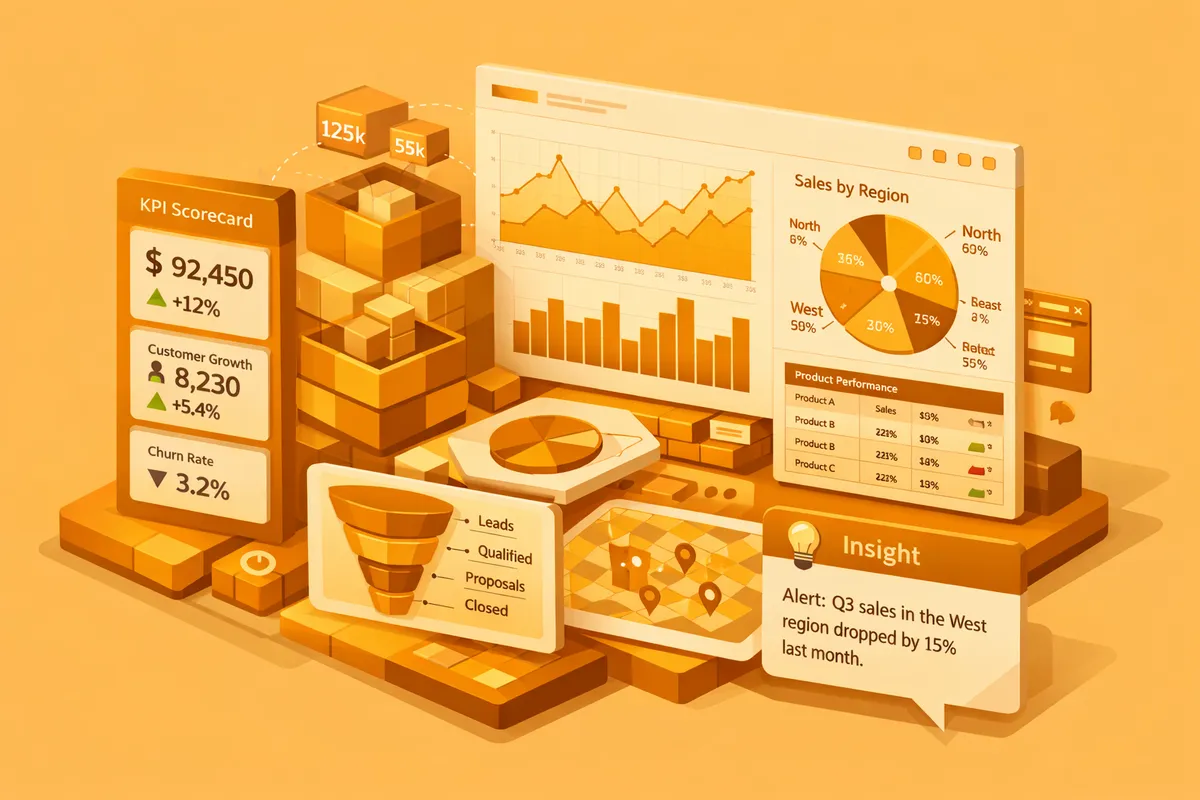
Dashboard design for Rogers Park organizations prioritizes simplicity and action-orientation. Every panel on a dashboard should answer a specific question or support a specific decision. We eliminate panels that display data without supporting a decision, because they add cognitive load without adding value. The result is dashboards that people actually use daily rather than dashboards that are impressive in demonstrations but ignored in practice.
Industries We Serve in Rogers Park
Community health and social services organizations including Howard Brown Health use BI to connect patient flow, appointment, clinical outcome, and financial data into dashboards that support capacity planning, program evaluation, and the reporting that community health funders require.
Nonprofit and advocacy organizations across the neighborhood use BI to connect program outcomes, financial data, volunteer hours, and community reach metrics into the integrated reporting that boards and funders need for organizational oversight and accountability.
Restaurants and food businesses on Clark Street and Devon Avenue use BI to connect sales, labor, inventory, and customer data into the operational dashboard that shows true profitability by day, service, and menu category, enabling pricing and staffing decisions based on evidence rather than intuition.
Retail and cooperative businesses near Sheridan Road and Glenwood use BI to track member engagement, purchasing patterns, inventory performance, and the operational metrics that drive co-op governance and business decisions.
Arts and cultural organizations including Lifeline Theatre and Mayne Stage use BI to connect ticketing, donor, grant, and operational cost data into the picture of organizational financial health and audience development that governance and development work requires.
Loyola-adjacent professional services firms use BI to track client acquisition by source, engagement profitability by service line, and the pipeline metrics that support business development prioritization.
What to Expect Working With Us
1. Decision inventory. We interview leaders and managers to document the decisions they make weekly and monthly, identify what data they currently use to make each decision, and identify the gaps where they are deciding without adequate data. This produces a prioritized list of the most valuable reporting to build.
2. Data source audit. We assess every data source your organization has, evaluate data quality and completeness, and design the integration and transformation approach that produces clean, reliable data for reporting.
3. Dashboard build and review. We build dashboards iteratively with your team reviewing each version to confirm it answers the questions it was designed to answer. Revision cycles during this phase ensure the final product reflects how your team actually thinks about your data.
4. Training and handoff. We train the staff responsible for using and maintaining the BI system, document the data sources and transformation logic, and ensure the organization can maintain the reporting infrastructure independently after our engagement ends.