How We Build AI Models for Rogers Park
Every engagement starts with data assessment. We inventory the data you have, evaluate its quality, check annotation status, and assess whether the data you possess represents the real-world distribution your model will encounter. For a Rogers Park research project, this often involves working through IRB documentation to understand what data can be used for what purposes. For a healthcare practice, it involves HIPAA boundary mapping and de-identification planning before any data leaves secured storage. For a small business, it involves looking at whether you have enough labeled data or whether annotation is part of the project scope.
We then define success. Model accuracy is not a number in the abstract. It is a number measured against a specific task that matters to your organization. For a research group, that might be thematic coding accuracy compared to expert human coders. For a healthcare practice, it might be documentation extraction accuracy measured against provider review. For a small business, it might be classification accuracy on a held-out test set representing real product variability. We establish these metrics before training begins so evaluation is grounded in business reality rather than generic benchmarks.
Model selection is next. For most Rogers Park projects, fine-tuning a foundation model is the right approach rather than training from scratch. Foundation models have broad capability already, and fine-tuning adapts them to your specific domain with manageable data requirements and timelines. We work with GPT-4 family models, Claude, Llama, Mistral, and others depending on the task, your data sensitivity constraints, and your deployment requirements. For vision tasks, we work with foundation vision models adapted to your specific visual domain. For multilingual tasks, we select models with the strongest coverage of the specific languages your project requires.
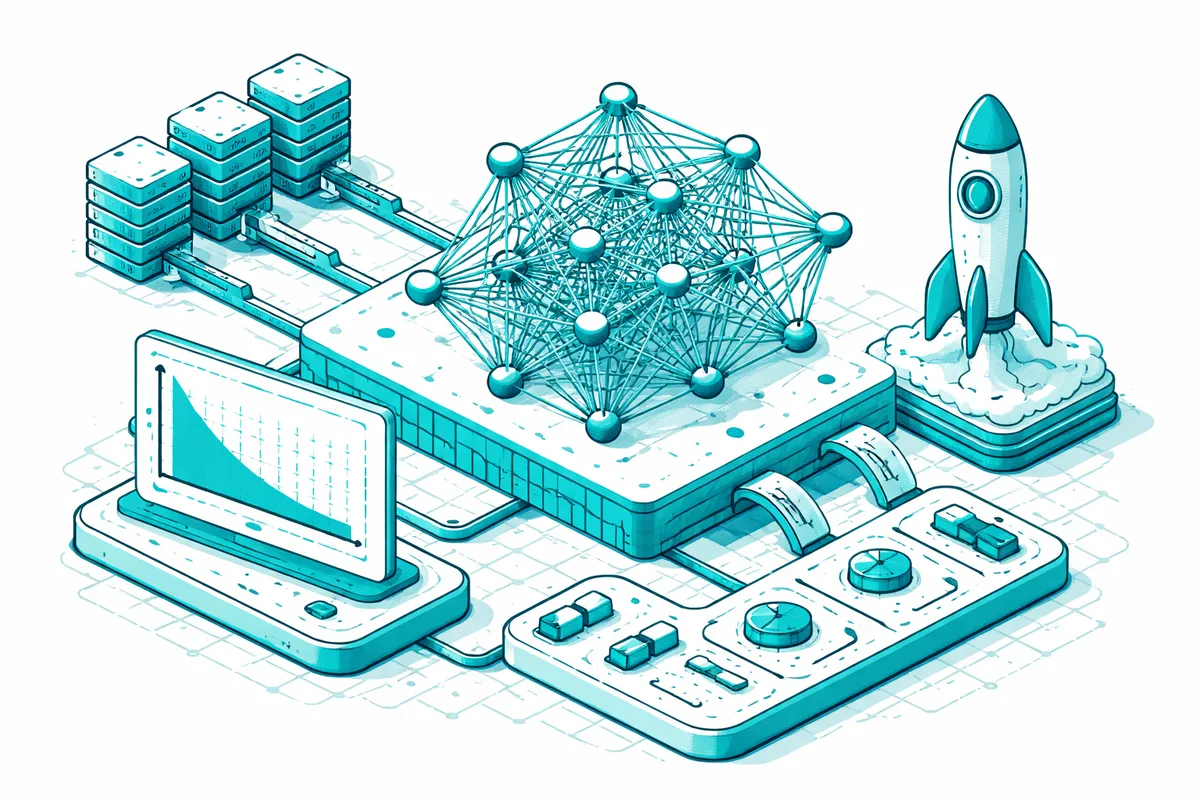
Training happens iteratively, not in a single big run. We train an initial version, evaluate it against your success metrics, identify where it falls short, adjust the data or methodology, and train again. For a research project, early training might reveal that the model confuses two adjacent thematic categories that matter for the study, and the fix might involve either additional annotation or a methodology change. For a healthcare project, early training might show strong performance on well-structured notes but weak performance on notes from specific providers whose documentation style differs, and the fix might involve adding more samples from those providers. The iteration is where custom training actually earns its value.
Deployment and monitoring close the loop. We deploy trained models to infrastructure appropriate to the scale, often just API endpoints hosted affordably for Rogers Park projects rather than enterprise-scale inference infrastructure. We set up monitoring that tracks prediction distributions and confidence levels over time, so drift from the training distribution shows up as alerts rather than silent degradation. For research projects, we often deliver model artifacts and reproducibility packages that allow the research team to extend the work or reproduce results for publication.
Industries We Serve in Rogers Park
Research groups and academic-adjacent labs tied to Loyola's Lake Shore Campus or other local institutions need custom models trained on specialized research data. Longitudinal study analysis, qualitative interview coding, clinical corpus analysis, and observational data modeling all benefit from models tailored to the specific study population and instruments rather than generic research AI tools.
Healthcare and behavioral health practices along Greenleaf, Lunt, Jarvis, and the Sheridan Road corridor use custom model training for clinical documentation tasks, patient population modeling, and specialty-specific extraction. Practices serving LGBT populations, immigrant populations, and other specific clinical communities benefit particularly from training on their actual documentation rather than generic clinical NLP.
Nonprofits and community organizations along Howard Street and Morse Avenue use custom model training for outcome prediction, program matching, service utilization forecasting, and multilingual content handling. Training on your specific service population's data produces models that reflect actual local dynamics rather than national averages that rarely match neighborhood reality.
Multilingual service providers working with Rogers Park's Ethiopian, Eritrean, Pakistani, Mexican, Vietnamese, Russian, and other immigrant communities need custom models for translation, document understanding, and conversation handling in languages where generic models underperform. Fine-tuning with native speaker annotation produces working models for these applications.
Small specialty businesses along Clark Street, Morse Avenue, and Devon Avenue use custom model training for classification, recommendation, and matching tasks specific to their catalog and customer base. A bookstore's recommendation model, a specialty food business's classification model, and a boutique's styling model all benefit from training on actual business data.
Theater companies and arts organizations tied to Lifeline Theatre, Mayne Stage, and neighborhood cultural institutions use custom model training for audience modeling, content recommendation, and subscription forecasting specific to their artistic programming and audience base.
What to Expect Working With Us
1. Data and compliance assessment. We inventory available data, check annotation status, map compliance constraints including IRB, HIPAA, FERPA, and any funder requirements, and establish the boundaries within which training will happen.
2. Success metrics and strategy. We define accuracy targets in terms of your actual task, design the training methodology, and plan the evaluation framework that will determine whether the model is production-ready.
3. Iterative training and evaluation. We train, evaluate, adjust, and train again until accuracy targets are met. Each iteration produces measurable improvement grounded in your evaluation metrics.
4. Deployment, monitoring, and handoff. We deploy to appropriate infrastructure, set up drift monitoring, and document the pipeline so your team can operate, extend, and retrain the model over time.