How We Build AI Document Processing for Rogers Park
Every engagement starts with a document inventory. We spend the first week or two walking through every document type your organization handles. What arrives? How does it arrive, by email, fax, portal, scan, or physical delivery? What fields do you actually need out of each document? Where does the extracted data need to land? For the nonprofit on Howard Street, that might be 12 document types ranging from intake forms to benefit verification letters, each with different required fields flowing into different systems. For the dental practice, it might be five document types all landing in the practice management system. We catalog each one.
We then design extraction schemas for each document type. This is the definition of what the AI should pull out. For an intake form, it might be name, address, household size, income, needs. For a clinical referral letter, it might be patient name, referring provider, diagnosis, requested services, insurance. For a lease application, it might be applicant name, current address, income sources, references. The schema tells the AI what to look for, and it tells the downstream system how to structure the output.
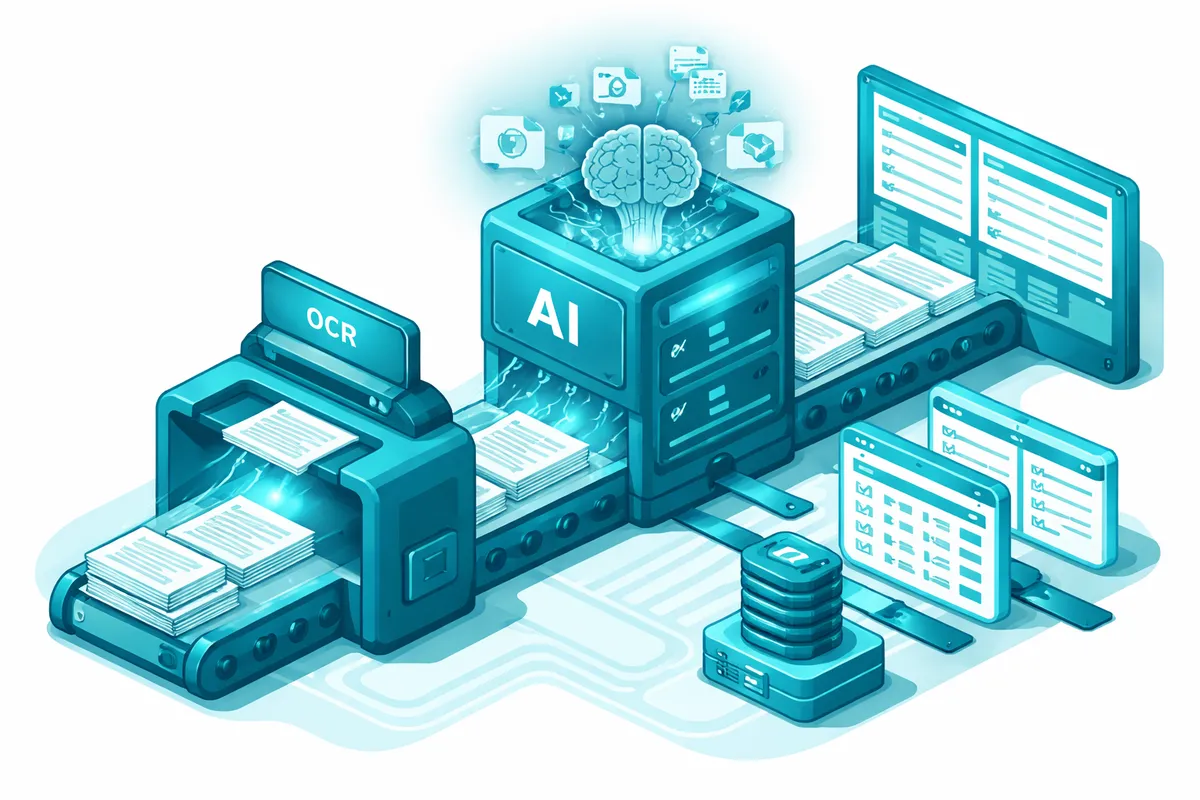
Model selection is next. For well-formatted typed documents like most contemporary forms, we use general-purpose large language models with extraction prompts tuned to your schemas. For handwritten content, which shows up heavily in nonprofit intake and older medical records, we use specialized OCR combined with language models for interpretation. For documents in languages other than English, we use multilingual models that handle extraction in the source language and produce English-structured output. We also configure confidence thresholds for every field so extractions below the threshold flag for human review.
Human-in-the-loop workflows are a core part of every deployment. We do not promise 100 percent automation, because that promise fails in real conditions. Instead, we promise that the 85 to 95 percent of extractions the AI is confident about flow through automatically, and the remainder land in a review queue where a staff member confirms or corrects in seconds. Over time, the correction feedback improves the model, and the percentage requiring review decreases.
Integration ties it all together. Extracted data flows directly into your downstream systems. A nonprofit's intake forms land in Salesforce NPSP. A practice's referral letters land in the EHR as structured fields. A landlord's lease applications land in the property management platform. Your staff stops being data entry clerks and starts working with data that is already in the right place.
Industries We Serve in Rogers Park
Nonprofits and social service organizations along Howard Street, Morse Avenue, and the broader Rogers Park service corridor use document processing for intake forms, eligibility verification documents, benefit letters, identification, and grant documentation. For organizations serving immigrant families, multilingual document handling is foundational. For organizations dealing with housing, food assistance, or legal aid, processing large volumes of supporting documentation is core to operations.
Healthcare and behavioral health practices along Greenleaf, Lunt, Jarvis, and the Sheridan Road corridor use document processing for referral letters, outside medical records, insurance cards, release authorizations, and clinical documentation coming from prior providers. HIPAA compliance is built into the pipeline from the start, with encryption, access controls, and audit logging at every stage.
Immigration services and legal aid providers serving Rogers Park's diverse immigrant communities process foreign-language documents including court records, consular papers, birth certificates, and educational credentials alongside English-language forms. AI handles the linguistic range and produces structured output that feeds case management and filings.
Property management and housing services across Rogers Park's dense residential base use document processing for lease applications, income verification, utility bills, rental history documentation, and move-in paperwork. Processing applications consistently and quickly matters because tenants are shopping multiple buildings simultaneously.
Independent schools, childcare providers, and youth programs near Loyola and throughout the neighborhood use document processing for enrollment packets, immunization records, emergency contact forms, and program registration documents. Small administrative teams cannot manually process these volumes during enrollment seasons without errors or delays.
Small professional services firms including accountants, therapists, and consultants based in Rogers Park use document processing to extract data from client-provided documents, receipts, supporting paperwork, and intake materials. The time savings goes straight to billable work.
What to Expect Working With Us
1. Document inventory and schema design. We catalog every document type your organization handles, identify the fields you need extracted, and define confidence thresholds. This typically takes two weeks and produces a clear scope for implementation.
2. Model configuration and integration build. We configure extraction models for each document type, set up multilingual handling where needed, build the human-in-the-loop review queue, and integrate with your downstream systems. Typical build time is four to seven weeks.
3. Testing and tuning. We test against representative samples of your real documents, calibrate confidence thresholds, and refine extraction schemas where accuracy needs improvement before going live.
4. Launch and ongoing improvement. Production deployment with monitoring. We review performance at 30 and 90 days, adjusting confidence thresholds and retraining models as the system accumulates feedback from your review queue.