How We Build AI Customer Service for Rogers Park
Our process starts with listening. We pull data from every channel where your customers currently reach you: website chat, email, phone logs, Instagram and Facebook DMs, Google Business messages, and any texting system you use. For a Clark Street restaurant, that might reveal a heavy cluster of reservation and dietary accommodation questions in English and Spanish, with a smaller but consistent volume of event inquiries from Loyola student organizations. For a Howard Street service business, the inquiry mix might lean toward scheduling, pricing, and urgent maintenance requests. We categorize every question type by volume and complexity so the AI knows what it will be asked.
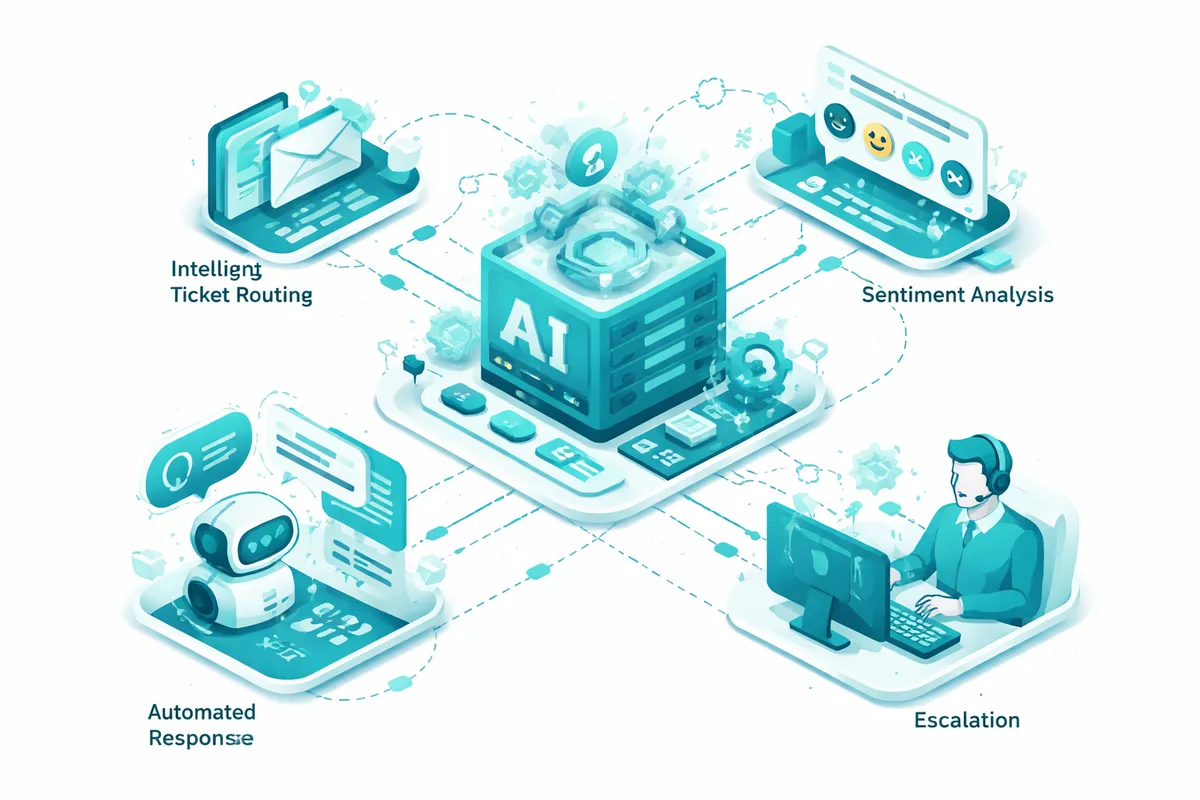
We then build your system in three tiers. The first tier handles the high-frequency questions that eat the most time: hours, location, parking options near the Morse or Loyola Red Line stops, menu basics, pricing, and appointment availability. The AI resolves these instantly in whatever language the customer uses. The second tier handles conversations that need a bit more back and forth: special dietary requests, custom orders, event planning for small gatherings, translation of complex policies into plain language. The AI gathers what it needs through natural conversation and either resolves the request or packages it for your team with full context. The third tier is escalation: anything sensitive, anything high stakes, anything the AI is not confident about. These go to a human with the conversation history attached so your customer never has to start over.
Language handling deserves specific attention in Rogers Park. We do not rely on generic machine translation and hope for the best. We build knowledge bases in the languages your customers actually use, reviewed by native speakers familiar with community terminology. An Amharic greeting that works in Addis Ababa may feel off to the Ethiopian community in Rogers Park. An Urdu menu description needs to reflect how Pakistani families in the neighborhood actually talk about food. We take this seriously because your customers do.
We also integrate with the systems you already use. Square for restaurant operations. Calendly or a custom scheduler for service businesses. Shopify for bookstores and retailers. QuickBooks or FreshBooks for invoice-related questions. Gmail or Outlook for team notifications. Your AI should feel like part of your existing stack, not an additional tool your team has to babysit.
Finally, we tune the tone. A bookstore near Armadillo's Pillow wants a warm, literary voice. A kosher deli wants respect for dietary laws reflected in every response. A progressive nonprofit near Howard Street wants language that reflects its values. We calibrate the system to each business rather than applying one house style to everyone.
Industries We Serve in Rogers Park
Independent restaurants and food businesses along Clark Street, Morse Avenue, Devon Avenue, and Howard Street use AI customer service to handle reservation requests, menu and dietary questions, catering inquiries, and event bookings. Ethiopian, Vietnamese, Mexican, Pakistani, kosher, and pan-Caribbean restaurants all have specialized dietary vocabulary and cultural context that the AI learns so responses are accurate, respectful, and in the customer's preferred language.
Healthcare and mental health practices around Greenleaf, Lunt, and Jarvis, including practices serving LGBT patients, multilingual immigrant patients, and the Loyola student population, use AI to handle appointment booking, insurance verification questions, and intake coordination. HIPAA boundaries are respected at every step, with PHI requests routed to secure, authenticated channels rather than handled in chat.
Nonprofits and community organizations along Howard Street, Morse Avenue, and the broader Rogers Park service corridor, including food pantries, legal aid providers, immigrant services organizations, and youth programs, use AI to answer intake questions, share eligibility information, and route urgent requests to case managers. The AI handles volume that small nonprofit teams cannot absorb while keeping case manager time focused on the conversations that require human support.
Independent retailers and bookstores near Morse Avenue and Clark Street use AI to handle hours, event schedules, inventory questions, special orders, and shipping logistics. For bookstores in particular, customers often ask detailed questions about specific titles, author events, and recommendations, and the AI can handle the logistical parts of those conversations so staff time goes to the recommendations themselves.
Property management and housing services operating across Rogers Park's dense residential base along Sheridan Road, Pratt, Greenleaf, and the blocks near the Red Line stations use AI to handle maintenance requests, lease questions, and showing scheduling. Multilingual handling matters here because tenants are not always most comfortable in English.
Small service businesses and freelancers based out of home offices or shared spaces in Rogers Park, many of them Loyola-adjacent consultants, therapists, tutors, and tradespeople, use AI to handle intake and scheduling without adding administrative overhead that would eat their margin.
What to Expect Working With Us
1. Interaction audit and language mapping. We analyze your current customer communication, categorize inquiry types, identify which languages show up in your real customer base, and map out what the AI should handle versus what should route to a human. For most Rogers Park businesses, 60 to 75 percent of inquiries are strong AI candidates.
2. System design and multilingual training. We build your AI using your actual business data, your brand voice, and knowledge bases in every language your customers speak. Where cultural or community context matters, we bring in native speaker review rather than leaning on generic translation.
3. Channel integration and launch. We deploy across every channel your customers use: website chat, email, SMS, Instagram, Facebook, Google Business, and voice if appropriate. The AI maintains conversation context across channels so a customer who starts on Instagram and follows up by email never has to repeat themselves.
4. Performance monitoring and iteration. We track resolution rates, customer satisfaction, language accuracy, and escalation frequency. Weekly adjustments improve accuracy. Monthly reports show exactly how many conversations the AI handled, in which languages, with what outcomes.