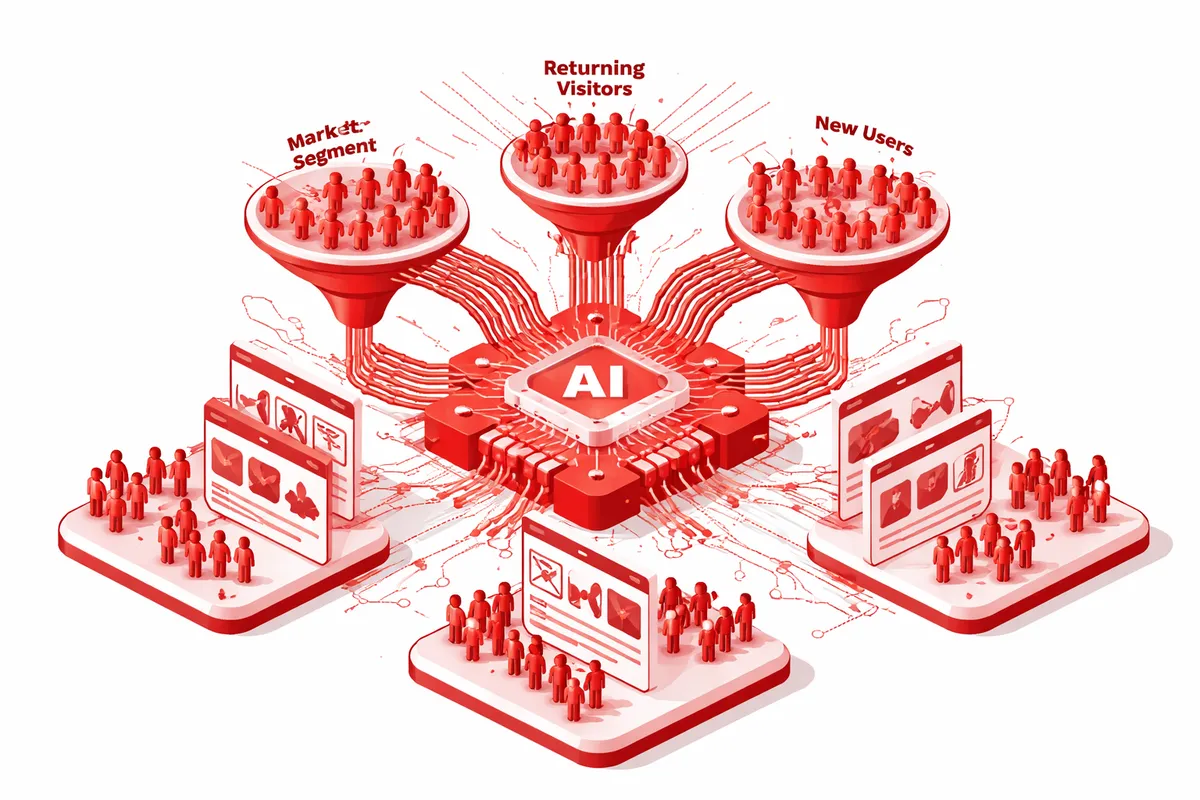
How We Build AI Content Personalization for Rogers Park
Our personalization work starts with understanding who actually visits your site and what they are looking for. We pull analytics data, review search queries, examine traffic sources, and interview your team about the different audience segments they encounter. For a Rogers Park business, this discovery often reveals segmentation opportunities that leadership had not consciously mapped. The restaurant turns out to have three very different customer types arriving with different needs. The clinic has patient journey stages that should be addressed separately. The nonprofit has supporters, clients, and community members visiting for completely different reasons.
Audience segmentation design. We define the priority segments, the signals that identify each segment, and the content variations each should see. For a Rogers Park clinic, segments might include new patient inquiries, returning patients seeking specific services, caregivers researching for family members, and insurance verification visitors. For each segment, we define what content changes and what stays consistent. The approach balances personalization value with operational maintainability.
Multilingual personalization. For Rogers Park businesses serving communities in multiple languages, language detection and switching is a core personalization capability. We implement signals including browser language preference, geolocation, referral source, and explicit language selection to route visitors to appropriate language content. We integrate translation workflows for businesses that produce content in one language and need accurate translations in others. We handle the right-to-left layout considerations for languages like Arabic and the font and typography considerations for scripts like Ethiopic and Devanagari.
Returning visitor recognition. Recognizing returning visitors and adapting experience accordingly is one of the highest-value personalization features. A Rogers Park restaurant that recognizes returning customers can skip repeated menu introductions and surface loyalty offers. A nonprofit that recognizes returning supporters can skip first-time donor content and move directly to recurring gift or additional engagement options. A clinic that recognizes returning patients can surface their care team and appointment history. The technical implementation uses first-party cookies, CRM integration, and behavioral signals calibrated to privacy requirements.
Account-based personalization for B2B. For Rogers Park B2B companies, especially Loyola-adjacent startups selling to enterprise buyers, we implement account-based personalization using intent data platforms that identify company-level visitors even when individual identities are anonymous. Named target accounts can see personalized homepages, case studies from similar organizations, and messaging calibrated to their specific context. This substantially improves enterprise sales conversion for companies with relatively small but highly valuable target account lists.
Privacy and consent. Illinois privacy law, CCPA for California visitors, GDPR for European visitors, and sector-specific regulations like HIPAA for healthcare organizations all shape how personalization can be implemented. We build personalization systems with proper consent management, clear privacy practices, and data handling that meets the regulatory environment Rogers Park businesses operate within. For organizations serving vulnerable populations, we add privacy considerations that go beyond strict regulatory minimums to protect client interests.
Industries We Serve in Rogers Park
Restaurants and hospitality along Clark Street, Devon Avenue, Morse Avenue, and the Howard Street corridor use personalization to recognize returning customers, adapt menu emphasis by customer segment, serve language-appropriate content to diverse communities, and drive reservation and catering conversion. Independent restaurants with loyal customer bases see meaningful lift from returning visitor recognition alone. Restaurants serving specific cultural communities see dramatic engagement improvements from language personalization.
Community clinics and healthcare practices serving Rogers Park use personalization to adapt content by patient journey stage, surface service-specific information based on visitor intent, and deliver language-appropriate patient education and intake materials. For clinics serving specific communities like Ethiopian, South Asian, or Latino populations along Devon and Clark, personalization that adapts language and cultural context significantly improves patient engagement with digital resources.
Nonprofits and community organizations across Rogers Park benefit from personalization that distinguishes between prospective donors, current supporters, program participants, and community members seeking services. Each audience has different needs, and a single generic website serves none of them particularly well. Personalization that surfaces donor content to donor prospects, service information to service seekers, and program updates to program participants dramatically improves engagement with each audience.
Loyola-adjacent startups and B2B companies operating near the Lake Shore Campus use account-based personalization to convert enterprise accounts efficiently. Intent data identifies companies visiting the site. Personalization shows industry-specific content, relevant customer logos, and case studies calibrated to the visiting company's profile. For startups with small enterprise sales teams and expensive marketing investment, this improves return on both sales and marketing spend substantially.
Independent retail and specialty businesses including bookstores, record shops, specialty grocers, and co-ops use personalization to adapt content by customer history, surface recommendations based on browsing behavior, and deliver seasonal and event-driven content relevant to each shopper. Co-ops benefit specifically from member recognition that adapts content for active members versus visitors considering membership.
Arts organizations and performance venues including Lifeline Theatre, Mayne Stage, and smaller performance companies use personalization to adapt content by patron history, surface productions and programming relevant to each visitor's interests, and manage subscription and single-ticket messaging appropriately. Returning audience members see different content than first-time visitors from paid campaigns.
Professional services and legal aid organizations use personalization to surface service-specific content based on visitor intent, adapt for different practice areas, and deliver appropriate intake flows for different client types. Legal aid organizations serving multiple language communities benefit from language personalization that reduces friction for clients already navigating stressful situations.
What to Expect Working With Us
1. Discovery and audience mapping. We review your current audience composition, traffic patterns, and available content. We use analytics data to identify where different audience types enter the site and where engagement drops off. We map the personalization opportunities with highest impact on your conversion goals. This phase typically takes two to three weeks.
2. Strategy and segmentation design. We define priority audience segments, the signals that identify each, and the content variations each should see. We create a personalization plan that delivers early wins within the first 30 days of implementation while building toward a comprehensive program. For multilingual implementations, we define language detection rules and translation workflows.
3. Platform implementation. We configure the personalization platform, integrate it with your analytics and CRM, build the initial content variations, and set up the experimentation framework that measures lift. We test before launch and monitor closely during the first weeks of operation. Platform selection depends on your existing stack and specific needs.
4. Ongoing optimization. We review personalization performance regularly, adjust segmentation and content based on results, and evolve the program as your products and audiences change. We train your team to manage content variations independently for the segments where that capability fits. We remain engaged for ML-heavy implementations that require ongoing model maintenance.