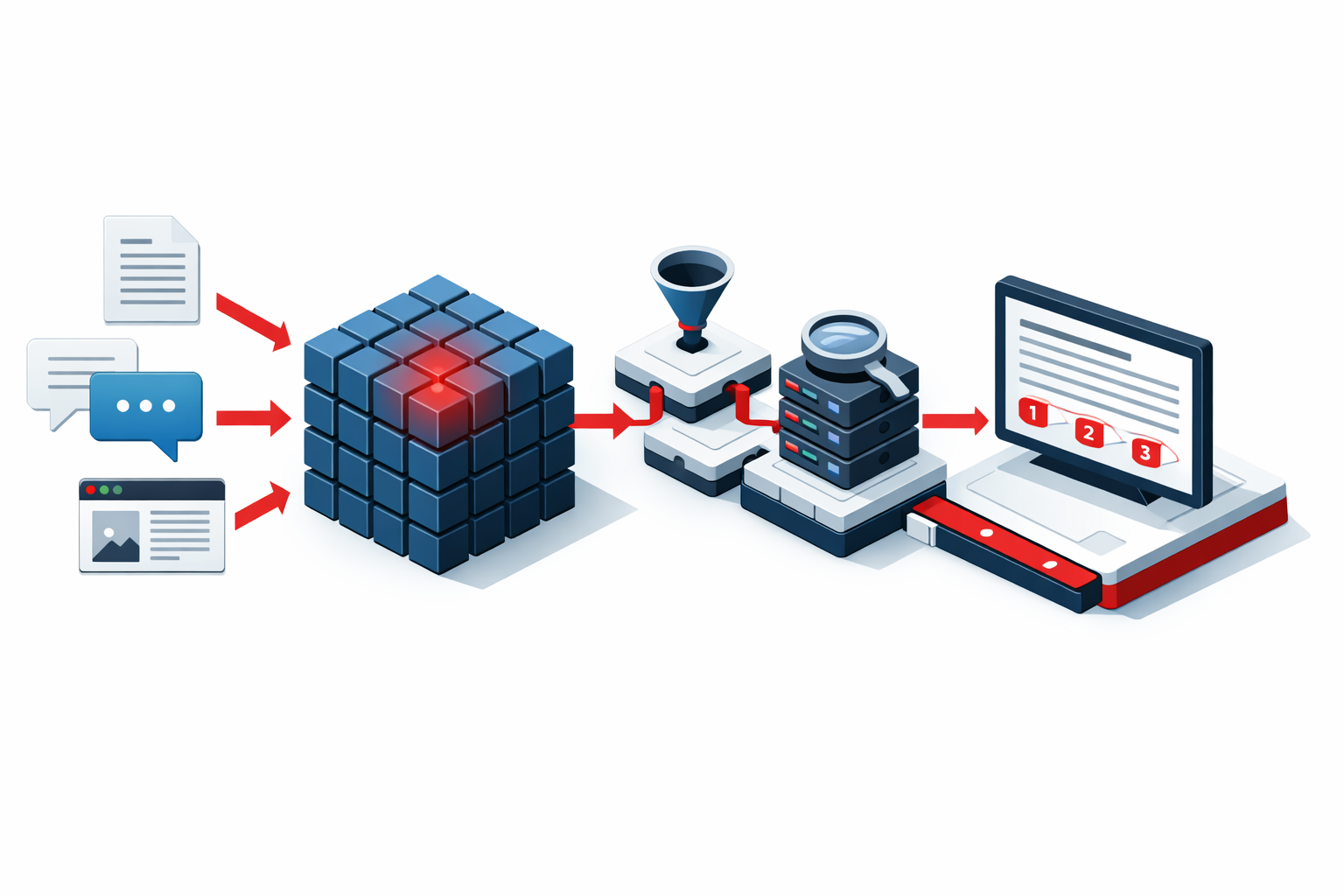
How We Build RAG Systems for River North
We begin with a knowledge inventory: what institutional knowledge assets your River North business has, where they live, what format they are in, and what questions they should be able to answer. For galleries, this includes exhibition records, collector correspondence archives, provenance research files, consignment records, and artist documentation. For Merchandise Mart vendors, this includes project files, specification records, client correspondence, product documentation, and sales history.
We assess the quality and organization of the knowledge base. RAG system quality is directly determined by the quality of the underlying knowledge base. Documents that are poorly organized, inconsistently formatted, or contain inaccurate information produce a RAG system that retrieves and synthesizes poor information. We work with clients to identify and address the most significant quality issues before building the retrieval system.
We build the knowledge base ingestion and indexing pipeline that processes your documents, extracts and structures the content, and builds the retrieval index that allows the system to find relevant information quickly in response to natural language questions. For galleries with extensive PDF archives and scanned documents, this requires optical character recognition and document processing before indexing.
We design the retrieval and synthesis layer that interprets questions, retrieves the most relevant documents from the knowledge base, and synthesizes responses grounded in that retrieved content. The synthesis quality depends on how well the retrieval finds the right documents. We test retrieval quality extensively against real questions your team needs to answer before deploying the system.
Industries We Serve in River North
Art galleries and dealers on Superior Street receive RAG systems built on exhibition archives, collector correspondence histories, provenance research files, artist documentation, and consignment records, making the gallery's institutional knowledge accessible to staff through natural language rather than manual archive search.
Showroom vendors at the Merchandise Mart receive RAG systems built on project histories, specification records, client correspondence archives, product documentation, and pricing decision records, making accumulated sales and product knowledge accessible to staff and new hires at any time.
Boutique hotels on Kinzie Street and Ontario Street receive RAG systems built on operational procedures, vendor relationship records, event documentation, guest service protocols, and property history, preserving institutional knowledge and making it accessible to staff at all levels.
Creative agencies and professional services firms between Clark Street and Ontario Street receive RAG systems built on past project files, client research archives, proposal records, methodological documentation, and case study materials, making the firm's accumulated intellectual capital searchable and reusable.
High-end restaurants on Hubbard Street and Wells Street receive RAG systems built on vendor relationships and sourcing histories, menu development records, event documentation, and operational procedures that preserve the institutional knowledge of how the restaurant operates at its best.
Real estate and property management firms near Marina City receive RAG systems built on property histories, tenant relationship records, maintenance and improvement histories, market research archives, and transaction records that make institutional knowledge about specific properties and the River North market accessible to current staff.
What to Expect Working With Us
1. Knowledge inventory and readiness assessment. We catalog the knowledge assets available, assess their quality and organization, identify the most important knowledge gaps, and evaluate the technical requirements for making the knowledge base RAG-ready. This phase takes two to three weeks for most River North businesses.
2. Knowledge base preparation and ingestion. We process and prepare documents for ingestion, building the structure and quality that makes retrieval accurate. This is often the most time-consuming phase, particularly for businesses with large archives of unstructured historical documents.
3. RAG system development and testing. We build the retrieval and synthesis system, test it against real questions your team needs to answer, and evaluate response accuracy and relevance. We iterate the retrieval configuration until the system consistently produces useful answers to the questions that matter most for your River North operation.
4. Deployment and adoption support. We deploy the system in your operational environment, train your team on how to query it effectively, and support the adoption process. RAG systems produce value only when the team uses them rather than defaulting to manual search habits. We invest in adoption support to ensure the system becomes part of how your team works.