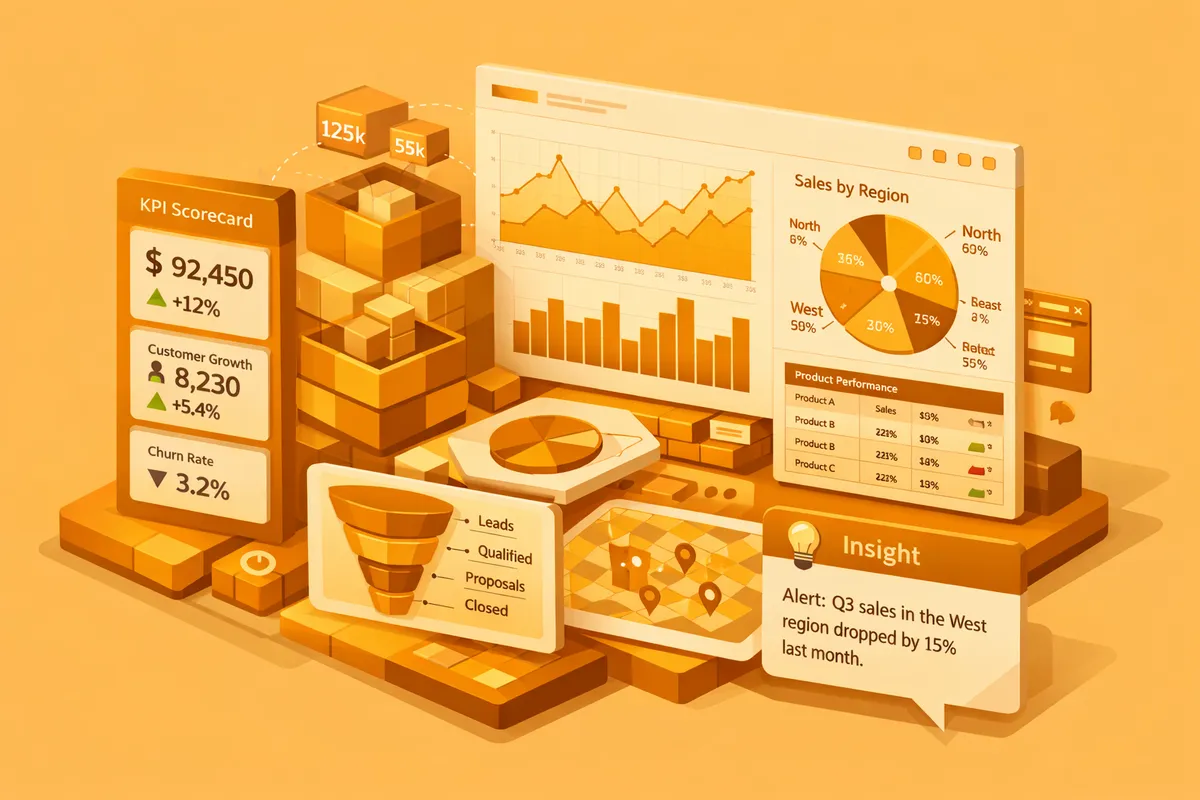
How We Build Business Intelligence for River North
River North BI engagements often involve businesses where the core asset is relationship-based: collector relationships for galleries, trade account relationships for design showrooms, group booking relationships for hotels. We build BI architectures that make those relationship portfolios visible as business metrics rather than contact lists.
For gallery clients, we map the full art sales pipeline from initial inquiry through studio visit, exhibition attendance, and purchase. We connect the gallery management system, the email and communication platform, and the financial system into a unified analytics layer that shows acquisition cost by collector source, conversion rate by price tier, and margin contribution by artist and medium. The result is a dashboard that transforms the gallery director's intuition about which relationships matter into a data-supported view of which relationships are commercially productive.
For boutique hotels near the Merchandise Mart and along Clark Street and Wells Street, we build revenue management analytics that surface forward booking pace, channel contribution, group booking progress against budget, and food and beverage revenue per occupied room. We connect property management systems, channel management platforms, and food and beverage POS data into a dashboard the general manager reviews each morning rather than a report the revenue manager produces each week.
For design showrooms and creative agencies, we build operational dashboards that track the business development metrics most relevant to their relationship-based revenue models: trade account reactivation rates, project pipeline velocity, utilization by team, and margin by client and engagement type.
Industries We Serve in River North
Art galleries in the River North Gallery District along Superior Street use BI to track artist consignment margin, collector acquisition cost by channel, inquiry-to-sale conversion rates, and exhibition ROI. When a gallery director can see that private collector events generate three times the purchase conversion rate of public opening nights at a fraction of the marketing cost, the programming calendar shifts accordingly.
Boutique hotels and hospitality operators near the Merchandise Mart and along Wells Street use BI to monitor daily revenue per available room, booking pace against prior year, channel mix contribution, and food and beverage revenue per occupied room. A well-instrumented River North hotel makes rate decisions daily rather than weekly, capturing the demand signals that short booking windows produce.
Design showrooms and interior design firms operating in River North's trade market build BI around trade account activity, referral source performance, floor traffic conversion, and project pipeline value by designer. The Merchandise Mart's market week calendar creates seasonal patterns in showroom activity that BI makes visible and plannable rather than reactive.
Advertising and creative agencies in River North's renovated warehouse spaces use BI to track client retention, project margin by account, billable utilization by team and discipline, and new business pipeline velocity. For agencies where the relationship between utilization and revenue is direct, real-time visibility into how hours are allocated changes the weekly staffing conversation.
High-end restaurants and bar operators on Hubbard Street and Ontario Street use BI to track covers per server, average check by section, bar revenue as a percentage of total, and private dining booking pace against capacity. The River North dining market's concentration of expense account and event-driven traffic creates revenue patterns that reward operators who can read them in real time.
Professional services firms serving River North's creative and hospitality industries use BI to track matter profitability, client concentration risk, and billing realization rates. For an accounting firm or law practice whose client base is drawn from the gallery and hospitality sectors, understanding which client relationships drive margin is not a quarterly exercise; it is an ongoing operational question.
What to Expect Working With Us
1. Relationship-model mapping session. River North businesses tend to be relationship-driven in ways that standard industry BI templates do not capture. We begin by mapping the specific relationships your business depends on, whether those are collector relationships, trade accounts, group booking contracts, or agency retainers, and we define the metrics that measure the health and commercial productivity of each.
2. Source system inventory and pipeline design. We identify every operating system that holds data relevant to your business decisions: gallery management software, property management systems, channel managers, CRM platforms, accounting systems. We design the extraction and normalization pipeline for each source before any dashboard work begins.
3. Iterative dashboard builds with role-specific review. We build dashboards for the specific roles that will use them, not generic views for the whole organization. A gallery director's dashboard and a gallerist's consignment tracking view serve different purposes and get built and reviewed separately. We deliver working versions every two weeks and refine based on actual user behavior rather than stated preferences.
4. Ongoing analytics partnership. River North businesses in relationship-driven sectors benefit from quarterly analytics reviews where we assess which metrics have stabilized, which new questions the data has surfaced, and where the BI system should expand. We offer structured ongoing engagements for clients who want analytical partnership rather than a one-time build.