How We Build Business Intelligence for Ravenswood
Ravenswood's manufacturing and maker community operates with physical production complexity that most BI implementations are not designed for. We approach production analytics by mapping the production workflow first: what does a batch record look like, what cost inputs does it capture, and how does the production record connect to the inventory and sales records downstream?
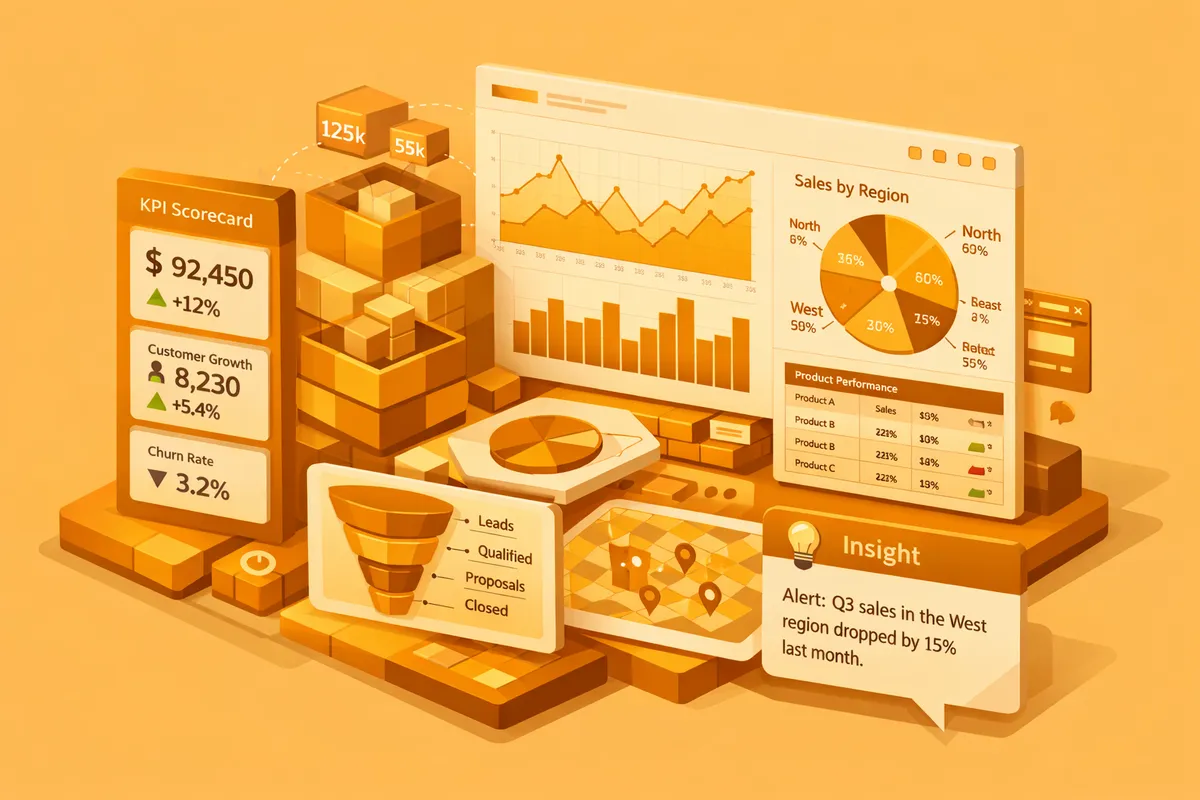
For craft beverage producers along Ravenswood Avenue, the pipeline connects the brewing or distilling production log to ingredient cost records, then connects finished goods inventory to channel sales by SKU. The resulting dashboard shows cost-per-barrel by batch, channel margin by SKU, and the account-level distribution analytics that guide sales allocation decisions.
For artisan food producers and specialty manufacturers on the Ravenswood industrial corridor, the pipeline connects production batch records to input cost data and then to wholesale and retail channel sales. Per-unit cost by SKU and channel margin by outlet are the core metrics.
For custom fabricators on Lawrence Avenue and Ashland Avenue, the pipeline connects job estimates to actual hours and materials by project, producing the job costing variance analytics that improve estimating and reveal the project types that consistently underperform.
We build in Metabase for operations where straightforward analytics without enterprise cost is the right fit, and in Power BI for operations with more complex data models or existing Microsoft infrastructure. We match the platform to the business, not the other way around.
Industries We Serve in Ravenswood
Craft breweries and distilleries on Ravenswood Avenue near Begyle Brewing and Empirical Brewery build production cost and channel revenue analytics that connect batch cost-per-barrel to taproom, retail, and distributor revenue by SKU, enabling the pricing and channel allocation decisions that protect craft beverage margins.
Artisan food producers and specialty manufacturers on the Ravenswood industrial corridor build per-unit cost and channel margin analytics by SKU that make the portfolio profitability decisions concrete: which products to expand, which to discontinue, and which channels to prioritize for each product line.
Metal and wood fabricators on Lawrence Avenue and Ashland Avenue build job costing analytics that track actual hours and material costs against project estimates, revealing the variance patterns that improve estimating accuracy and identify the project types that consistently erode margin.
Design studios on Damen Avenue and Wilson Avenue build project margin and utilization analytics that track billable hours by project type and client, revealing the work that is actually profitable and the accounts worth investing in for growth.
Specialty retailers on Montrose Avenue and Ravenswood Avenue build inventory turn and category margin analytics that connect purchasing decisions to sales performance and identify the product categories worth expanding versus those that consume floor space without generating proportionate margin.
Independent restaurants near Welles Park and along Lawrence Avenue build food cost, labor cost, and revenue analytics that give operators the shift-level operational data they need to make staffing and menu decisions rather than waiting for monthly accounting reports.
What to Expect Working With Us
1. Production workflow mapping. For Ravenswood's manufacturing community, BI starts with understanding the production process: how batch records are created, what cost inputs are captured, and how finished goods connect to sales records. We map the production workflow before designing any data pipeline.
2. Cost and revenue integration. The most valuable BI for a maker business connects production cost to channel revenue in a single view. We design the pipeline to bring cost data and revenue data together in the analytics layer rather than leaving them in separate systems that only connect during monthly accounting.
3. Build with production and sales staff. The head brewer and the taproom manager have different data needs. Both participate in the dashboard design review. Analytics that the production team understands and uses are more valuable than technically sophisticated dashboards that sit unused.
4. Training for operational use. Ravenswood's makers are operators, not analysts. We train your team to read and use the dashboards we build for weekly operational decisions, not for quarterly reviews. The brewery head brewer should pull up the cost-per-barrel dashboard on a Monday morning before deciding whether to adjust a recipe.