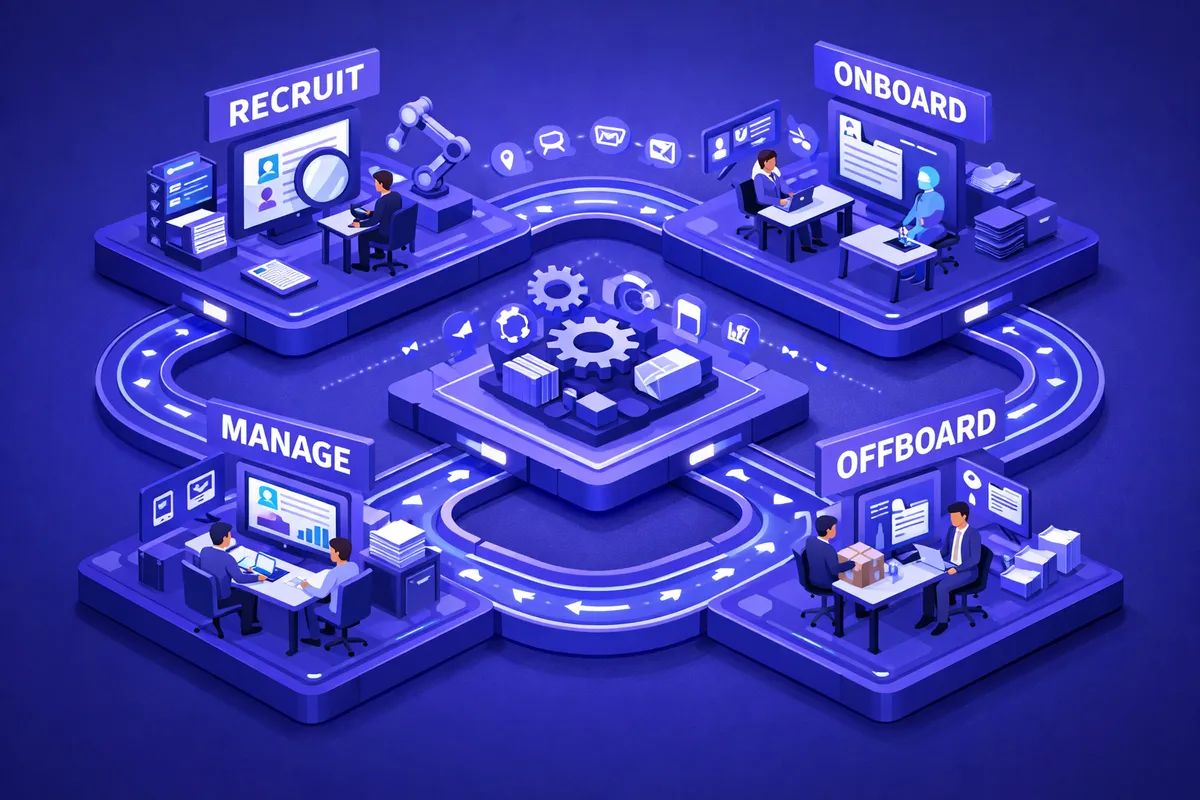
How We Build HR Automation for Pilsen Businesses
We start by cataloging every HR task that your business currently performs manually: who does it, how long it takes, how often it happens, and what the consequences are when it goes wrong or gets forgotten. This catalog typically reveals three to eight processes where automation would have immediate, measurable impact on management time or compliance reliability.
Platform selection follows the assessment. For most Pilsen businesses, the right tools are purpose-built HR and scheduling platforms rather than custom-built systems: Gusto for payroll and benefits automation, Homebase or Deputy for scheduling, BambooHR for onboarding and document management, or combinations that cover the specific workflow gaps identified in the assessment. We evaluate options based on your workforce size, industry, existing software stack, and budget.
Configuration is where the value is realized or lost. A scheduling platform that is set up with the wrong shift definitions, wrong time zone settings, or no connection to your actual employee roster is worse than useless because it generates unreliable outputs. We configure every system we deploy against your real data: your actual employees, your actual shift structures, your actual payroll cadence, and your actual compliance requirements for the Chicago market.
Integration between systems is essential for automation that works. Scheduling data should flow to payroll without re-entry. New hire records created in onboarding should propagate to scheduling, payroll, and document management automatically. We connect systems through available APIs or through configured data exchange processes so that information enters once and populates everywhere it is needed.
Training follows configuration. The managers and employees who will use the systems need to understand not just how to click through the interface but why the system is configured the way it is and what to do when they encounter a situation the configuration did not anticipate. We run separate training sessions for administrators, managers, and employees because each group interacts with the system differently.
Industries We Serve in Pilsen
Restaurants and food service businesses on 18th Street and throughout the neighborhood benefit most from scheduling automation, shift communication tools, and payroll integration that eliminates the time-of-attendance to paycheck gap that manual processes create. We configure platforms that handle tip credit calculations, overtime alerts, and paid sick leave accrual specific to Chicago restaurant operations.
Nonprofits and community organizations need HR automation that handles grant-funded employee categories, volunteer tracking alongside paid staff, and documentation required by funders. The Pilsen community's strong nonprofit sector manages HR complexity that benefits enormously from systems that make grant reporting and compliance documentation automatic.
Retail and small commercial businesses along 18th Street and Blue Island Avenue manage shift-based hourly workforces with scheduling needs that change weekly. We deploy scheduling tools that give employees visibility into their schedule, allow self-service shift swaps within manager-defined rules, and connect to payroll so hours worked translate to paychecks without manual calculation.
Small manufacturing and fabrication businesses in the neighborhood's industrial corridor need time-tracking tools with job cost allocation, so that labor costs attach to specific jobs rather than disappearing into general overhead. HR automation for these businesses often focuses on time-tracking accuracy and payroll integration rather than scheduling.
Home services and contractor businesses need HR tools that handle variable compensation, mileage and expense reimbursement, and the compliance documentation requirements specific to Illinois contractor licensing and employment law.
What to Expect
HR audit and automation roadmap. We document your current HR processes, identify the highest-impact automation opportunities, and sequence them by value and implementation complexity. The roadmap is a practical plan you can execute incrementally rather than a sweeping transformation that disrupts operations.
Platform selection and configuration. We select and configure the tools best suited to your specific situation. We do not implement enterprise systems at small business scale. We choose tools that are appropriately sized for your operation and configure them to match your real workflows rather than defaulting to out-of-box settings that fit generic businesses.
Integration and testing. We connect the systems we deploy and verify that data flows correctly before go-live. We test edge cases: partial-week hires, employees with multiple pay rates, shift swaps that cross pay periods. These edge cases are where automation breaks in ways that create payroll errors, and we find them in testing rather than in production.
Training and ongoing support. We train administrators and employees, monitor the systems during the initial weeks, and are available to adjust configurations when real-world usage reveals gaps in the initial setup.