How We Build Employee Portals for Pilsen Businesses
Our process starts with how your team actually works today, not how a software template assumes they work. We interview your managers, your HR staff if you have them, and a sample of frontline employees. We map every workflow that is currently manual: how new hires get onboarded, how shift changes are communicated, how time-off requests are handled, how policy updates are distributed. For bilingual workforces common across Pilsen, we assess language needs from the first conversation so that interface design and content translation are built into the project, not added as an afterthought.
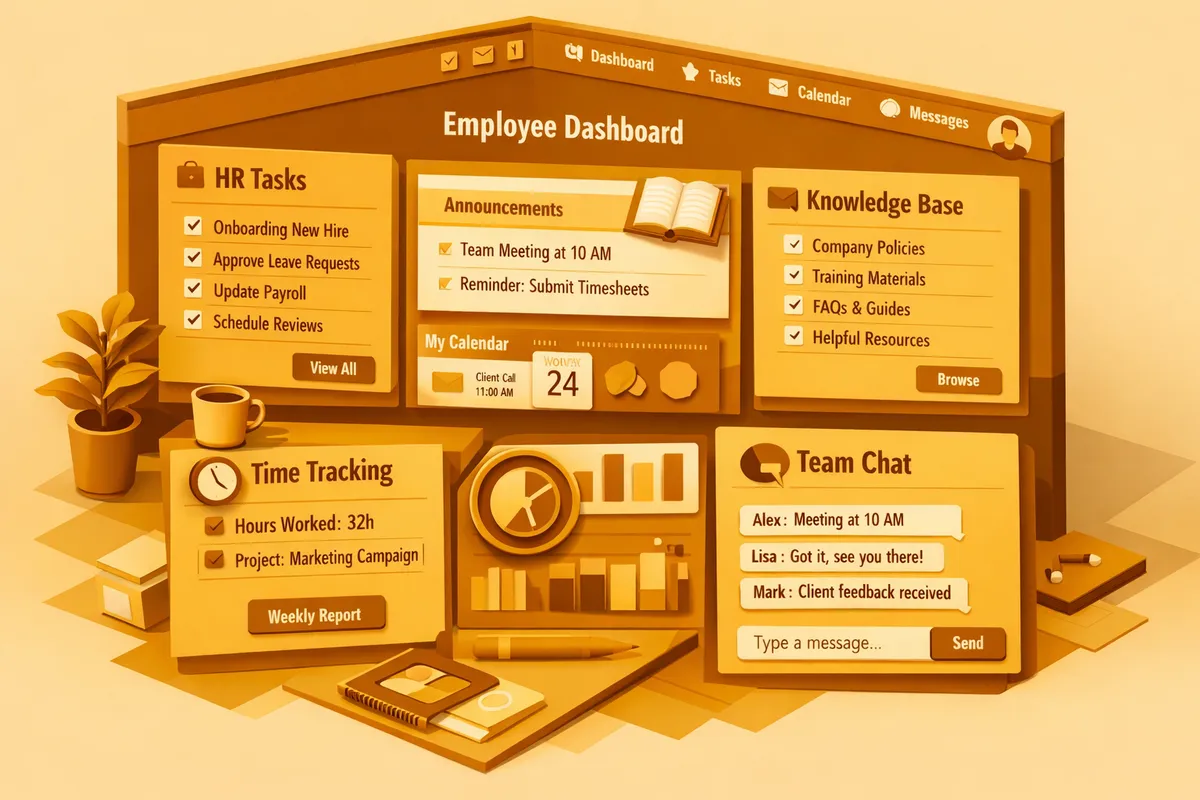
We design role-specific portal experiences. The back-of-house crew at a 18th Street restaurant needs a different interface than the front-of-house team, and neither of those looks like what the nonprofit director on Racine Avenue needs. Role-based access control determines what each user sees, what they can edit, and what requires manager approval. This is not just a security feature. It is what makes a portal usable rather than overwhelming.
Integration with existing systems is a core part of every project. Most Pilsen businesses are already using payroll software, scheduling tools, or accounting platforms. We integrate the portal with those systems so data flows automatically rather than requiring duplicate entry. When an employee's pay stub is generated in Gusto or ADP, it appears in the portal without anyone doing additional work. When a manager approves a time-off request in the portal, it updates the scheduling system.
We build for mobile access first. Many of Pilsen's frontline workers check work information from their phones, not from a desktop computer. A portal that only works well on a desktop is a portal that does not get used. Every feature we build functions on mobile devices with the same reliability and clarity as on a larger screen.
Industries We Serve in Pilsen
Restaurants and food service operations on 18th Street and across the neighborhood's commercial corridors use employee portals to manage shift scheduling, time-off requests, onboarding documentation, and communication across kitchen and front-of-house teams. For bilingual restaurant crews, we build interfaces and policy libraries in both English and Spanish so that critical information is accessible to every team member.
Community organizations and nonprofits like Pilsen Neighbors and similar organizations managing community programs use portals to track staff hours by grant program, distribute policy updates, coordinate volunteers, and maintain compliance documentation required by funders. Portals built for nonprofit operations often require more granular time-tracking categories than commercial HR systems provide.
Art studios and fabrication businesses in the Chicago Arts District manage mixed employment types, project-based work schedules, and materials and equipment access that requires documentation. Portals for creative and fabrication businesses handle contractor agreements alongside employee records and give managers visibility into which workers are available for upcoming projects.
Retail and small commercial businesses along 18th Street and Blue Island Avenue use portals to handle onboarding for hourly workers, manage seasonal scheduling, track training completions, and distribute operational updates without relying on group text threads that miss people and preserve nothing.
Health clinics and social services organizations serving Pilsen's community need portals that handle credential tracking for licensed staff, document training completions required by licensing bodies, and manage scheduling across multiple service sites. Compliance documentation requirements in social services and healthcare make a systematic portal more than a convenience.
What to Expect
Discovery and workflow mapping. We spend the first two weeks understanding your organization. We interview managers, employees, and anyone who currently handles HR administration. We document every workflow, identify which are candidates for automation, and define the compliance requirements specific to your industry and workforce. This phase produces the specification that guides every design and development decision.
Design and user experience. We produce detailed wireframes and workflow diagrams reviewed by your team before any development begins. Role structures, permission levels, and integration architecture are confirmed at this stage. For Pilsen businesses with bilingual workforces, we finalize translation requirements and verify that all user-facing content is professionally translated rather than machine-generated.
Build and testing. Core HR self-service functionality is delivered first. You begin gaining value before the full build is complete. User acceptance testing involves real employees across roles, not just managers. Feedback from testing is incorporated before each phase launches.
Launch, training, and ongoing support. We train your administrators and managers on managing the portal day to day. We provide 60 days of post-launch monitoring to catch adoption gaps and technical issues. Ongoing development is available for organizations that need to expand portal capabilities as they grow.