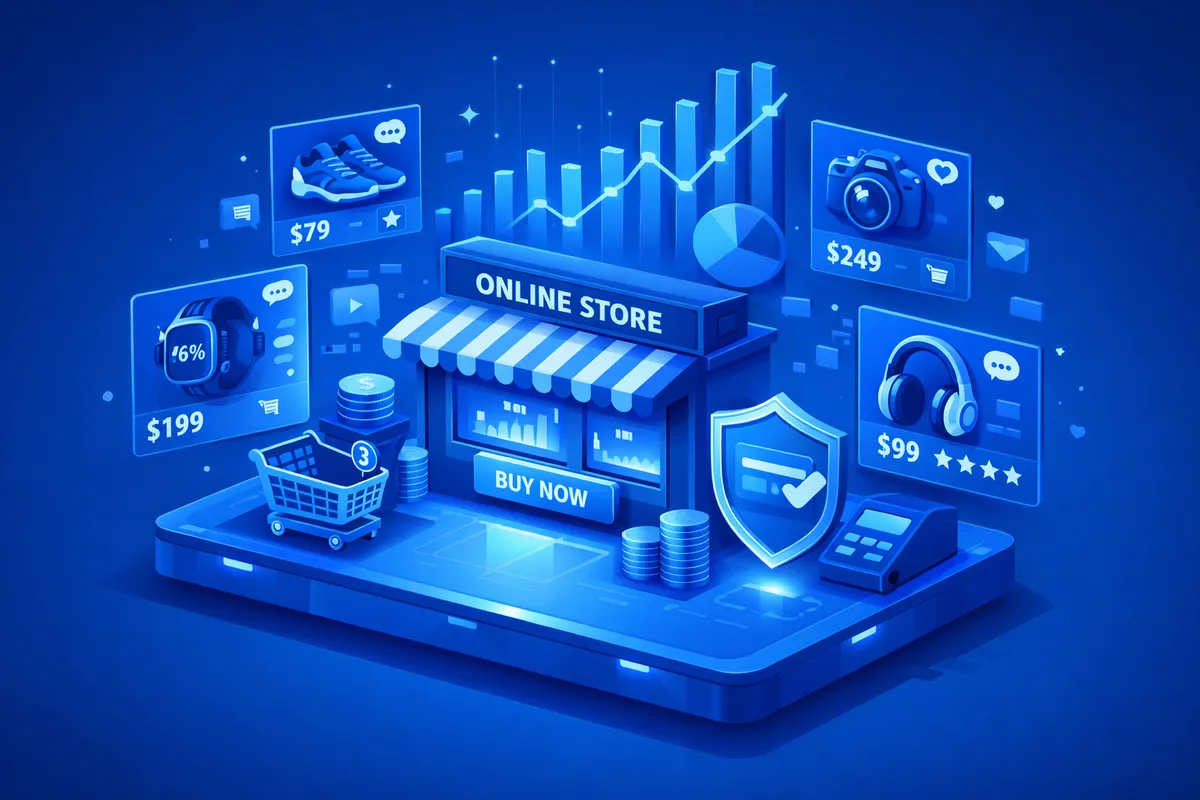
How We Build E-commerce for Pilsen
E-commerce development for Pilsen businesses starts with product and audience analysis. What are you selling? Who is buying it? How do they currently discover it? What does the purchase journey look like from discovery to decision? What objections arise before purchase? Those questions shape everything from the information architecture to the content strategy to the payment flow.
Platform selection is the first technical decision. For most Pilsen small businesses, we build on Next.js with custom design rather than Shopify or WooCommerce, because custom builds produce stores that are faster, more distinctive, and more tightly integrated with your specific operational systems. For businesses that need Shopify's ecosystem of apps and payment infrastructure, we build custom Shopify themes that avoid the template look while using Shopify's proven commerce backbone.
Product presentation is where e-commerce for Pilsen's artisan businesses most needs to depart from generic template design. A ceramics piece needs multiple high-quality photographs from different angles, a description that communicates material, process, and scale accurately, and ideally a short video showing the piece in context. Specialty food products need ingredient photography, provenance storytelling, and the preparation or serving context that makes the purchase tangible. We design product pages for the specific nature of your products.
Checkout and payment are built for conversion. A checkout flow that requires too many steps, does not save payment information for returning customers, or creates anxiety about security loses sales at the last moment. We build checkout flows that are clear, fast, and trustworthy, with multiple payment methods including credit cards, Apple Pay, Google Pay, and where appropriate, Buy Now Pay Later options for higher-priced artisan goods.
Fulfillment integration connects the store to your operational systems. For a food producer, that means connecting order data to your production scheduling and shipping carrier systems. For a gallery, it means connecting purchases to your inventory management system and, for shipped work, to your fulfillment and shipping workflow. For a restaurant selling packaged goods, it means connecting online orders to your production and pickup or delivery workflow.
Analytics and growth tools connect the store to the marketing infrastructure that drives discovery and repeat purchase. Email list capture, remarketing pixel installation, conversion tracking, and the SEO structure that makes the store findable through organic search.
Industries We Serve in Pilsen
Ceramics studios and visual artists in the Chicago Arts District use custom e-commerce to sell work directly to collectors and gift buyers across Chicago and nationally, with product pages and store design that reflect the gallery quality of the work being sold.
Specialty food producers on Blue Island Avenue and throughout Pilsen use custom e-commerce to sell their products to Chicago retail buyers and direct consumers, with the storytelling and product presentation that differentiates specialty products from commodity food items.
Artisan businesses on 18th Street and Halsted that sell handmade goods use custom e-commerce to extend their neighborhood reputation to buyers who discover them through social media, press coverage, and organic search, then purchase without visiting the physical location.
Restaurants that develop packaged goods, merchandise, or specialty food products use custom e-commerce to build a direct-to-consumer product business alongside their primary service, with fulfillment workflows that work within their operational constraints.
Galleries use custom e-commerce to sell prints, reproductions, artist publications, and select original works in an online environment that reflects the gallery's aesthetic standards and presents the work in context.
What to Expect Working With Us
Product and audience discovery. We understand your products, your buyers, and your current sales channels before designing anything.
Store design and prototype. We design the store experience and build an interactive prototype for your review before full development begins.
Development and integration. We build the store with all product pages, checkout flow, and operational integrations. We test the complete purchase flow before launch.
Content and product photography guidance. We provide guidance on the product photography and copy your store needs to convert visitors, and we can produce AI-assisted product photography for your initial product catalog.
Launch and marketing setup. We launch the store, configure analytics and marketing tools, and ensure the store is indexed and findable through search.
Post-launch support. We provide post-launch support for any issues and ongoing support for store updates, new product additions, and feature expansion.