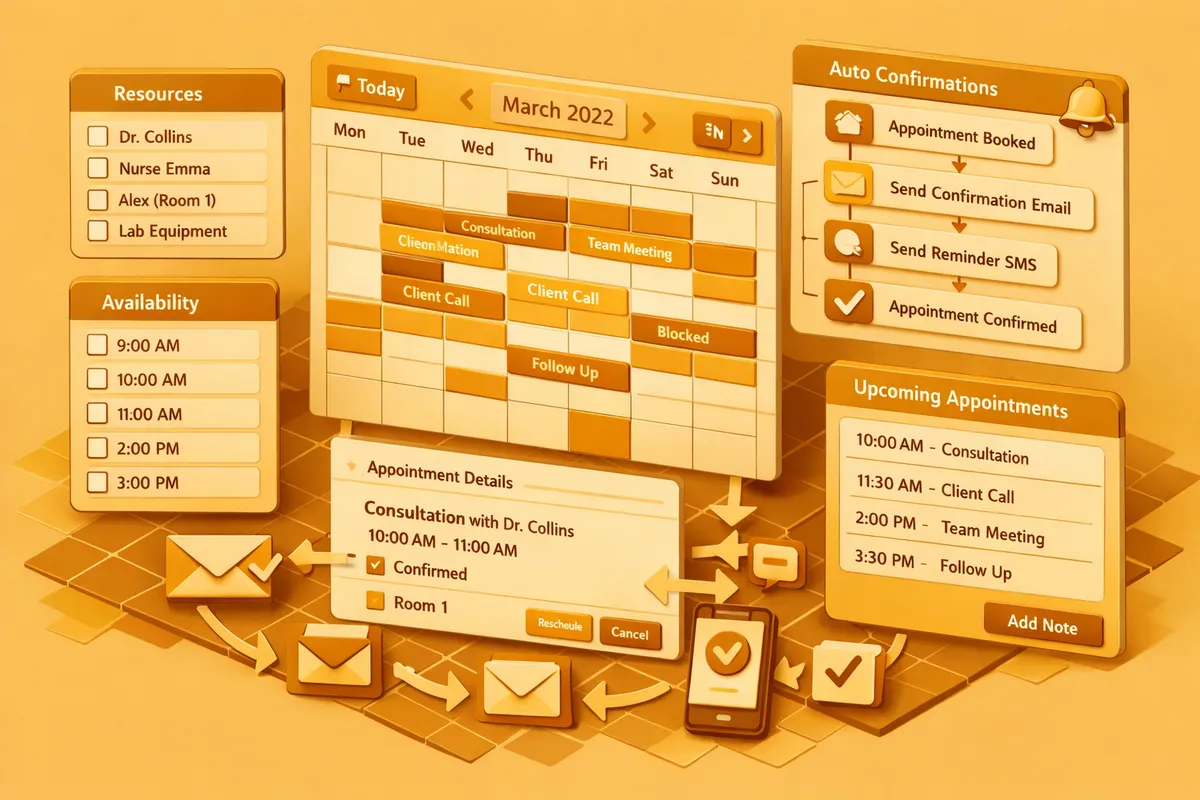
How We Build Booking Systems for Pilsen Businesses
Designed for Independent Operators
We build booking systems for Pilsen's reality: small teams, tight budgets, and operators who are skilled at their craft but do not have time for complex technology management. The system needs to be configured once and run itself. The owner checks the daily schedule, handles exceptions, and lets the system manage everything else.
Setup starts with the operator's actual workflow. We do not impose a standard template. A ceramics studio that offers five different booking types gets five distinct booking flows, each configured for its specific requirements. A sole practitioner who offers two service types gets a simple two-option booking page. The system's complexity matches the business's complexity, nothing more.
For businesses with tight margins, we select cost-effective platforms and configure them to maximize value. A solo acupuncturist does not need the same booking platform as a 50-person fitness studio. We match the tool to the operator's actual needs and budget, avoiding over-engineering that creates unnecessary cost and complexity.
Bilingual Booking for Pilsen's Community
Pilsen's Mexican-American community represents a significant portion of the neighborhood's customer base. Many residents are bilingual, and some prefer to interact in Spanish. Businesses that serve this community benefit from booking systems that operate in both English and Spanish.
We configure bilingual booking interfaces where the customer selects their preferred language at the start of the booking flow. Service descriptions, confirmation messages, reminders, and follow-up communications all deliver in the selected language. A parent booking a birthday workshop at a ceramics studio can complete the entire process in Spanish, receiving confirmations and logistics details in Spanish, without the studio owner needing to manually translate each communication.
For businesses where staff are bilingual but automated communications have historically gone out in English only, adding Spanish-language automation improves the experience for a significant customer segment. The booking system sends the right language to the right customer based on their preference, with no manual intervention required.
Gallery and Studio Booking for Creative Businesses
Pilsen's art galleries and creative studios need booking systems for exhibition viewings, studio visits, workshops, and events. The National Museum of Mexican Art and the surrounding gallery district draw visitors who want to see exhibitions, attend openings, and participate in cultural programming.
For galleries, we configure viewing appointment booking that distinguishes between casual visitors, collectors, press, and curators. Each visitor type sees appropriate booking options. A collector booking a private viewing provides their collection focus and interest areas. A journalist booking a preview receives press materials in advance. An educator booking a group visit provides group size, age range, and curriculum focus.
For studios that offer public workshops, the booking system manages class registration with capacity limits, material fees, skill-level requirements, and bilingual pre-class communications. A weekend screen-printing workshop books participants through an online registration page that collects sizing for merchandise, experience level, and design preferences. The instructor receives this information before the workshop so they can prepare materials and adjust the lesson plan for the group's skill level.
Open studio and co-working space booking manages hourly or daily access for shared creative facilities. A photographer booking a shared studio space selects their time slot, specifies equipment needs, and pays the rental fee through the booking flow. Access instructions and studio rules deliver automatically upon confirmation.
Industry Solutions Across Pilsen
Restaurants on 18th Street
18th Street's restaurant scene has grown from a neighborhood taqueria corridor into a dining destination that draws visitors from across Chicago. Restaurants that once operated entirely on walk-in traffic now face demand that benefits from reservation management.
For restaurants transitioning to reservations, we implement a gradual approach. Start with weekend dinner service, where demand consistently exceeds capacity. Offer reservations for 6 to 9 p.m. on Friday and Saturday while keeping all other service times walk-in. The system manages the reserved tables while the host continues handling walk-ins for unreserved seating. As the restaurant and its customers adapt, reservation availability expands.
Walk-in management improves even without full reservation adoption. A virtual waitlist lets arriving customers join a queue from their phone, see an estimated wait time, and receive a notification when their table is ready. They can browse 18th Street's shops and galleries instead of standing in a crowded vestibule. The host manages the waitlist alongside any reservations in one view.
For restaurants that host events, Dia de los Muertos dinners, live music nights, mezcal tastings, and seasonal celebrations, the booking system manages event tickets, capacity, and communications. An event page on the restaurant's website handles registration with pricing, capacity limits, and menu details. Automated confirmations include event logistics and any preparation information.
Wellness and Holistic Practitioners
Pilsen's wellness community includes acupuncturists, massage therapists, herbalists, curanderos, yoga instructors, and holistic health practitioners. Many operate from shared spaces, home studios, or part-time locations. Their booking needs are straightforward but essential: show available times, let clients book, send confirmations and reminders, and manage cancellations.
We configure simple, effective booking systems for these practitioners. Available appointment times display on a clean booking page embedded in the practitioner's website or shared through their social media. Clients select a service, choose a time, complete any intake requirements, and receive instant confirmation. Reminders send 24 hours before the appointment. Post-visit follow-ups encourage rebooking and provide aftercare instructions relevant to the treatment received.
For practitioners in shared spaces, the booking system coordinates room availability with practitioner schedules. An acupuncturist who practices Tuesday and Thursday afternoons in a shared wellness suite sees only those days as available in their booking calendar. The room is available for other practitioners at other times. The shared space manager sees all practitioners' bookings in one view to ensure no room conflicts.
Intake forms for new clients collect health history, treatment goals, and any conditions the practitioner needs to know about before the session. The practitioner reviews the intake before the appointment rather than using the first 10 minutes of a session on paperwork. For practitioners who accept sliding-scale or income-based pricing, the booking system can present pricing options during checkout without requiring an awkward in-person conversation.
Creative Workshops and Maker Spaces
Pilsen's maker economy includes ceramics studios, print shops, woodworking studios, jewelry-making workshops, textile arts spaces, and collaborative art facilities. These businesses run a mix of regular classes, special workshops, open studio access, and private events.
For regular classes, the booking system manages semester or session enrollment with weekly scheduling, capacity limits, and prerequisite tracking. A ceramics studio offering beginner, intermediate, and advanced wheel-throwing classes routes students to the appropriate level based on their experience. A screen-printing shop offering introductory and advanced workshops prevents beginners from enrolling in sessions that assume prior knowledge.
Equipment and facility booking manages shared resources. Kiln-firing slots, printing presses, darkrooms, and specialized equipment book by the time block with appropriate setup and cleanup buffers. The system prevents the double-booking that occurs when equipment scheduling happens through informal channels. Every potter with kiln access sees the same availability and books through the same system.
Birthday parties and private events at creative studios book through a dedicated workflow with date selection, package options, participant count, age range, and special requests. The system sends pre-event logistics to the booking parent and post-event follow-up with photos and a review request.
Galleries and Cultural Institutions
Pilsen's gallery scene, centered around the blocks near 18th and Halsted and extending to the National Museum of Mexican Art, draws collectors, art enthusiasts, students, and tourists. Galleries use booking for private viewings, group tours, educational programming, and event space rental.
Exhibition-related programming books through event-specific pages: opening reception RSVPs, artist talks, panel discussions, and curator tours each have their own booking flow with capacity management and appropriate communications. A curator tour limited to 15 participants manages enrollment, sends preparation materials about the exhibition, and follows up with exhibition catalog information.
For galleries offering residency programs, application and scheduling manage through the booking system. Artists apply for residency slots with portfolio submission, statement of intent, and preferred dates. The gallery reviews applications through a pipeline view and confirms residencies with automated welcome communications that include studio access details, community guidelines, and exhibition opportunity information.
What to Expect Working With Us
1. Independent operator assessment. We evaluate your booking needs based on your actual team size, technical comfort level, and budget. No over-engineering.
2. Multi-service booking configuration. Whether you offer two service types or ten, we build distinct booking flows for each within one unified system.
3. Bilingual setup. For businesses serving Pilsen's bilingual community, we configure English and Spanish booking interfaces and automated communications.
4. Creative business specialization. For studios, galleries, and maker spaces, we build booking that handles the unique requirements of creative businesses: workshops, equipment sharing, exhibitions, and events.
5. Launch and low-maintenance operation. After launch, the system requires minimal daily attention. You focus on your work. The system manages your schedule.