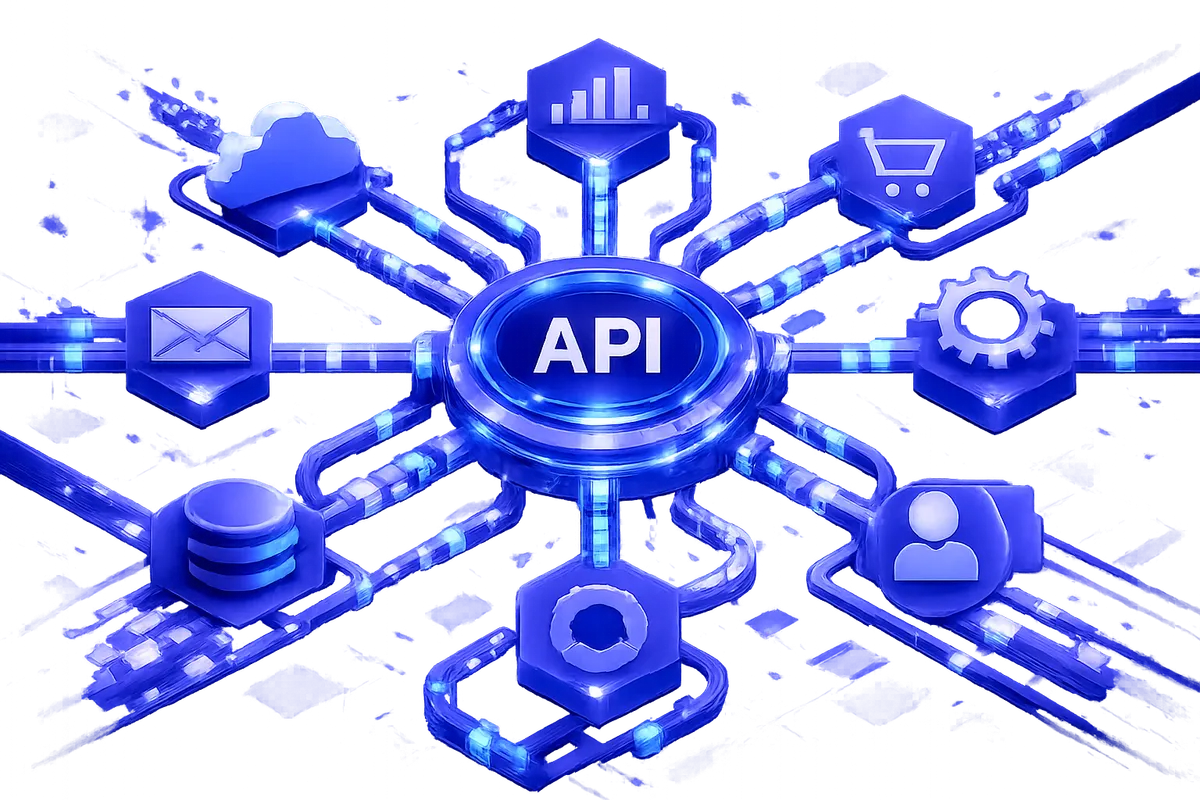
How We Build API Integrations for Pilsen
Every integration project starts with a data flow audit. We document every software tool in your stack, what data each tool generates, where that data currently goes, and where it needs to go to serve your operations. That audit produces a map of integration opportunities ranked by the operational value each connection would create.
Direct API connections are the simplest integration when software vendors have built compatible APIs. Connecting QuickBooks to Square, Mailchimp to your e-commerce platform, or a booking system to your CRM often involves configuring existing integration features rather than building custom code. We evaluate available connectors for your specific tool combination before building custom solutions.
Integration middleware handles the connections that require transformation of data between systems. When your reservation system records customer information in a format that your CRM does not accept directly, middleware normalizes the data format during transfer. When your POS system generates transaction data that needs to be summarized before entry into your accounting system, middleware handles the aggregation logic.
Custom webhook integrations handle event-driven connections. When an order is placed, your inventory system needs to be updated immediately. When a customer's payment fails, your customer service system needs an alert. Webhook integrations trigger these responses in real time without waiting for a scheduled data sync.
Scheduled sync jobs handle data that can be transferred on a defined schedule rather than in real time. Daily sales totals from your POS to your accounting system. Weekly customer list updates from your e-commerce platform to your email marketing platform. Nightly inventory reconciliation between your ordering system and your accounting. These scheduled syncs handle the bulk of routine data movement with predictable, low-maintenance automation.
Error handling and monitoring is built into every integration. Data transfers fail. APIs go down. Data formats change when vendors update their software. We build retry logic, error alerts, and monitoring into every integration so failures are caught and corrected before they create downstream data problems.
Industries We Serve in Pilsen
Restaurants and food businesses on 18th Street and throughout Pilsen use API integration to connect POS systems to accounting, email marketing, inventory management, and payroll platforms, eliminating the manual data transfers that consume staff time after each service.
Galleries and arts organizations in the Chicago Arts District use API integration to connect ticketing, CRM, email marketing, and accounting systems so collector and visitor data flows automatically between the platforms that need it.
Service businesses across Pilsen use API integration to connect lead capture forms to CRM, CRM to email automation, and project management systems to invoicing platforms, creating automated workflows that move each customer through the business process without manual coordination.
Community organizations use API integration to connect program registration platforms to participant tracking databases, donor management systems to accounting, and communication platforms to event management tools.
Retail businesses on Halsted and Damen use API integration to connect inventory management to e-commerce storefronts, point of sale to accounting, and customer data to email marketing platforms.
What to Expect Working With Us
Integration audit and map. We document your tool stack and identify the integration opportunities that will produce the most operational value, ranked by impact and implementation complexity.
Integration build and testing. We build each integration, test with real data from your systems, and validate that outputs match what your receiving systems expect before going live.
Parallel validation period. We run the automated integration alongside your existing manual process for a defined period so you can verify accuracy before depending on the automation exclusively.
Documentation and training. We document every integration we build and train your team on how to identify when integrations are working correctly and what to do when something looks wrong.
Ongoing monitoring and support. We provide ongoing monitoring and maintenance to handle the vendor API changes, platform updates, and data format changes that require integration adjustments over time.