How We Build Employee Portals for Old Town
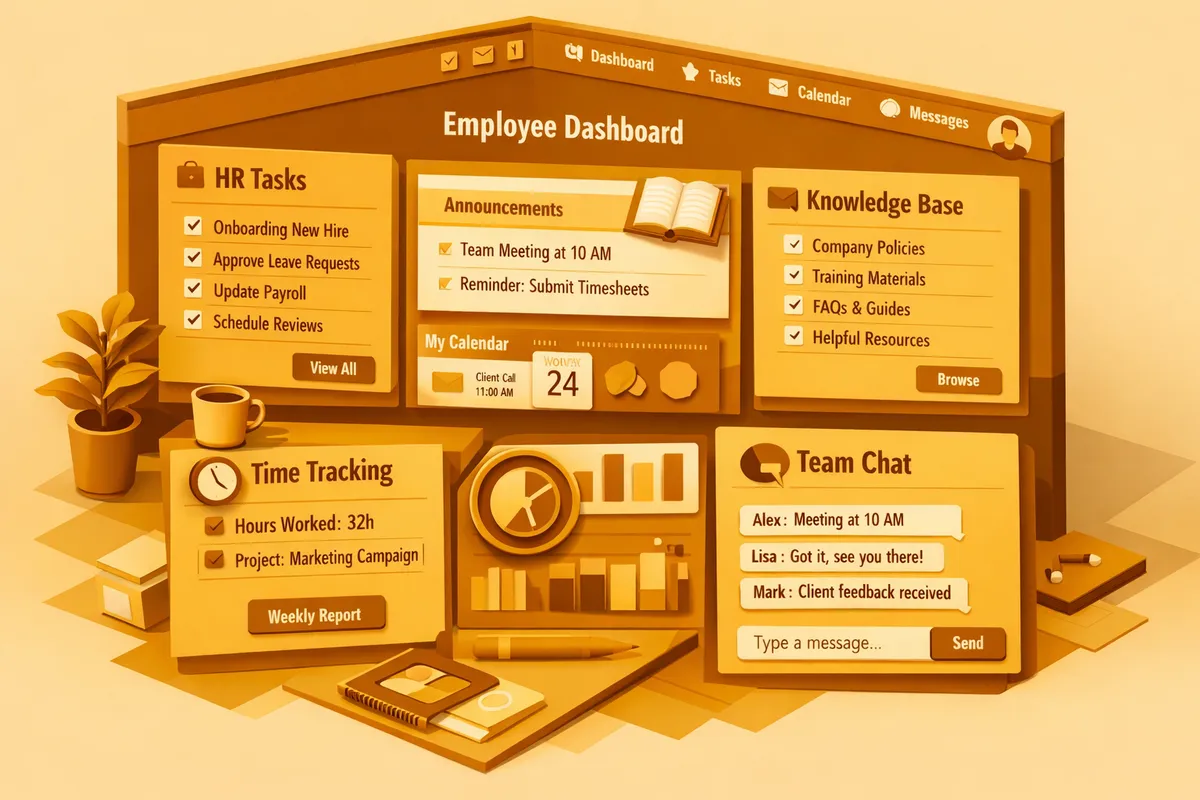
We design employee portals around the roles that exist in your specific business, not a generic template of what an employee portal should contain. A comedy club on Wells Street has backstage staff, front-of-house staff, bar staff, and box office staff, each with different scheduling patterns, different document types, and different communication needs. The portal has role-specific views: the stage manager sees crew call times and production schedules; the box office staff sees shift assignments and ticket sales summaries; the bar team sees inventory pull lists and shift close procedures.
Setup begins with a role and workflow inventory. We document every HR and scheduling workflow that currently requires a manager's direct involvement: schedule creation and communication, shift trade requests and approvals, time-off requests, onboarding document collection, payroll question resolution, and performance documentation. Each workflow maps to a portal feature. Our goal is that every workflow on that list moves from manager-initiated to employee-initiated or fully automated by the time the portal launches.
For businesses on Sedgwick Street and the residential blocks with smaller, more stable teams, the portal design emphasizes communication and performance: team announcements, document storage, training materials, and direct manager messaging. For the high-turnover hospitality businesses on the entertainment strip, it emphasizes self-service onboarding, digital document collection, and mobile-first schedule access.
Industries We Serve in Old Town
Comedy clubs and performance venues along Wells Street manage a workforce that includes both hourly staff and performers on contract arrangements. An employee portal built for a venue like Second City adjacent businesses handles both: hourly staff see schedules and pay stubs in the standard employee view, while contracted performers access their agreements, payment schedules, and production documents through a separate portal view with appropriate access controls.
Restaurants and bars between North Avenue and Eugenie Street run on shift schedules that change weekly and generate constant communication overhead. Employee portals for these businesses center on schedule access and shift communication: staff see their schedule immediately after it posts, request trades directly in the portal, and receive automatic notifications when a covering shift is confirmed. Manager approval happens with one tap instead of a series of texts.
Boutique retailers on Wells Street with small, stable teams use employee portals primarily for HR document storage, training materials, and performance tracking. Onboarding a new sales associate includes digital completion of tax documents, a library of product training modules, and access to the store's policies and procedures, all accessible from the portal before the first shift.
Medical and dental practices near LaSalle Drive have compliance-driven documentation requirements that employee portals handle well. Credential tracking, HIPAA training completion records, professional license expiration reminders, and employee acknowledgment of policy updates all flow through the portal with automated reminders and auditable completion records.
Interior design studios and project-based businesses in the Old Town Triangle area use employee portals to share project documentation, track time against client projects, and manage contractor relationships alongside full-time staff. The portal provides a single location for all team members regardless of employment type to access current project information and submit time and expense records.
Real estate offices on LaSalle Drive use employee portals to manage agent licensing records, continuing education tracking, transaction documentation checklists, and commission statement access. A portal that centralizes all of that removes the administrative coordination that typically falls on a managing broker's assistant.
What to Expect Working With Us
1. Workflow and role mapping. We document every administrative and HR workflow currently handled by a manager or owner and map each to a portal feature. This inventory typically surfaces three to five workflows that no one has systematically analyzed before but that consume significant manager time when added up across a month.
2. Role-based portal design. We design the portal interface for each employee role in your business. Managers see the admin view with approval queues and reporting. Employees see the self-service view with their records, their schedule, and their request forms. We present the designs before development begins so you can validate that the proposed views match actual workflows.
3. Integrations and data migration. We connect the portal to your existing payroll processor and scheduling tool where integrations are available. Employee records, historical pay statements, and existing PTO balances migrate into the portal before launch so employees see a complete history from day one, not just data from the go-live date forward.
4. Staff rollout and adoption support. A portal only works if staff actually use it. We plan the rollout with you: announcement timing, a brief orientation for each team, and a two-week period where managers actively direct staff to the portal for requests they would otherwise handle directly. Most Old Town businesses reach 80-plus percent active portal adoption within the first month when the rollout is managed deliberately.