How We Build Document Management Systems for Old Town
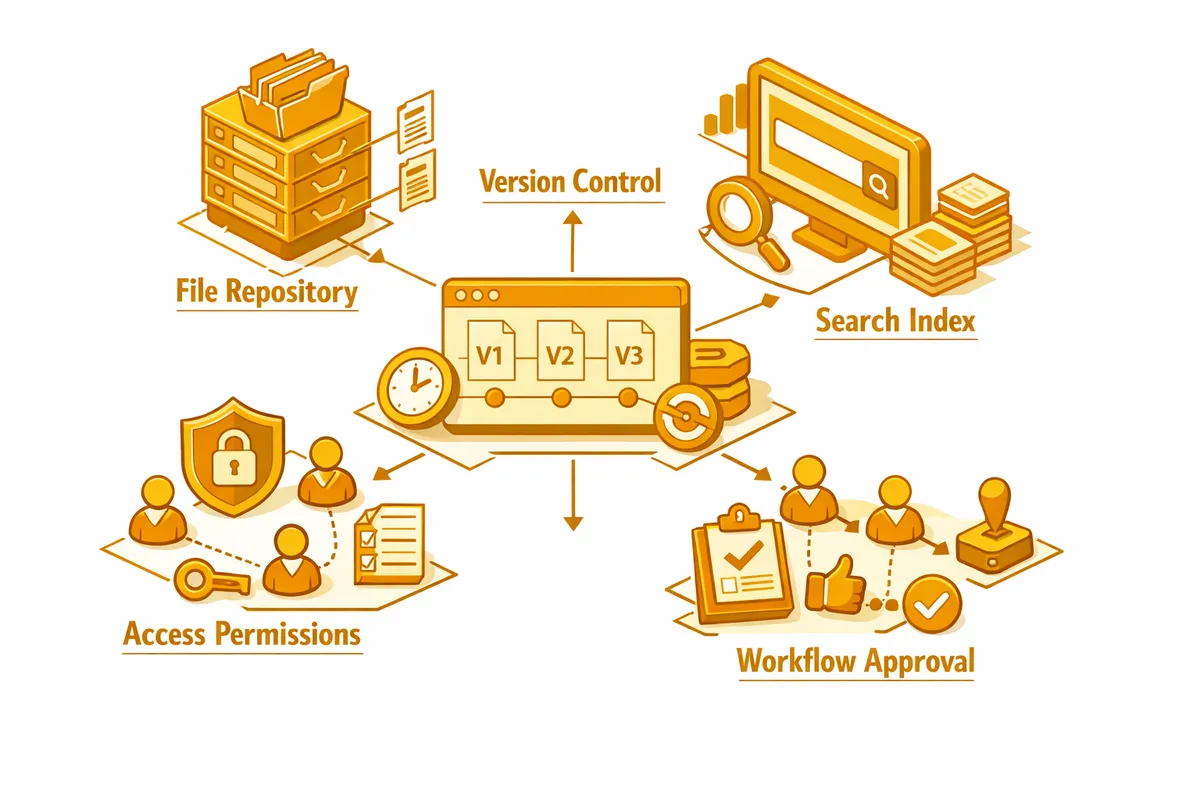
Every engagement begins with an intake that maps the full document universe of the business: what types of documents exist, where they currently live across physical files, email, shared drives, and cloud storage, who needs access to which document types, and what retrieval scenarios the business faces most often. For a Wells Street boutique retailer, that intake might reveal that vendor contracts live in a drawer, lease documents are in a personal Dropbox, and insurance policies are accessible only to the owner. For an interior design firm, it might reveal that client project files are organized by client name in one person's desktop folders in a structure no one else understands.
From the intake we design the taxonomy that matches how the business operates. An interior design firm in Old Town needs a project-centric taxonomy: every client and project is a container, and every document belongs to a project, a client, and a document type within that project. Contracts, proposals, material specifications, invoices, and correspondence are all tagged and searchable. For a real estate office on Sedgwick Street, the taxonomy is transaction-centric: each property and transaction is the organizing unit, and every document associated with a transaction, from listing agreement through closing, is tagged, versioned, and searchable.
Access controls are designed from the start around who actually needs what. In a small Old Town boutique, the owner needs access to all documents. A manager needs vendor and operational documents but not financial or HR records. Staff need access to the operational documents relevant to their function. These access structures are configured once and maintained as roles change, rather than managing permissions document by document.
Industries We Serve in Old Town
Boutique retailers and independent shops along Wells Street and the Old Town Triangle manage vendor contracts, lease documents, insurance policies, sales records, and tax filings. A document system organized around business function lets a small retail operation retrieve any document in seconds without relying on the memory of the person who filed it. When a vendor dispute arises or a lease renewal requires the original agreement terms, the documents are there.
Interior designers and home furnishing studios in Old Town manage client contracts, project specifications, material orders, and invoices across multiple concurrent projects. A project-centric document system with version control for design specifications and client approval records keeps the paper trail clear for each engagement. When a client questions a material selection or a scope change made six months into a project, the system shows the full record.
Comedy clubs and entertainment venues, including the establishments that form Old Town's entertainment corridor, manage performer contracts, booking agreements, licensing documents, and event records. These documents need retention policies that preserve the full record for the duration of possible disputes, version control for agreements that are often negotiated through multiple drafts, and access controls that separate financial terms from operational records.
Medical and dental practices on LaSalle Drive and near Moody Church operate under HIPAA requirements for patient record retention, access controls, and audit trails. A document management system built for small and mid-size practices enforces record integrity and access controls without the cost and complexity of enterprise healthcare software. Retention policies are configured to the specific holding periods that HIPAA and state medical record law require.
Real estate offices and brokerages in Old Town manage property disclosures, purchase agreements, inspection reports, title documents, and closing binders across a continuous rotation of transactions. A transaction-centric document system with full version control for negotiated agreements and a complete record of each transaction preserves the documentation that supports the business when disputes arise and makes regulatory audits manageable.
Professional service firms including law offices, financial advisors, and consulting practices operating from the Old Town area manage client files, engagement letters, work product, and compliance records. A client-centric taxonomy with access controls tied to matter teams and version control for deliverables brings document discipline to small professional firms that have been managing with shared drives and email.
What to Expect Working With Us
1. Discovery and document mapping. We walk through your current document storage across physical files, shared drives, email, and cloud accounts to build a complete picture of what exists and what the business needs to find. This includes understanding the retrieval scenarios that matter most: vendor disputes, client requests, audits, renewals, and transactions.
2. Taxonomy and system design. We design the classification structure, metadata schema, version control configuration, access control model, and retention policy framework specific to your business type. Old Town businesses with entertainment or event components receive taxonomy designs that handle the specific document categories those operations generate. You review and approve the full architecture before implementation begins.
3. Implementation and migration. We build the system and migrate existing documents into the new structure, applying consistent metadata during migration. Your highest-priority document categories are operational first, typically within six to ten weeks for a small Old Town business.
4. Training and ongoing support. Post-launch training for your team, adoption monitoring, and a warranty period. Optional maintenance retainers for system changes as your business evolves and your document needs grow.