How We Build Employee Portals for Oak Park
The build starts with an administrative process audit specific to how the business manages its people. For a law practice near the Oak Park Public Library with six employees, that audit surfaces the documents that exist in multiple versions across multiple storage locations, the processes that are informal and inconsistent, and the information that employees currently obtain by asking a colleague rather than consulting a reliable source. The audit also reveals what the business does well: some Oak Park professional practices have very organized HR processes that simply need a better delivery mechanism.
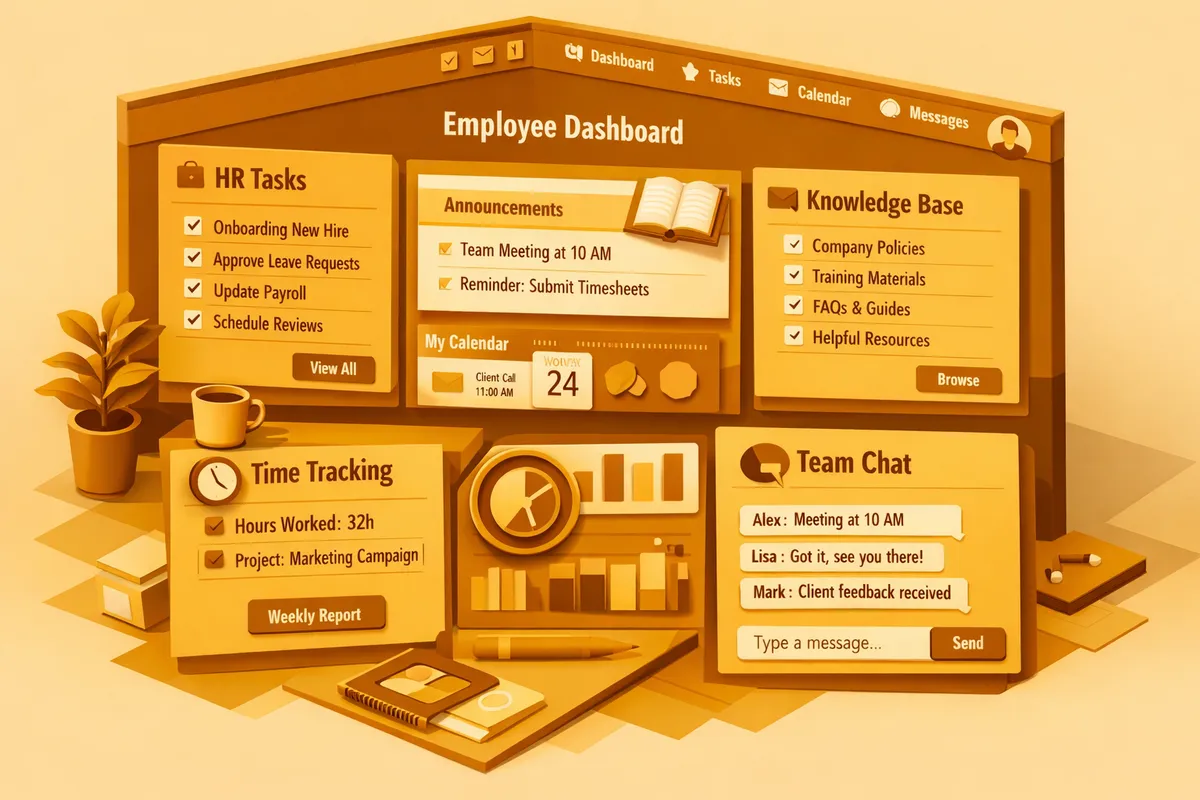
From the audit, we define the portal scope. Employee portals for small Oak Park businesses typically cover four functional areas: document library (policies, forms, employee handbook, benefit plan documents), onboarding workflows (new hire checklists, welcome materials, acknowledgment forms), HR requests (time-off requests, expense submissions, schedule requests), and communications (announcements, team directory, resource links). Larger practices may add performance review workflows, training records, or compliance certification tracking.
We make deliberate choices about what to build custom versus what to configure through an established platform. For a therapist or medical practice on Chicago Avenue with specific clinical staff documentation requirements, a custom portal that accommodates those requirements directly is worth building. For a six-person law firm on Lake Street whose needs align with what a well-configured platform can provide, the platform route is faster and more cost-effective. We recommend based on actual requirements, not on what produces the largest engagement.
Industries We Serve in Oak Park
Law and professional service practices along Lake Street employ a mix of attorneys, paralegals, and administrative staff with different access needs, different documentation requirements, and different roles in the onboarding and HR process. An employee portal gives each role a tailored view: attorneys see supervision and continuing education records, paralegals see client intake procedures and document management protocols, administrative staff see schedule and HR request workflows. Role-based access means no one is sifting through documents that are not relevant to their work.
Therapists and group counseling practices on Madison Street and Chicago Avenue have supervision and licensure documentation requirements that must be maintained for regulatory compliance. An employee portal that tracks supervision session logs, continuing education completion, license renewal dates, and clinical policy acknowledgments gives the practice director a dashboard view of compliance status across all clinical staff without requiring manual tracking in spreadsheets.
Independent retailers on Oak Park Avenue with seasonal staffing bring on temporary employees for peak periods including the Frank Lloyd Wright home tour season, the Farmers Market summer, and the pre-holiday window. An employee portal with a streamlined onboarding module lets seasonal employees complete their paperwork, review store policies, and understand their role before their first shift. This is particularly valuable when the hiring manager is also running the floor during the busiest period of the year.
Architecture and design firms near the Frank Lloyd Wright Home and Studio often have small, specialized teams with complex project documentation and cross-disciplinary work processes. An employee portal serves as the firm's operational backbone: project templates, vendor contact lists, specification libraries, and HR documentation all accessible from a single login. For a firm with employees working across multiple project sites in Oak Park and surrounding neighborhoods, the portal replaces the ad hoc file sharing that makes distributed work chaotic.
Healthcare and wellness practices on Chicago Avenue with multiple clinical staff have compliance documentation requirements more demanding than most other business categories. Employee portals for these practices include HIPAA training acknowledgments, clinical policy documentation, credentialing records, and mandatory reporting procedure references. Having these documents in an organized, auditable location is not optional for practices subject to state and federal healthcare regulations.
Financial and accounting practices on Madison Street maintain client confidentiality requirements that extend to employee documentation and training. An employee portal that includes role-specific confidentiality training, annual acknowledgment workflows, and data security policy documentation addresses this requirement directly. Practices subject to IRS Circular 230 or state CPA licensing requirements have additional documentation needs that a portal can organize and track.
What to Expect Working With Us
1. HR process and document audit. We inventory your existing HR documentation: what policies exist, where they are stored, how current they are, and how employees currently access them. For most Oak Park professional practices, this audit reveals significant documentation gaps and a storage approach that relies on individual knowledge rather than organized infrastructure. The audit produces a document inventory and a gap list that becomes the portal content plan.
2. Portal scope and access architecture. We define which functional areas the portal will cover and design the access architecture: which employees see which documents, who can submit which request types, and who has administrative access to update content. For a law practice with both licensed attorneys and administrative staff, the access architecture ensures that sensitive personnel documents are visible only to appropriate roles.
3. Build and content migration. We build the portal and migrate your existing HR documents into the organized structure the portal provides. Existing documents often need updating before they are appropriate to publish in a staff-facing system: policy language that referred to old processes, forms that had been informally modified without a formal revision, and onboarding documents that accumulated over multiple hiring cycles without ever being reconciled. We flag these for your review rather than publishing documents that contradict your current practices.
4. Staff rollout and adoption. Launching an employee portal requires a rollout communication that explains what changed and why. For an Oak Park professional practice with established staff, the message is straightforward: one place for all your HR documents and requests, organized and current. We prepare the rollout communication and the onboarding guide so the launch is smooth and adoption is high from day one rather than building gradually as people discover the portal exists.