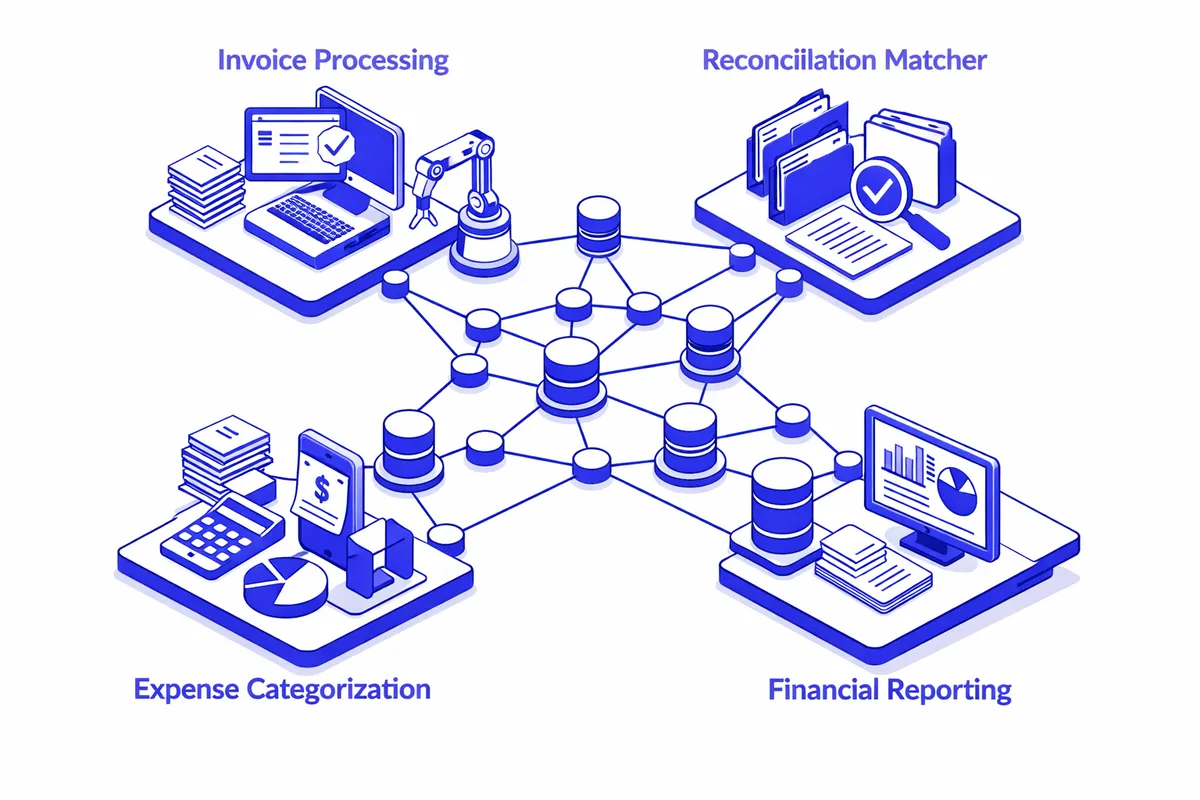
How We Build Accounting Automation for Oak Park
Oak Park's business community is skeptical of systems that promise to automate professional judgment. That is the right instinct. We do not automate judgment. We automate the retrieval, transfer, categorization, and posting of data that follows a deterministic rule. The judgment stays with the attorney, the therapist, the architect.
Every engagement begins with a process documentation session. We trace the current close cycle from first data source to final report, identifying which steps require interpretation and which steps follow a rule that has never varied. For a law firm near the Oak Park Public Library, that might reveal that trust account reconciliation takes four hours per month and follows an identical process every time. That process is an automation candidate. The partner review of the reconciliation output is not.
We build on the platforms Oak Park businesses already use. QuickBooks, Clio for legal billing, SimplePractice or Therapy Notes for mental health practices, and Studio Designer or ArchiOffice for design and architecture firms are all systems we build automation workflows around. We do not replace your system of record. We build the connective tissue that moves data between systems automatically and reduces the manual transfer steps that currently require human time.
Legal practices with trust accounts get automation built to Illinois ARDC requirements. Therapy practices billing insurance get automation built to the reconciliation logic their specific carrier mix requires. Retailers near Scoville Park automating their vendor invoice processing get workflows that match the seasonal purchasing patterns of their business.
Industries We Serve in Oak Park
Law and professional practices near the Oak Park Public Library and along Lake Street use accounting automation to streamline trust accounting, matter billing reconciliation, and partner compensation calculations. Trust accounting in Illinois follows strict ARDC requirements for three-way reconciliation; automated reconciliation applies those requirements as built-in constraints, producing audit-ready output without requiring manual verification of every entry.
Therapists and counseling practices on Oak Park Avenue and Chicago Avenue automate insurance billing reconciliation, copay tracking, and session revenue posting. Mental health practices often have the most complex per-client billing structures of any professional services category; automation handles the complexity at scale, flagging the exceptions that require human review and posting the routine transactions automatically.
Architecture and design firms near the Frank Lloyd Wright Home and Studio district automate their project accounting: time and expense entry from project management tools, milestone billing generation, and reimbursable expense reconciliation. These firms often maintain retainers across five to fifteen active clients simultaneously; automation keeps the billing current without requiring a dedicated billing administrator.
Independent retailers and boutique shops on Lake Street and Madison Street use accounting automation to handle vendor invoice processing, inventory cost tracking, and daily revenue reconciliation. Oak Park's independent retail character means these businesses depend on operational precision to compete with chain alternatives; reducing administrative overhead by even a few hours per week changes the economics of owner-operated retail.
Real estate offices operating near Harlem Avenue and Ridgeland Avenue automate commission tracking, escrow reconciliation, and transaction-based accounting. Real estate income timing is irregular by nature; automation builds the expected cash flow pattern into the accounting logic and flags when actual transactions deviate from the model.
Nonprofits and community organizations tied to Scoville Park and Oak Park's civic infrastructure automate grant tracking, event revenue reconciliation, and membership dues posting. Oak Park's strong civic culture produces organizations with significant administrative transaction volumes and small staffs; automation scales to the volume without adding headcount.
What to Expect Working With Us
1. Practice-specific process mapping. We document your current accounting workflow at the step level before building anything. For a therapist practice, that means mapping every interaction between your scheduling software, insurance billing system, and accounting records. For a law firm, it means mapping trust accounting, billing, and partner draws separately. The map becomes the automation scope.
2. Regulatory requirements as first constraints. For any Oak Park practice operating under professional licensing requirements, Illinois ARDC rules, or insurance carrier billing standards, we build those requirements into the automation logic before anything else. Compliance is a constraint, not a feature to add later.
3. Parallel testing against historical records. Before any automation touches live transactions, we run it against three months of historical data and compare outputs against your actual records. You see proof of accuracy before anything goes live.
4. Handoff built for the person who runs your books. Every automation we build is documented and trained to the person who currently manages your accounting, whether that is an office manager, a bookkeeper, or a CPA firm you retain. The tools work at their technical level, not ours.