How We Build Document Management for Oak Lawn
Document management projects begin with a document audit. We survey every document type your business handles, how it is currently stored, who needs access, how long it must be retained, and what happens to it when it is no longer active. For a medical practice on 95th Street, that audit covers clinical records, billing files, insurance authorizations, HR documents, and administrative records, each with different access and retention requirements.
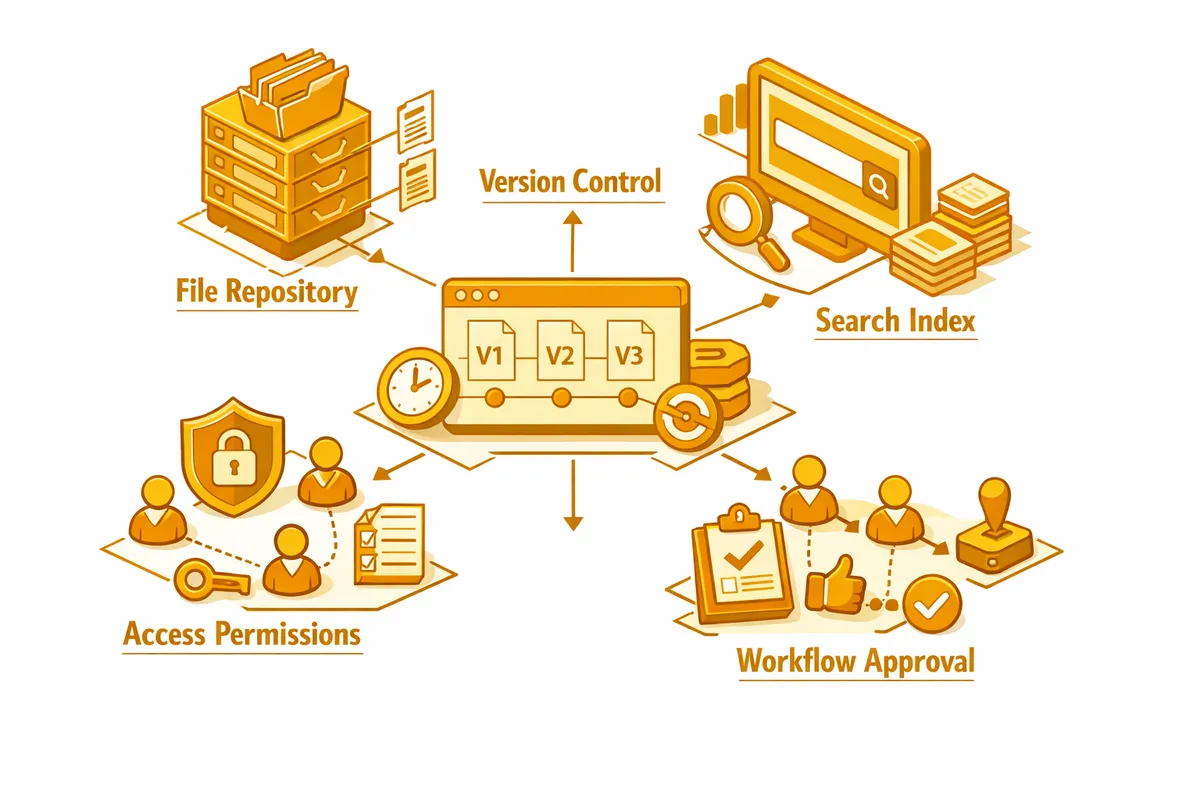
From the audit, we design the document taxonomy: the folder structure, naming conventions, metadata schema, and permission model that will organize your documents going forward. This design phase is the most important and most neglected part of document management implementations. Most businesses pick a platform and start uploading files. The system becomes a digital version of the filing cabinet: different enough to require training but not different enough to improve the fundamental problem.
Migration is handled in phases, starting with the document types that are most actively used. We do not attempt to scan and organize 20 years of historical records before the new system can be used. Active files move first, the new system becomes operational, and historical records are migrated on a schedule that does not interrupt ongoing work.
Industries We Serve in Oak Lawn
Medical practices and clinical offices near Advocate Christ Medical Center on 95th Street handle patient records, insurance authorizations, clinical protocols, HR files, and compliance documentation. Document management for healthcare practices includes access controls that separate clinical records from administrative documents, retention schedules aligned to HIPAA requirements, and audit trails that log every record access event.
Insurance agencies on Cicero Avenue manage policy files, client correspondence, claims documentation, carrier agreements, and licensing records. A document management system for an Oak Lawn insurance agency organizes files by client and policy, enables full-text search across all correspondence, and maintains the version history needed when a disputed communication needs to be reconstructed.
Auto dealers and service centers on Harlem Avenue generate vehicle purchase agreements, financing documents, service authorizations, warranty records, and customer vehicle histories. Document management connects the paper trail that follows every transaction to the customer record and the vehicle record, making every piece of documentation retrievable in seconds during a service visit or a dispute.
Law offices and accounting firms on Pulaski Road and throughout Oak Lawn serve clients whose matters span years of correspondence, filings, and financial records. Document management for professional services firms includes matter-level organization, version control for documents that go through multiple drafts, and a permission model that allows access to be granted to clients for their own files without exposing other client matter.
Specialty retail businesses near The Fairway Retail Center on 103rd Street manage vendor contracts, purchase orders, warranty documentation, employee records, and tax files. A document management system organizes these categories, ensures vendor contracts are findable at renewal time, and keeps employee records separate from operational files with appropriate access controls.
Small professional service offices throughout Oak Lawn benefit from document management systems that replace shared network drives and email attachment chains with organized, version-controlled repositories where every staff member knows where to find what they need without asking someone else.
What to Expect Working With Us
1. Document audit and taxonomy design. We survey every document type in your current workflow, map the access requirements and retention rules, and design the folder structure and metadata schema that will organize your documents going forward. For Oak Lawn healthcare and financial service businesses, this includes mapping compliance retention requirements into the system design.
2. Platform selection and configuration. We recommend a document management platform appropriate for your business size, industry compliance requirements, and technical environment. We configure the permission model, folder structure, naming conventions, and workflow rules before any documents are migrated.
3. Phased migration and staff training. We migrate active document types first, conduct staff training before the system goes live for daily use, and establish the habits and workflows that keep the system organized over time. We migrate historical records on a schedule that does not disrupt ongoing operations.
4. Audit readiness and ongoing support. For healthcare and professional service clients, we configure the document management system to support audit readiness: access logs, retention schedules, and the ability to produce specific documents on demand. We provide 60 days of post-launch support to address questions and refine the system as your team develops their workflow.