How We Build Autonomous Agents for Oak Lawn
Workflow agents begin with process mapping. Before automation is possible, the workflow must be documented with enough precision to specify agent behavior: what triggers the process, what data flows into each step, what decision logic applies at each step, what outputs each step produces, and what escalation conditions route the case to human review. We conduct this mapping with the people who execute the workflow currently, observing the actual process rather than relying on documented procedures that often differ from how work is actually done.
Process mapping reveals the automation opportunity honestly. Some workflows are highly automatable: every step has clear decision rules, the inputs are structured, and exception rates are low. Others have automation potential in two thirds of steps and genuine human judgment requirements in the remaining third. We identify which category applies to your target workflow before committing to a scope.
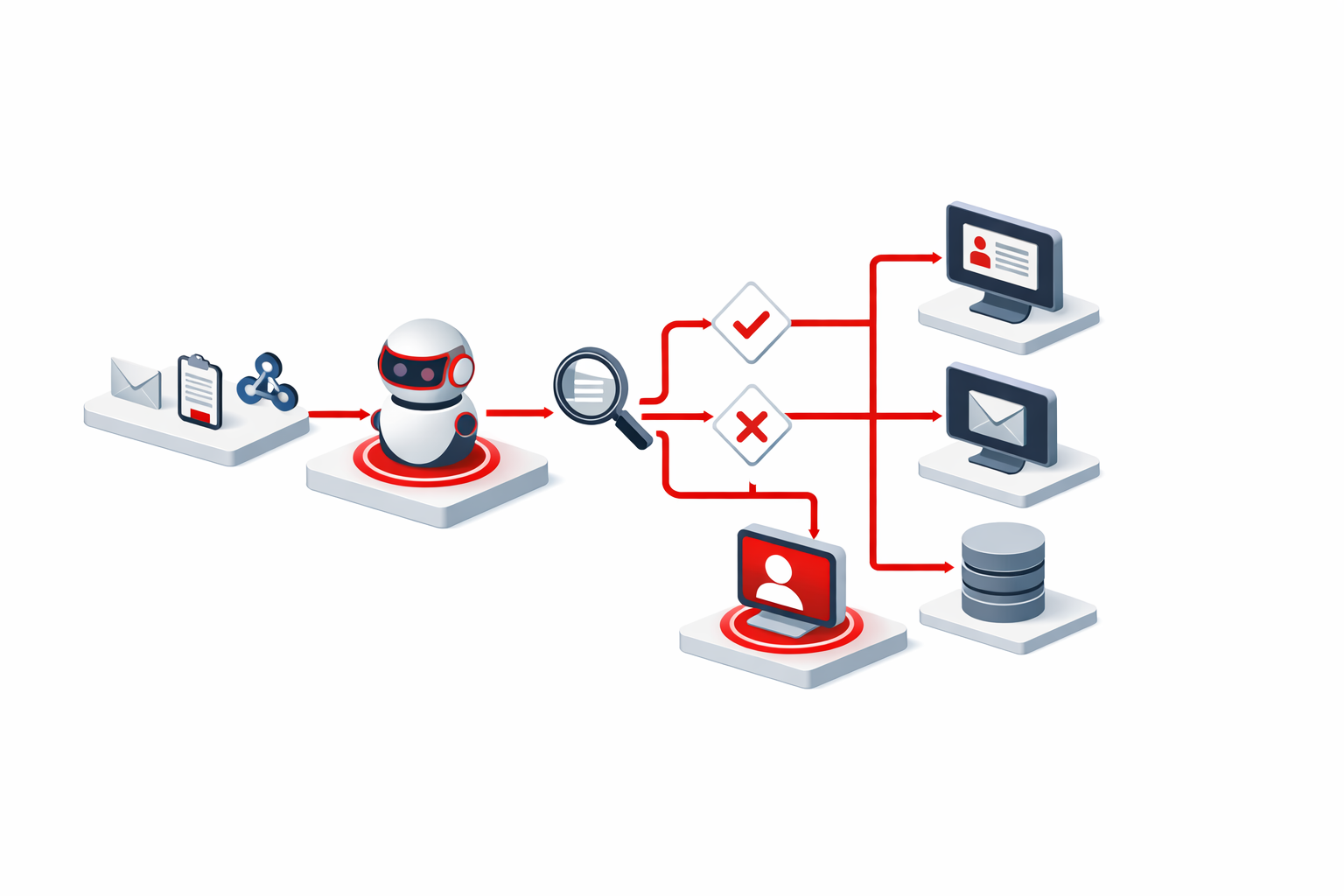
Agent architecture specifies how automation handles each step. For a prior authorization workflow, one agent handles clinical criteria collection from the referral document, a second applies payer-specific guidelines to the collected criteria, a third assembles the authorization request package, and a fourth submits and monitors the request through the payer's portal. Each agent has defined inputs, logic, outputs, and escalation conditions. When a case does not meet the criteria for automated handling at any step, it routes to a human with full context from completed steps, so the human picks up where the automation reached its limit rather than starting over.
Integration is where automation delivers value. Workflow agents that do not connect to your actual operational systems, your practice management platform, your claims system, your payer portals, your CRM, are not automating your workflow. They are creating parallel processes that require manual data transfer. We build the integrations first, ensuring agents can access and update the systems your staff currently uses, before wiring automation logic around them.
Testing runs with real workflow cases from your operation. Prior authorization agents tested against actual requests from your common payers identify the edge cases specific to your payer mix. Claims processing agents tested against your actual billing data surface the documentation patterns and payer rule combinations that generate exceptions in your specific practice. We resolve these before deployment so the first weeks of live operation are tuning, not troubleshooting.
Industries We Serve in Oak Lawn
Insurance agencies on 95th Street and Cicero Avenue deploy autonomous agents for new application intake and verification, routine underwriting decision generation for personal lines and small commercial accounts, policy renewal processing, claims intake and initial routing, and broker communication workflows. Oak Lawn agencies that automate routine underwriting free their experienced underwriters for the non-standard risks and large accounts where judgment creates competitive differentiation.
Medical practices and specialty clinics near Advocate Christ Medical Center deploy autonomous agents for prior authorization workflows, referral processing, new patient intake and eligibility verification, appointment reminder and confirmation cycles, and post-visit follow-up communication. Prior authorization automation alone, for a practice that manages dozens of auths per week, represents significant staff time recovered and authorization processing time reduced.
Medical billing services deploy autonomous agents for the full claims lifecycle: charge validation, claim assembly and scrubbing, submission, ERA processing, denial categorization and routing, and resubmission for qualifying denials. Billing services that automate routine claims processing increase the case volume their staff can handle without proportional headcount growth.
Healthcare credentialing and staffing firms serving the Oak Lawn healthcare corridor deploy autonomous agents for provider credentialing workflows: primary source verification outreach, documentation collection and completeness tracking, committee preparation, and re-credentialing cycle management. Credentialing firms that process applications for multiple facilities benefit most because the verification steps are identical across facilities but require separate tracking per facility.
Auto dealerships along the southwest suburban corridor deploy autonomous agents for service appointment confirmation and reminder cycles, warranty claim submission workflows, parts order tracking and customer notification, and trade-in appraisal documentation assembly. Service department autonomous agents reduce the administrative burden on service advisors, who spend more time with vehicles and customers when standard communication workflows run themselves.
Professional services firms including accounting practices near the Oak Lawn Public Library deploy autonomous agents for client onboarding workflows, document collection and follow-up, engagement letter generation and signature tracking, and billing cycle automation. Accounting firms that automate onboarding and document collection recover hours per client engagement that compound across a full client roster during peak season.
What to Expect Working With Us
1. Process mapping and automation assessment. We document your target workflow in operational detail, identify which steps are candidates for agent automation, and assess the expected automation rate for the workflow. This phase produces a workflow specification and automation scope document your team reviews and approves. Typically two to three weeks.
2. Agent architecture and integration design. We design the agent system, specify each agent's logic, and plan integrations with your operational systems. We identify integration requirements for each system the agents need to access, verify technical feasibility, and plan the integration build. Architecture review with your team before development begins.
3. Development, integration, and testing. We build agents, connect integrations, and test with real workflow cases. Testing reveals edge cases that require logic refinement before deployment. We address issues in the test environment, not in production. Development and testing typically takes six to ten weeks for a focused single-workflow build.
4. Deployment, staff training, and monitoring. We deploy with a structured go-live process, train staff on working alongside agents, and monitor the first four weeks actively. Daily monitoring during hypercare catches issues early. We transition to weekly review after the system stabilizes.