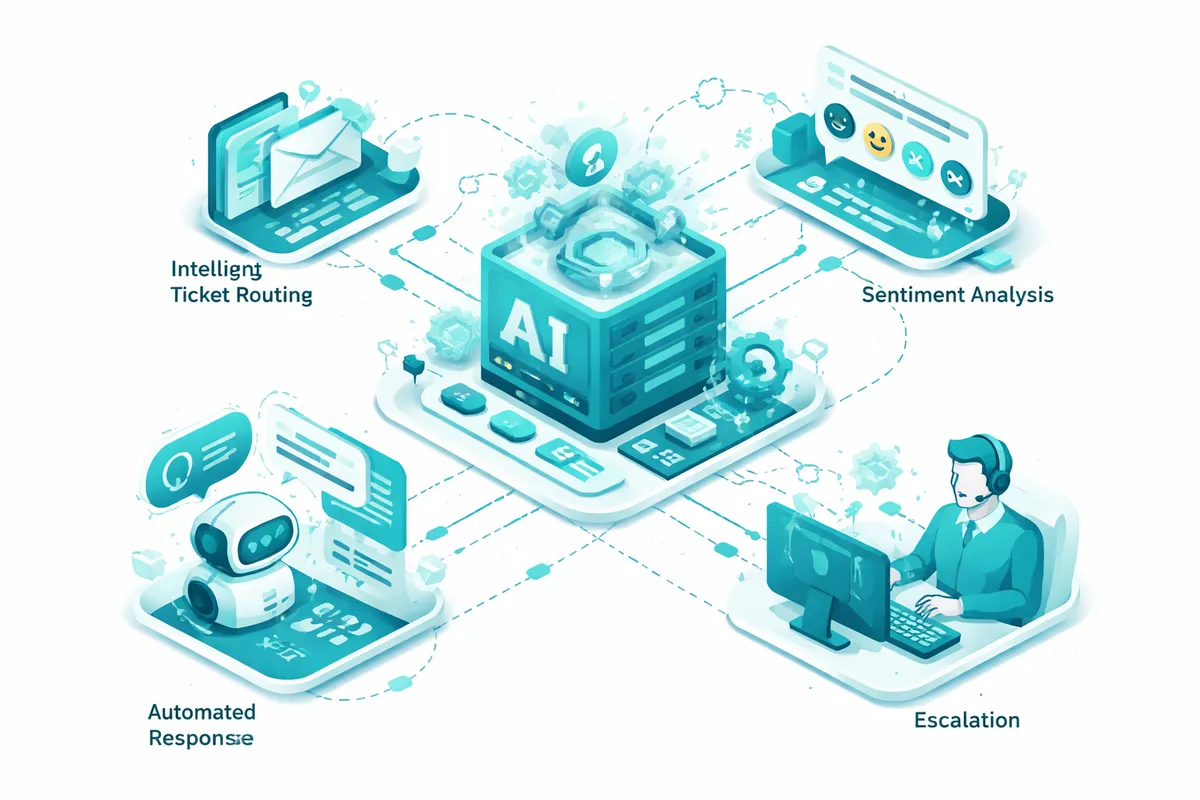
How We Build AI Customer Service for Oak Lawn
Our process begins with a detailed audit of your current customer communication. For an Oak Lawn medical or dental practice, that means pulling data from your phone system, your EHR or practice management platform, your website contact forms, and any patient portal messaging. We categorize every inquiry by type, frequency, and the clinical versus administrative nature of the request. For a typical dental practice, this audit usually reveals that 70% of inbound communication is administrative (scheduling, confirmations, insurance questions, directions) and can be fully automated, while 30% requires clinical or human judgment and should be routed to staff.
We then build your AI customer service system with healthcare-appropriate safeguards. Patient-facing interactions use language and tone calibrated for a medical context, not a retail one. The AI is trained on your specific practice, your clinicians, your services, your insurance contracts, and your scheduling rules. If your practice near Advocate Christ does not take a particular insurance, the AI will not accidentally book a patient who has it. If a particular procedure requires a referral, the AI will explain that and capture the referral information during the conversation.
Integration with practice management and EHR systems is where most healthcare AI implementations live or die. We integrate with the systems Oak Lawn practices actually use: Dentrix, Eaglesoft, Open Dental, Athena, Epic (for the larger practices affiliated with Advocate), eClinicalWorks, and Practice Fusion, among others. The AI pulls live schedule availability, patient records where appropriate, and insurance eligibility, then writes scheduling and intake data back into your system. Your staff does not re-enter anything the AI captured.
Escalation is calibrated for clinical sensitivity. The AI is explicitly trained to recognize urgent symptoms, emotional distress, and requests that require clinical judgment, and to route those interactions immediately to a human team member. A patient calling a cardiology practice who mentions chest pain does not get a scheduling conversation; they get routed to your triage protocol in seconds. We work with your clinical leadership to define the exact escalation rules so the AI behaves the way your practice would want it to in every edge case.
For non-healthcare Oak Lawn businesses, the approach is similar but tuned to the sector. A dental supply distributor on 95th uses AI to handle order status, product questions, and account inquiries. A law firm uses AI to qualify leads, schedule consultations, and answer common procedural questions. A financial advisor uses AI to handle scheduling, document requests, and meeting confirmations while keeping all substantive conversations with the advisor.
Industries We Serve in Oak Lawn
Dental practices throughout Oak Lawn use AI to handle appointment scheduling, confirmations, insurance verification questions, and new patient intake. Practices with multiple operatories and a single front-desk team typically recover 10 to 15 hours of staff time per week after deployment.
Medical specialty practices clustered around Advocate Christ Medical Center use AI for appointment scheduling, referral intake, pre-visit questionnaires, and post-visit follow-ups. The AI respects HIPAA boundaries, uses appropriate clinical language, and escalates symptom-related calls to human triage immediately.
Physical therapy, chiropractic, and rehabilitation clinics along 95th Street and throughout the area use AI to handle high-volume scheduling, authorization questions, and progress-update inquiries. Initial intake conversations that used to require 20 minutes of front-desk time now complete as AI-guided chat in under five.
Imaging, diagnostic, and lab services near the medical corridor use AI to manage appointment scheduling, preparation instructions, results inquiries, and prescription coordination. After-hours voicemail piles that used to require morning callbacks now resolve automatically overnight.
Independent pharmacies in the Oak Lawn area use AI for refill requests, transfer coordination, insurance questions, and vaccination scheduling. Pharmacists reclaim time for clinical counseling instead of phone logistics.
Professional services firms in the 95th Street corridor, including accounting, legal, financial planning, and insurance, use AI to handle lead qualification, consultation scheduling, and document collection, with human handoff at the point where real expertise is required.
What to Expect Working With Us
1. Interaction audit and compliance review. We document your current customer communication patterns, your regulatory requirements (HIPAA if applicable, plus any state-specific rules), and the integration points with your practice management or business systems. You get a report showing exactly which interactions are candidates for full automation and which need human oversight.
2. System design and clinical calibration. We design the AI customer service system around your specific practice or business. For healthcare clients, that includes defining escalation triggers with your clinical leadership, training the AI on your services and insurance contracts, and setting up HIPAA-appropriate handling of any patient information. For non-healthcare clients, we calibrate tone, scope, and escalation for your specific sector.
3. Integration and phased launch. We integrate with your phone system, website chat, text messaging, and backend systems (EHR, practice management, CRM, scheduling). We launch in phases, often starting with website chat and text messaging before adding voice AI on the phone system. This lets your team adjust and gives us real-world data to tune the system before the highest-volume channel goes live.
4. Monitoring, refinement, and monthly reporting. After launch, we monitor every conversation the AI handles. We review escalations, accuracy, patient or customer satisfaction, and resolution rates. Monthly reports show you exactly how many interactions the AI handled, how many it resolved without human involvement, how much staff time was recovered, and where refinements are needed.