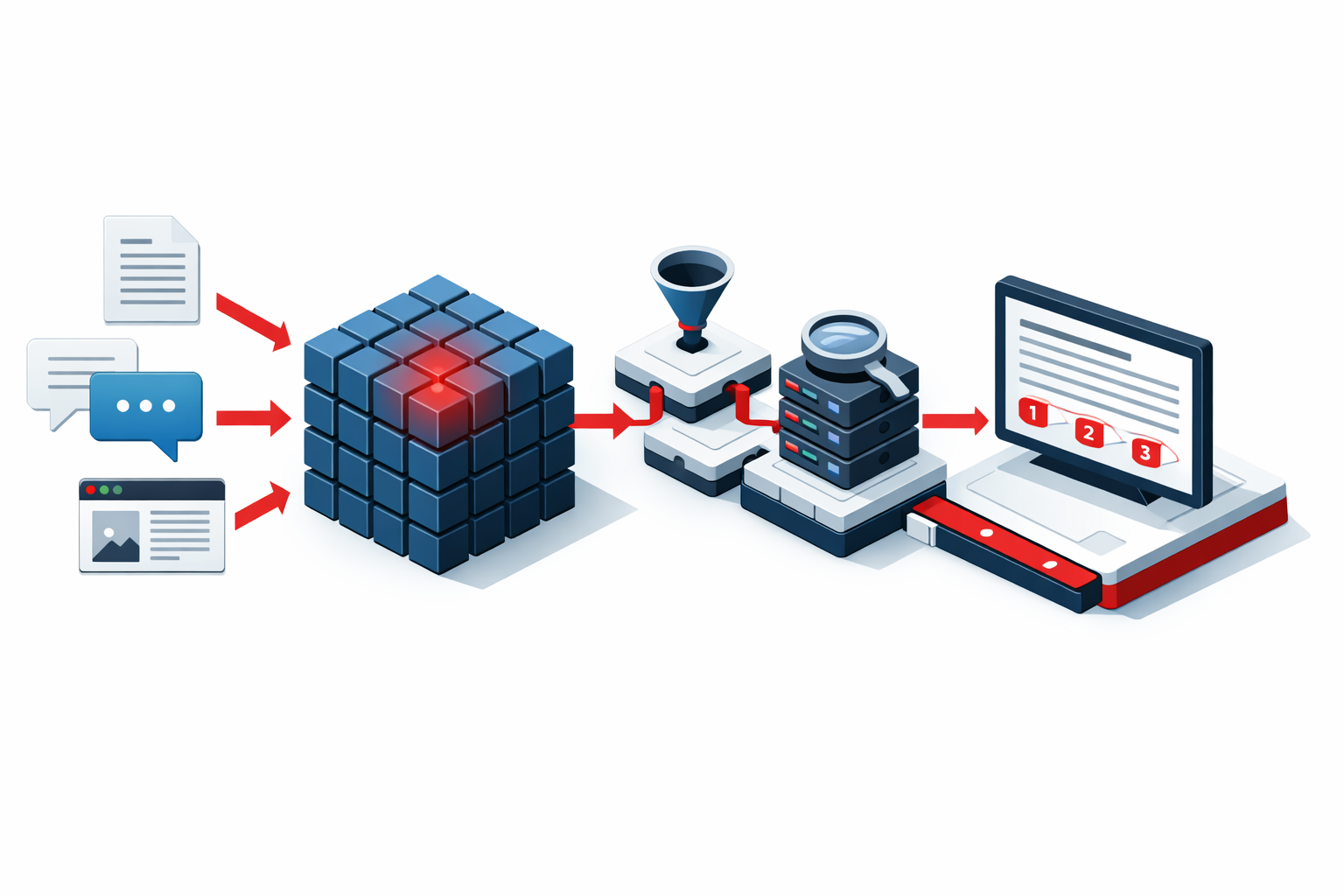
How We Build RAG Systems for North Center
RAG system development begins with a knowledge inventory. We work with your team to identify what documents, files, and structured data represent the knowledge that should be made retrievable. For a North Center law office, this might include engagement letters, legal memoranda, correspondence templates, and matter summaries. For a home services contractor, it might include project scopes, estimate templates, supplier contracts, and job documentation from completed projects. The inventory is not just about finding what exists; it is about determining what is actually valuable and what is in a condition to be indexed.
Document preparation is often the most time-consuming phase of RAG development, and for good reason. Documents accumulated over years in a small business are rarely in consistent formats, may contain outdated information, and may include documents that should not be part of the retrievable knowledge base because they are superseded, incorrect, or confidential in ways that require access restrictions. We conduct document preparation in partnership with your team, helping identify what should be included, what needs to be updated before indexing, and what access restrictions are appropriate for different document categories.
The technical RAG implementation connects a vector database containing indexed representations of your documents to a language model that can formulate searches and synthesize retrieved content into coherent answers. The language model answers questions by searching your specific documents, retrieving the most relevant sections, and synthesizing an answer from what it found, with citations to the source documents so your staff can verify the information. When the answer is not in the knowledge base, the system says so, which is itself useful information about gaps in your documentation.
Integration design determines how your team accesses the RAG system in practice. A chat interface accessible from any browser is the simplest deployment. Integration with communication tools your team already uses, whether Slack, Teams, or email, brings the system into existing workflows without requiring new habits. For businesses with customer-facing applications, a RAG system can power a customer support chat that answers questions from your product or service documentation rather than from generic AI responses.
Industries We Serve in North Center
Law offices and professional service firms near the Rockwell corridor and Lincoln Avenue maintain substantial document libraries: matter files, legal research, contract templates, and correspondence precedents. A RAG system that indexes this material allows attorneys and paralegals to retrieve relevant precedents, locate applicable contract language, and surface relevant research in seconds rather than minutes. For practices that handle recurring matter types like residential real estate or estate planning, retrieval of prior work product dramatically reduces time spent on first-draft preparation.
Healthcare and dental practices throughout North Center operate with clinical protocols, insurance billing documentation, patient communication guidelines, and staff policies that need to be consistently accessible to staff with different roles and different tenures. A RAG system allows front desk staff to retrieve insurance billing answers, clinical staff to access protocol references, and practice managers to surface policy guidance without calling the owner or practice administrator.
Home services contractors on Damen Avenue, Western Avenue, and throughout North Center's residential streets accumulate project documentation, supplier information, equipment manuals, and the operational knowledge of years of work in North Center's specific housing stock. A RAG system that indexes this material allows estimators to retrieve comparable job history, technicians to access equipment troubleshooting documentation, and operations managers to surface relevant supplier terms.
Specialty retailers on Lincoln Avenue and the Rockwell corridor maintain product documentation, supplier terms, return policies, and the buying history that informs merchandising decisions. A RAG system allows staff to answer detailed customer product questions accurately, retrieve warranty and return policy specifics without looking them up manually, and access supplier contact and terms information during reordering.
Financial advisors and accounting practices serving North Center families maintain client documentation, regulatory guidance, and the advisory history that informs ongoing client relationships. A RAG system allows advisors to retrieve relevant regulatory guidance, locate applicable tax treatment precedents, and surface client advisory history without manual file searching.
Family-oriented service businesses including music schools, tutoring centers, and youth programs accumulate curriculum documentation, student records, program policies, and teaching materials. A RAG system allows instructors to retrieve lesson resources, administrators to access program policy guidance, and program directors to surface student history without manual record review.
What to Expect Working With Us
1. Knowledge inventory and document assessment. We conduct a structured inventory of your existing documents and data sources, identify what knowledge is valuable to make retrievable, assess its current condition, and determine what preparation work is required before indexing. This assessment also identifies appropriate access controls for document categories that should not be universally retrievable.
2. Document preparation and knowledge base construction. We prepare your documents for indexing: cleaning formats, removing superseded versions, applying access controls, and structuring documents to maximize retrieval quality. We build the vector database and configure the retrieval system, then test retrieval quality against representative questions from your business context.
3. Interface design and integration. We design the interface through which your team will access the RAG system and configure the integration to fit your team's existing workflow. We test the integration against realistic use scenarios before deployment.
4. Deployment, training, and ongoing maintenance. We deploy the system with training on effective query formulation and establish a maintenance process for adding new documents as they are created and updating indexed documents when policies change.