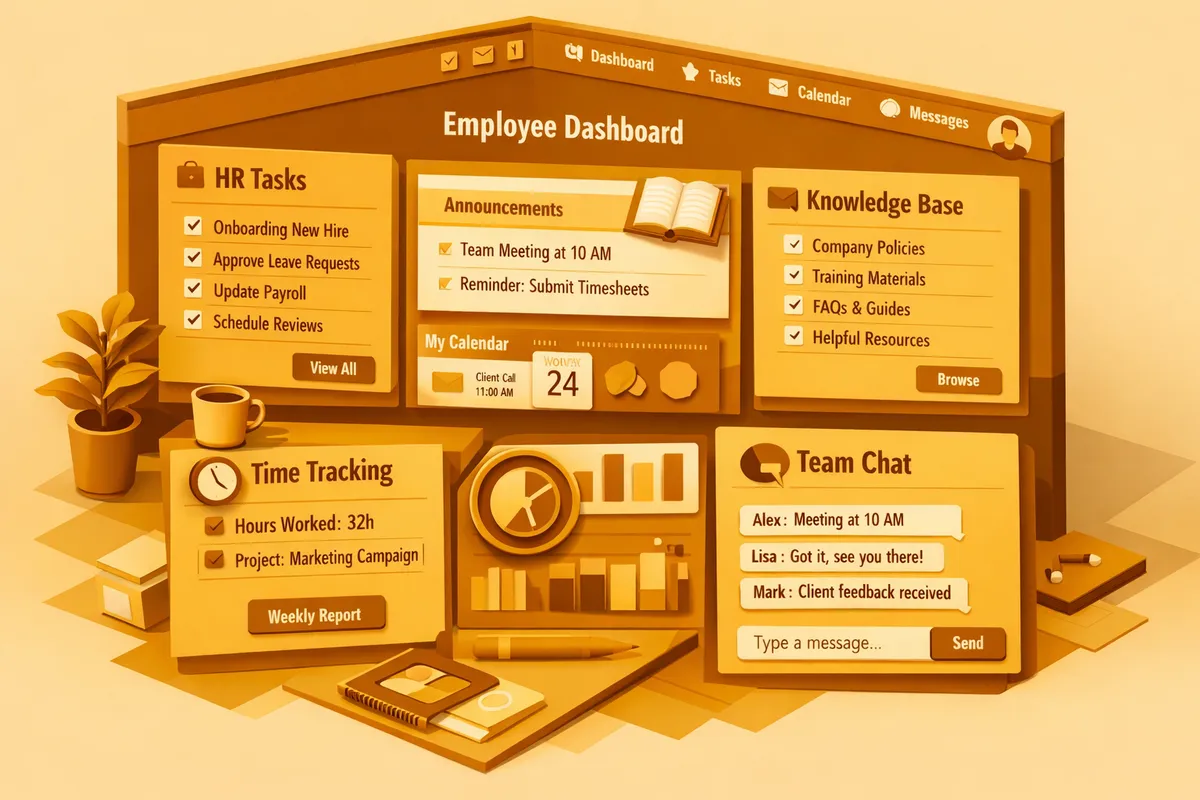
How We Build Employee Portals for North Center
Employee portal projects begin with a staff operations audit: how does scheduling actually work today, what documents does your team need access to, what requests generate the most back-and-forth between staff and management, and where is information living that is not actually accessible to the people who need it? For a boutique fitness studio on Lincoln Avenue, that audit typically surfaces three friction points: class schedule visibility and swap requests, substitute instructor coordination, and training material access for new instructors.
We build portals with mobile-first design because North Center's small business staff use phones, not desktop computers, to check schedules and manage their work logistics. The instructor finishing a 7 AM class at a studio near Welles Park is not going back to a desk to check if her sub request was approved. The portal works on a phone, loads quickly, and puts the most frequently used actions on the home screen.
Access control is built around actual role structures: what a floor instructor needs to see is different from what a manager needs to see, which is different from what the owner sees. We build those permission tiers from the real organizational structure of your team, not from a generic HR hierarchy. Every feature we add is tested against the actual workflows your staff uses, because a portal that does not match the way your team operates gets abandoned within a month.
Industries We Serve in North Center
Pediatric and family medical practices on Western Avenue and Irving Park Road use employee portals to manage clinical and administrative staff scheduling, credential and certification tracking for licensed providers, policy document distribution with confirmation acknowledgment, and new hire onboarding checklists. The portal becomes the single place where a new front desk coordinator finds the insurance verification procedure, the after-hours protocol, and the patient communication templates without asking a senior colleague to walk them through it twice.
Boutique fitness studios along Lincoln Avenue have among the most complex scheduling environments of any North Center small business: classes run six days a week, instructors have different availability each week, substitute needs arise with little notice, and peak periods before and after school-year transitions create schedule changes that ripple across multiple weeks. A portal with a schedule management module, sub request workflow, and availability submission interface makes that complexity manageable for both instructors and managers.
Preschools and early childhood education programs near Addison Street have teaching staff, aide staff, and administrative staff who all need different levels of access to curriculum materials, incident report forms, child allergy protocols, and emergency contact procedures. Employee portals for these programs centralize safety-critical documents and make it fast for any staff member to access the right version of the current protocol, rather than hunting through email attachments for the most recent update.
Wedding and event planning businesses in North Center often operate with a mix of full-time staff and freelance coordinators brought in for specific events. A portal that distinguishes between these two categories and gives freelancers access to event-specific documents, vendor contacts, and day-of logistics without giving them access to internal HR documents serves that hybrid team model cleanly.
Family restaurants and dining spots on Irving Park Road and Lincoln Avenue use employee portals for shift scheduling, time-off request management, policy acknowledgments for seasonal staff hired ahead of peak periods, and tip reporting documentation. The portal reduces the group text thread that most small restaurant managers rely on for shift coordination and replaces it with a system where every request is logged and confirmed, which matters for labor compliance.
Boutique retail stores on Damen Avenue with seasonal staffing for back-to-school and holiday periods use portals to handle onboarding documentation, schedule management, and training material distribution for staff who may only work for three months. Getting a seasonal employee productive quickly requires that training materials are actually accessible from a phone, not printed in a binder somewhere in the back room.
What to Expect Working With Us
1. Staff operations interview and feature scoping. We interview the owner, one manager, and two or three front-line staff members to understand how coordination actually works today and where the friction points are. This conversation shapes the feature set: we build what your team will actually use, not a comprehensive HR platform with features no one at a 12-person studio ever opens. The goal is a portal that becomes part of the team's daily rhythm within two weeks of launch.
2. Role and permission architecture. Before building, we map every role in your organization against the data and features each role needs to access. A substitute instructor at a Lincoln Avenue fitness studio does not need access to HR documents or owner-level financial reports. Getting permission structure right at the design stage prevents the most common employee portal failure mode: staff who cannot access what they need and give up on the system.
3. Build and internal pilot. We build the portal, then run a two-week internal pilot with a small group of staff from each role level before the full launch. Pilot feedback surfaces interface issues and workflow gaps that cannot be caught by testing alone. For a North Center family practice with three providers and two front desk coordinators, the pilot usually takes one week because the team is small and feedback is fast.
4. Full launch and 30-day check-in. After the full team is onboarded, we schedule a 30-day check-in where we review adoption metrics: which features the team is using, which they are not, and whether the workflows we built match how the team actually operates. In the first 30 days, small adjustments to interface language, notification timing, or feature placement can significantly improve adoption among staff who were lukewarm at launch.