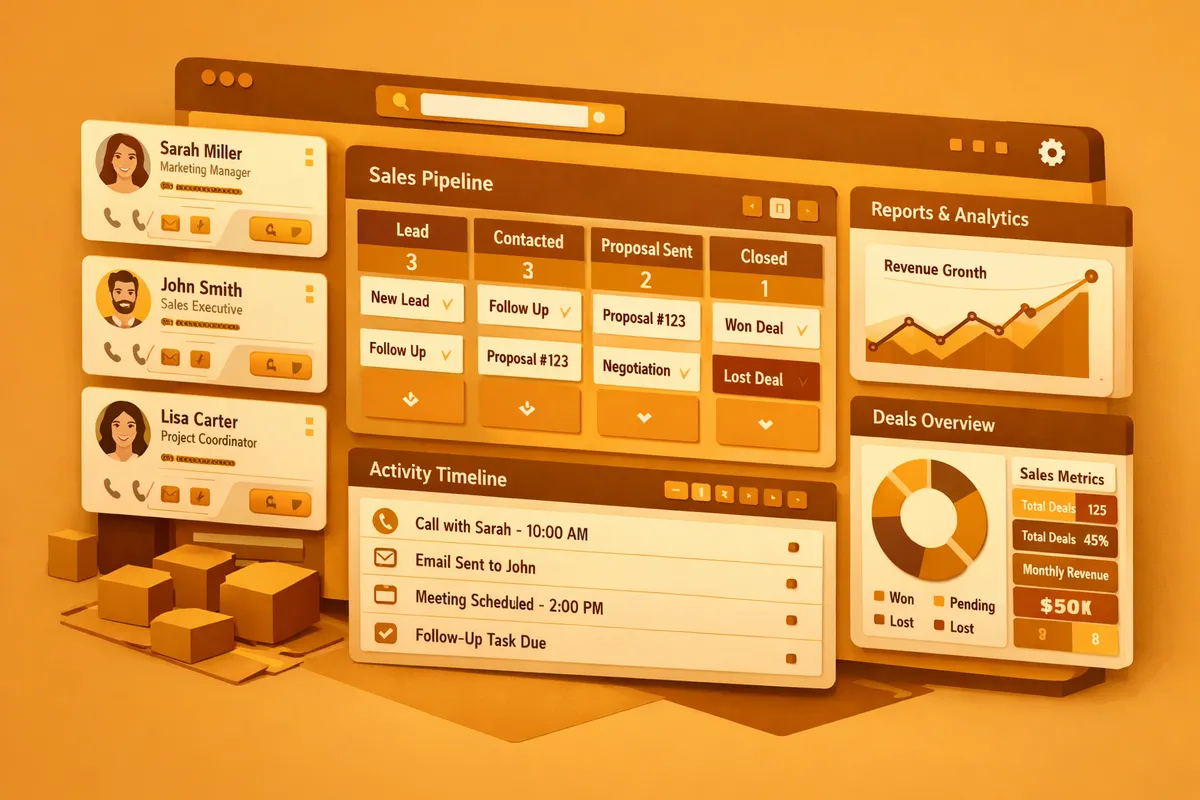
How We Build Custom CRMs for North Center
Building a custom CRM starts by understanding what relationships you actually manage and what your team does manually today that should be automated or structured. We spend the first week in conversation with the people who use the system daily: the front desk coordinator at a pediatric practice on Irving Park Road who manages recall reminders, the membership manager at a fitness studio on Lincoln Avenue who tracks renewals, the enrollment director at a preschool near Chicago Waldorf School who manages inquiry pipelines from August through October.
From those conversations, we map the data model: what entities you track, what fields you need for each, how they relate to each other, and what lifecycle stages a client moves through. We also map the workflows: what triggers an automated follow-up, how the team handles tasks that require human judgment, and what reports the owner looks at weekly. The custom CRM we build reflects that map, not a generic sales funnel.
We build on modern web technology with a clean, accessible interface your team can use on a tablet at the front desk or on a phone when a staff member is following up from home. The system is yours: hosted on infrastructure you control, with data you own and can export at any time. We do not put your client relationships behind a platform that can change its pricing, remove features, or shut down.
Industries We Serve in North Center
Pediatric and family medical practices along Western Avenue need CRM functionality that extends beyond appointment scheduling: household records that connect siblings and parents, recall tracking that flags which families are overdue for annual well visits, insurance status monitoring across household members, and referral source attribution so the practice knows which community channels are generating new families. Custom CRM turns a disconnected patient database into a living household relationship record.
Boutique fitness studios on Lincoln Avenue manage a member lifecycle that generic tools do not represent well. A new member starts with a trial period, then converts or churns, then potentially returns after a lapse, then becomes a long-term member with package renewals, and may eventually become an ambassador who refers others. Each stage requires different outreach. A custom CRM built for a North Center fitness studio models that lifecycle explicitly so the team knows where every member stands and what the next touchpoint should be, without manual tracking.
Preschools and early childhood programs near Addison Street have an enrollment pipeline that runs on a tight calendar. From August inquiry to September enrollment decision to October deposit, the sequence of touchpoints is specific and time-sensitive. A custom CRM tracks every prospect family through that funnel, automates confirmation emails and form reminders, and surfaces which families have not completed a required step so the enrollment coordinator can follow up before the deadline passes.
Wedding and event planners serving North Center use custom CRM to manage the full client lifecycle from initial inquiry through contract signing, planning milestones, vendor coordination, and post-event referral follow-up. The CRM timeline shows every touchpoint so any team member can pick up a conversation with complete context, without reconstructing history from scattered email threads.
Family restaurants and neighborhood spots on Irving Park Road use CRM functionality for reservation history, dietary preference tracking for regular guests, birthday and anniversary follow-up, and catering inquiry management. A restaurant that knows a regular family always requests the same seating section, has a child with a nut allergy, and celebrates a birthday in October can make that family feel genuinely remembered without the owner being personally involved in every reservation.
Boutique retail stores on Damen Avenue, especially those serving the same North Center households year after year, use custom CRM for purchase history tracking, wish list and notification management for out-of-stock items, loyalty tracking that reflects actual purchase behavior rather than a point system, and personalized restock outreach. A shop that texts a customer when the children's winter coat they were looking at last month comes back in stock does not need a discount to close the sale.
What to Expect Working With Us
1. Relationship and workflow mapping. We spend one to two weeks interviewing the team members who will use the CRM daily, mapping your current client data model, and identifying every manual workflow the new system should replace or support. For a North Center pediatric practice, that typically surfaces household relationship tracking, recall management, and referral attribution as the three highest-value capabilities.
2. Data model design and migration plan. We design the custom data schema, including all entity types, field definitions, relationship structures, and lifecycle stage definitions. If you have existing client data in a spreadsheet, an old CRM, or a booking platform export, we create a migration plan that brings that history into the new system. A business with five years of member data on Lincoln Avenue is not starting from scratch.
3. Build, QA, and staff training. We build the CRM, test every workflow with your team, and train the staff who will use it daily. Training is done with your actual data in a staging environment so the team is learning on something that looks exactly like the real system. The front-facing staff's most frequent tasks get the most attention, since that is where training friction is highest.
4. Post-launch optimization. The first 60 days after a custom CRM launch always surface things that work differently in practice than they did in planning. We include scheduled check-ins, workflow adjustments based on how the team uses the system, and any additional automation that the first weeks reveal as necessary.