How We Build Business Intelligence for North Center
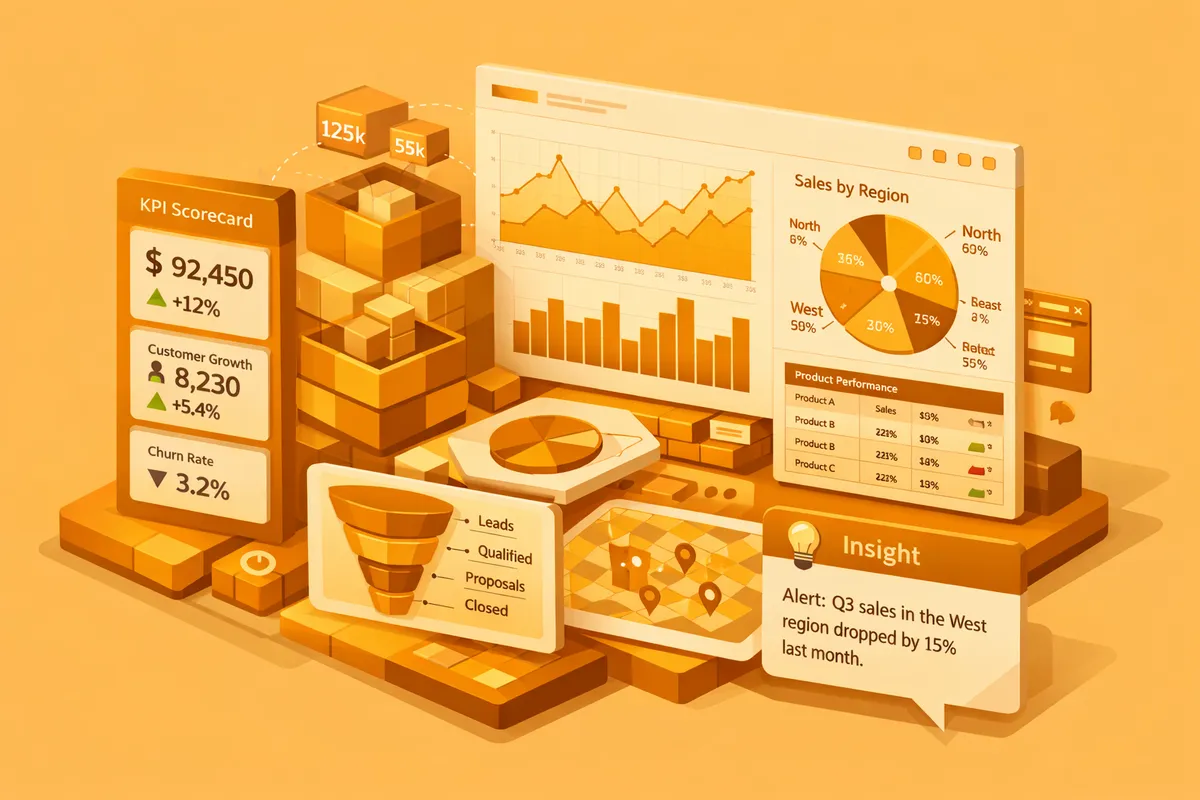
Business intelligence projects begin with a data inventory: every platform the business uses, the data each one holds, how far back the history goes, and what export or API access is available. For a North Center fitness studio, that might be a booking platform with five years of class attendance data, a CRM with email engagement history, a POS with retail purchase records, and a website analytics tool with traffic data. Each of these is a data source. The BI project is about building the pipeline that pulls from all of them into a central warehouse and then building the reporting layer on top.
We use lightweight, cost-appropriate warehouse infrastructure for North Center's small and mid-sized businesses. Not enterprise-scale platforms with six-figure annual contracts, but modern cloud data warehouses that can store and query years of business history for a few hundred dollars a month. The dashboards we build on top are in tools your team can actually use without training: Looker Studio for most businesses, Metabase for clients who want more self-service query capability, or Microsoft Power BI if your team already has an Office 365 ecosystem.
The dashboards we build are organized around the specific decisions a North Center business owner makes repeatedly. What does my class schedule look like relative to last year's comparable period? Which products need to be reordered before the school-year rush? Which patients are overdue for a recall appointment? The warehouse is built once. The dashboards evolve as you ask new questions, adding views without having to rebuild the underlying data structure.
Industries We Serve in North Center
Pediatric and family medical practices on Western Avenue use business intelligence to track patient retention, appointment utilization rates by provider, insurance mix over time, and the productivity of each intake channel. Multi-year trend views are particularly valuable: a practice that can see its new patient volume by referral source over five years can identify when word-of-mouth referrals started declining, correlate that timing with changes in staff or scheduling availability, and act before revenue reflects the problem.
Boutique fitness studios along Lincoln Avenue generate rich attendance data that most owners never mine. BI infrastructure lets a studio see which instructors have the highest class retention rates, which time slots are underperforming relative to their capacity, how member lifetime value varies across membership types, and whether the members acquired during Welles Park summer marketing campaigns have materially different retention rates than members acquired through other channels.
Preschools and early childhood programs near Chicago Waldorf School track enrollment pipeline, yield rates from inquiry to application to enrollment, retention rates from one academic year to the next, and the distribution of siblings and multi-year families. A school that tracks these metrics over time can see whether its inquiry-to-enrollment conversion is declining before enrollment numbers fall, identify which program formats have the best retention, and benchmark current year inquiries against prior year pacing in real time during the August enrollment surge.
Wedding and event planners serving the North Center and Roscoe Village corridor need BI to understand their sales pipeline: how many inquiries are active at each stage, what the average time from first inquiry to signed contract is, which months generate the most bookings, and what the average contract value is by event type. That pipeline view is essential for revenue forecasting and for knowing how hard to push marketing in a given quarter.
Family restaurants and dining spots on Irving Park Road use business intelligence to track cover counts, average ticket size, and table turn time by day of week and season. When combined with reservation platform data, a restaurant owner can see whether the Irving Park corridor's pre-event traffic before Horner Park events drives meaningfully different table behavior than typical evenings, and use that to schedule staffing and menu promotions proactively.
Boutique retail on Damen Avenue serving North Center families generates years of purchase history that, properly analyzed, reveals which product categories have the highest repeat purchase rates, which customers are most likely to respond to a restock notification, and how seasonal sales patterns have shifted year over year. That analysis turns a handwritten inventory order into a data-driven restock plan that reduces overstock on slow-moving items and avoids stockouts on high-demand products.
What to Expect Working With Us
1. Data inventory and warehouse architecture. In the first two weeks we catalog every data source, assess data quality and history depth, and design the warehouse schema. For most North Center businesses, the warehouse holds data from three to six source systems and covers two to five years of history depending on what platforms have retained. We make infrastructure choices appropriate to your data volume and budget, not over-engineered for a business doing half a million in annual revenue.
2. Pipeline build and historical data load. We build the data pipelines that pull from your source systems into the warehouse, then load historical data so your first dashboard shows real trend analysis rather than just the last 30 days. For a pediatric practice on Western Avenue, loading three years of appointment and patient data means the business intelligence view is meaningful on day one rather than requiring months of accumulation.
3. Dashboard design and business logic validation. We build dashboards around the specific metrics and decisions your business relies on, then validate the numbers against your existing systems before sign-off. If the BI dashboard shows 842 active members and your booking platform shows 841, we find the one-record discrepancy and fix it rather than accepting close enough. North Center owners who have been running on intuition for years tend to trust precise numbers and are skeptical of approximations.
4. Training and quarterly business reviews. We train your team on reading and navigating the dashboards during a two-hour session after launch. Then we schedule quarterly reviews where we sit with you and walk through what the data shows across the past 90 days: what changed, what appears in trend, and what is worth investigating further. These sessions turn the infrastructure investment into decisions.