How We Build No-Code Platforms for Mount Greenwood
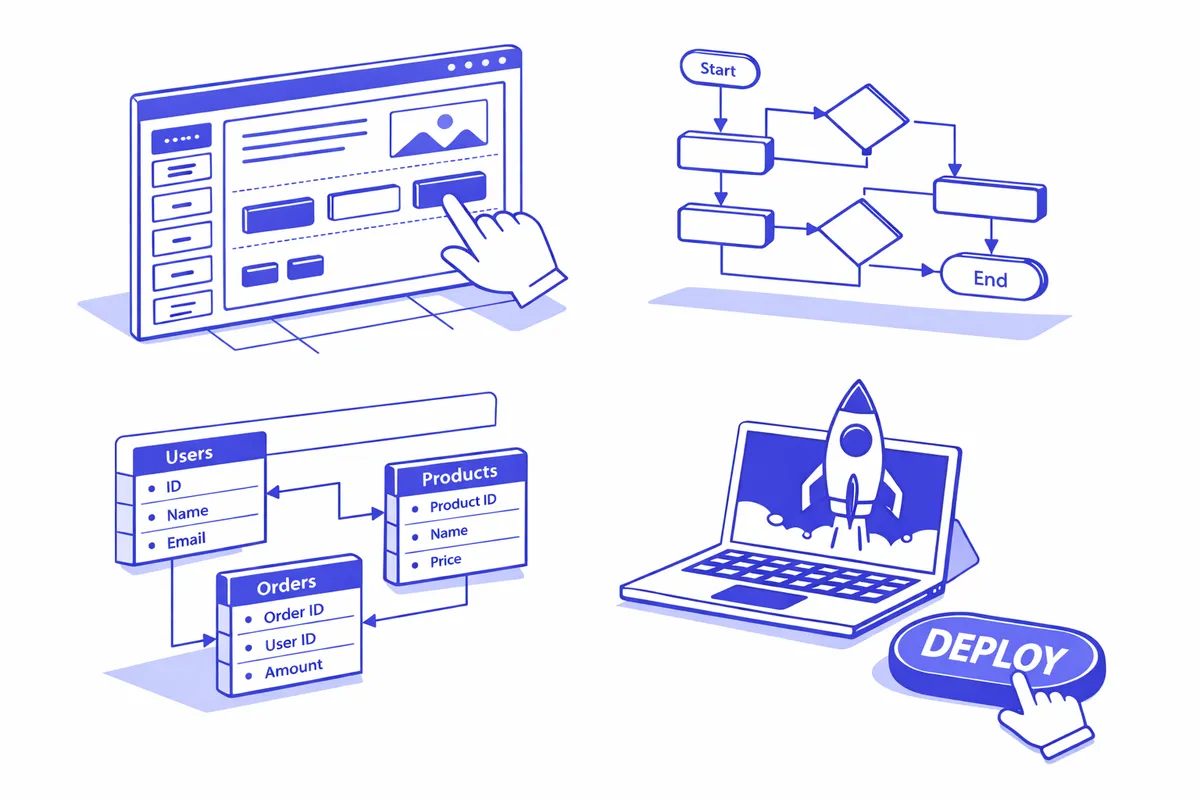
We start by understanding the relationship, not just the workflow. Before we recommend a platform we sit down with you, often at the office on 111th Street or Kedzie Avenue, and map who your clients are, how they came to you, and what would happen if a renewal or a deadline got missed. For a Mount Greenwood insurance agency that means understanding the rhythm of policy renewals across a base of police and fire families. For an accounting office it means understanding the pressure curve of tax season. The platform choice follows from what the business cannot afford to drop.
We design the data model before any building begins. We map how a client, a policy or a project, a deadline, and a communication connect, so the application mirrors how a Mount Greenwood firm actually serves people. You review that structure and approve it before configuration starts, because rebuilding a data model later is the most expensive mistake in no-code.
Then we build, with a clear bias toward tools your front-desk staff can run. A renewal tracker, a client portal, a job-status board near Sawyer Avenue should be something the office manager can extend without calling us. We configure the workflows, set up the reminders that catch what people forget, connect the systems you already use, and test against a real busy stretch. We finish with training. We teach your staff to add clients, adjust fields, change reminder timing, and pull reports, so the application belongs to the firm and stays that way.
Industries We Serve in Mount Greenwood
Insurance agencies along Pulaski Road use no-code platforms to build renewal-tracking and client-management systems sized to a book of police and fire households. The application flags policies coming due, logs every client conversation, and gives the front desk a single view of the household, so no renewal near Mount Greenwood Park slips because it was buried in a spreadsheet.
Accounting and tax offices near 111th Street adopt no-code platforms to replace shared folders with a real client portal and workflow tracker. During tax season the office can see every return's status at a glance, and clients stop calling to ask where things stand, which gives the staff back the hours that closeness in this neighborhood demands.
Contractors and small construction firms working across the Far Southwest Side use no-code platforms to turn the truck-cab notebook into a searchable job history and scheduling board. A contractor bidding new work near Kedzie Avenue can pull past job costs, track crew assignments, and keep homeowners updated without the paperwork living in three different places.
Family-owned restaurants and bars on 111th Street rely on no-code platforms to manage private-event bookings, catering orders, and reservation lists for a clientele that includes a lot of parish and school events. A neighborhood bar handling a Marist High School fundraiser or a retirement party builds a booking app the whole staff can see and update.
Florists and neighborhood retail near Mount Greenwood Park use no-code platforms to manage custom orders tied to the area's heavy calendar of funerals, weddings, communions, and school events. A florist on 115th Street tracks every order, its delivery window, and its payment status in one place, so the busy weeks around graduation and the holidays run on a system instead of memory.
Civic groups and parish organizations connected to institutions like the Chicago High School for Agricultural Sciences and local parishes use no-code platforms to handle event registration, volunteer scheduling, and membership records. A group organizing a fundraiser or a community event builds a sign-up and coordination tool the volunteers can run themselves.
What to Expect Working With Us
1. A conversation about what you cannot afford to drop. We start by sitting down at your office on 111th Street or Kedzie Avenue to map your clients, your referral patterns, and the renewals or deadlines that would hurt most if missed. The platform recommendation comes from that risk, not a feature list.
2. A data model approved before the build. We diagram how your clients, projects, deadlines, and communications connect, and we walk you through it in plain language. Nothing gets configured until you sign off, because in no-code the data model is the foundation everything else sits on.
3. A build your front desk can run. We configure the application with a bias toward tools your office manager can extend without us, set up the reminders that catch what staff forget, and test against a real busy stretch like tax season or the spring contracting rush.
4. Training that keeps it in-house. We teach your staff to add clients, adjust fields, change reminder timing, and pull reports. In a neighborhood where you coach the teams and know your clients by name, the software should stay under your own roof, and we make sure it does.